
October 23, 2008
The World For
Seth Carnes, my old friend and former partner in both One Infinity and 47 has a brand new project that allows the whole world to get in on this US presidential election. Check it out below and don't forget to vote.
February 07, 2008
True Conservatives
When uber right wing pundit Ann Coulter stated she'd campaign for Hillary Clinton over John McCain I was quick to write it off as a play for attention from one of the worst media whores in the business. Coulter loves to take extreme positions and run with them as far as possible. But the continued hate for John McCain spewing from the likes of Coulter, Rush Limbaugh and James Dobson is fascinating.
Politically I've never gotten McCain's rep for being centrist. He's a right wing warmonger in my book and his vote record is deeply right wing. But when Coulter says Hillary is more conservative than McCain, she's not really talking policy and shockingly enough she's actually right. Policy wise of course Clinton is moderate but far to the left of McCain. But personality wise, Clinton couldn't be more conservative.
At it's core conservatism as a philosophy is about maintaining the status quo, keeping the power structure intact. Clinton has climbed her way to the top of US politics and she has no interest in sharing that power or letting it slip away. McCain on the other hand has spent years cultivating an image as a maverick, a man who will think for himself and won't take orders. For people like Rush Limbaugh and Coulter who value blind obedience to the power structure this is a threat of the highest order. There is no space for mavericks in their world view, free thinking undermines their values to the core.
It's exactly because of this that voters tend to flock to Obama in the days leading up to their primaries, yet a substantial number break to Clinton at the last second. As inspiring as Obama may be his message of change is scary to the conservative minded. Hillary is the safe path, the choice of the risk adverse, the people who regardless of how they stand on policy are scared of new.
No matter how much conservatives hate Clinton personally, there must be a huge comfort in the pattern, they did Bush then Clinton before, why not keep it going. They wanted Bush as king, but Hillary as queen is far more palatable then a maverick or change agent as president.
February 05, 2008
Union Experience
Despite being part of "Super Tuesday" New York still hasn't gotten much of the full court political press. Judging from the conversations overhead at the Time Warner repair center today it seems like plenty of New Yorkers just heard the name Barack Obama this morning. Meanwhile the only people I've seen actively campaigning for Clinton are union members outside Grand Central.
It's a pretty remarkable contrast really, gruff teamsters pushing Hillary's tepid literature. It's certainly a sign of progress on one level that the gasp of blue collardom in New York City is out pushing for a female president. But at the same time it's not quite the coalition of the future is it? The hands on down and dirty politics the Clintons love to play certainly fits right into to an old school union hall. But for better or worse it's not really that clear that the hall itself is ready for the 21st century...
January 26, 2008
What More Can I Say, Top Billing
When Bill Clinton started going after Obama it sure made it easier to see my the right wing hates him so much. But man when he shifts back to attacking the right, it's pretty easy to remember what was so great about him. His praise of John McCainfor instance, is such a deft and subtle political maneuver that it brings a smile to my face. The Clintons clearly have identified McCain as their biggest threat in a general election and by tying him publicly to Hillary, they are striking right where it will hurt him most in his attempt to win the Republican nomination. So nasty but so clever...
January 25, 2008
"They Thinking Short When They Should be Thinking Long. Shameful Sheeit"
You can't fault Hillary Clinton for not doing everything in her power to win this election, but man you have to wonder when that line between making power grabs and seeming power mad gets crossed. I'm a registered independent and for this election at least I'm voting for whoever the Democrats toss up. And I was quite happy with the three options until a week or two ago. Heck if anything I maybe leans a tiny bit in Hillary's direction. And she's doing everything in her power to make me hate her. Maybe that's what it takes to win the nomination, but is that what it takes to win it all?
January 09, 2008
Relapse 08
To an American information junkie like me, the presidential elections are hard drugs. I've relished the past week or so the way I imagine a real junkie relishes a relapse after a few clean years. It's been familiar yet thrilling, and at the same time completely unwanted.
I shouldn't even care at this point, I'm registered as an independent and after 7 years of Bush I'm voting for whoever the Democrats toss up. But the call of the process still pulls me in, so much information, unfolding in real time with extraordinary stakes, I can't stay away. Gonna be loading a reloading an awful lot of blogs and webpages in the next 10 months... If there's an upside, at least maybe it'll wake up these dormant pages.
October 24, 2007
Photoshop by Committee

It's easy to just say design by committee. The story behind the new New York City Taxi graphics reads like a text book case. A firm makes a design. The client gives feedback. A new look comes in. Another firm comes late in the game with a new design element. A powerful department rejects a design for intruding on it's turf. The result is a sloppy hodgepodge of elements. Designers are rather predictably lining up to critique it.
Personally I rather like it. NYC Taxis have always had a sloppy mix of design elements on their side. Anything cleaner and neater, anything better designed, would threaten the only design element that matters. The bright yellow color screams "New York Taxi" louder than anything millions of design and innovation consulting fees could ever generate. As long as the cabs stay yellow, those taxis will look the same. What will never look the same again is NYC.
The new taxis provided a bit of political cover for an even bigger design project. New York City has a new logo. The suddenly infamous Wolff Olins designed it. and the new NYC taxis are the first place most New Yorkers have been exposed to it. Those taxis are design by committee, but that logo is something different. You can call it Photoshop by committee. Get used to it cause you'll be seeing a whole lot more of it.
What happens when you have a committee where every single member has a copy of Photoshop on their computer? Or worse yet every member has a designer on staff? Design by committee once broke down to a bunch of opinions and needs, all sorted out by one or two designers. The committee stacked up its requirements, its problems and its bullshit, and the designer cooked it all up into some bland result. A designer in that situation today would feel blessed.
What happens in Photoshop by committee is far worse. The needs and the problems and the bullshit are still there of course. But then comes the designs. Not just from the designer, but from the committee members. From their staff designers. From their assistants. From their teenagers and toddlers. From their neighbors, coffee shop baristas and dogs. Committees were once additive, the members just piled on the guidelines and suggestions and the designer boiled them down into a result. Now committees are recombinant. They warp, splinter and evolve into competing designs. The designer is barely the designer at all. They are the person who must make these mutations all work together.
Design by committee is about making rules. Photoshop by committee is about breaking rules. It's often the only way the designer can get the multiplying designs to recombine. Wolff Olins' professional salespeople call this "container logos" and it seems to be winning them some super premium clients. Most of us would just call it bullshit, but we aren't the ones with the super premium clients.
In the case of New York City what this amounts to is a big old smudge of the letters NYC. Not surprisingly it looks a lot like design from the early days of Photoshop. A design from an era where designers had no idea how to use the powertools in their hands. It's ugly and clunky and has nothing to do with NYC beyond using the letters. I love it. It follows none of the rules of design that stifle the profession. It's loud and bold and will show up in all sorts of places. Like the full NYC taxi design it graces, it will never step out of the shadows of a far bolder design, Milton Glaser's classic I (heart) NY logo. Is it great graphic design? Not at all. But it is great Photoshop by committee and it will work just fine.
August 08, 2007
Anticongestion Antipricing
Every once in a while a political issue rises up to put your various political beliefs to the test. As a cyclist and bicycle commuter in New York City I'm a huge advocate of Mayor Bloomberg's congestion pricing plan. As a pragmatist I like it even more, the track record of congestion pricing in London is stellar, this isn't just an idea du jour, its one that's proven to be both implementable and effective. Bloomberg sometimes moves with a speed that's shocking unpolitical, and he whipped the idea of congestion pricing in NY from a political dead letter to the hot issue of the day in months, and it was easy to get swept up in the enthusiasm. But then it ran straight into some classic legislative congestion in the form of the New York State legislature and all of a sudden no on has any clue where this plan is going. It's in that pause that I remembered one thing and realized another. One congestion pricing is some scary surveillance society shit, and two that there probably is a much better way.
While I'm on my bike I'm pretty much in favor of any idea that gets cars out of the way and away from me. Everyone has there own little biases, and I've come to realize I don't believe anyone behind the wheel of a car has any rights at all. They might be my favorite person in the world, but when they are driving (and I'm not in the car!) well they are just another one of those subhuman driver things... But congestion pricing is something of trojan horse for left, a concept that legitimizes extensive implementation of computer guided video surveillance, a vehicle to make our world feel a whole lot more 1984. Big Bloomberg is watching you, and making sure the streets stay nice and clear for those nice cyclists...
I've got a better idea, instead of building a massive infrastructure to watch the roads and bill the drivers a measly $8 a day, why not make driving in New York City (or at least Manhattan or in the legislative terms the CBD) truly expensive and clear the streets right out. Why not ban public parking? Just cut it out completely. Any vehical left unattended on a Manhattan CBD street gets towed. Real simple.
That's an extra two lanes on just about every street. You could make the left one a bike lane on every street for bonus points, but really I wouldn't even care. Wider streets with less cars would make NYC a cycling paradise with or without bikelanes. And at the rates garages charge in NY that will cut the amount of drivers radically, they'll be paying a whole lot more than $8 a day to drive around downtown that's for sure. Libertarians of all people have been getting hyped to a variation on this idea, but as per there style it's much more money obsessed. There version is that on street parking should be more expensive, that it should be charged at the market rate, in the libertarian eyes on street parking is a subsidized government privilege and they want the subsidy gone. I'll go further though. It's not the cheapness that's a privilege, it's the very existence of parking on the street. Maybe it made sense once, back in the day when cars were rare and stables more common than garages, but in this day and age the question we really need to ask is can cities afford to give that much public space over to parking private vehicles?
February 14, 2007
Political Targets
Reading Googlection 2008 makes it look like the Republicans are way ahead on using search engine advertising to push their candidacies for the US president. It's not super surprising knowing that Karl Rove comes from a direct marketing background and the GOP has historically been better at micro-targeting voters. It is ironic though that for all the Democrats diversity rhetoric, they still market themselves to the masses, while the Republicans push a monoculture world view and then push their candidates to diverse niches...
January 20, 2007
DJ Dramas || Parallel Economies
Close followers of hip hop, the music industry or the sidebar to this blog are probably well aware that the suddenly rather aptly named DJ Drama and his associate Don Cannon were arrested earlier this week and charged with the rather dubious felony of selling hip hop mixtapes. Drama was at the absolute top of his game, producing some of the most spectacular mixtapes of the past few years, most notably of late catapulting Lil Wayne into the role of hip hop's crown prince. Quite coincidentally (or perhaps not?) Drama was also about to receive some serious big journalism coverage, exposing the mixtape underground to a large audience almost completely outside it's standard base of operations. The Recording Industry Association of America (RIAA) was the prime driving force behind Drama's arrest and quite clearly they saw a threat in both his own rise and in the rise of mixtape itself as both an artistic and economic endeavor.
Over the past couple years the mixtape industry has grown into a rather uneasy but working relationship with the traditional music industry that the RIAA represents. The mixtape world was a place to find new talent, test new songs, and build up street level buzz for artists. For artists like 50 Cent, T.I. and the Dipset crew the result was millions of dollars for both the artists and the record labels. Many of the songs on those mixtape cds may have been unauthorized and living in a legal gray area, but their existence was sparking the sales of those officiated CDs that make the dues paying members of the RIAA their money. That relationships clearly is no longer, although it's rather unclear whether RIAA ever quite realized what sort of relationship many of its member had with the mixtape industry, ironically enough DJ Drama was due to release his first major label back mixtape.
Culturally the RIAA's actions are about as hamfisted and assbackwards as it gets. They just went out and arrested a friend and associate of some of their best artists and members and alienated even more of their customer base. But economically it's a whole other story. The mixtape industry operates in what could be called a parallel economy. It's products circulate in shadowy networks, it's transactions off the record, it's details unreported. One can imagine situations where big rappers get paid by DJs to appear on mixtapes, and one can also imagine situations where rappers pay DJs to place them on mixtapes. What actually goes down is pretty much behind the scenes and off the books.
The music and mixtape industries may have had an uneasy but working relationship, but now that the RIAA has gone on the offensive one can see just who really threatened who. The music industry has been running scared since Napster first rolled on the stage like the chupacabra, and the mixtape world is just the latest, and quite possibly the greatest threat yet. Peer to peer file sharing threatened the music industry right were it hurt the most, the area of distribution, the point where the record labels were taking in all their money. But distribution is only one part of the music industries much larger business structure. They are also in the business of what they call A&R, the finding, filtering and amplification of new talent. They provide high risk financing to artists. They are in the manufacturing business, creating the physical products for sale. And they are in the marketing business big time, hyping up artists and getting them the attention they often want, and almost always need in order to sell large amounts of music.
What is some remarkable about the mixtape industry is just how thoroughly it threatens the established recording industry. The mixtape industry has a manufacturing base, the ability to make hundreds of thousands, and most likely millions of units. DJ Drama alone had 80,000 CDs taken from him during his arrest. More importantly though it has a distribution network, the ability to get it's products into the hands of retailers across the entire US, and those retailers are for the most part completely outside the RIAA's standard sphere of influence. Then there is the A&R, a role that mixtape DJs played so well that more than a few have been recruited to the major labels, and sometimes even given their own imprint to develop. All that the mixtape industry lacked was large artist development and marketing budgets of the major labels. But even with marketing the mixtape players were in all likelihood selling far more CDs per marketing dollar spent than the labels, and with that sort of result the artist development budgets might well be there sooner than later. In other words at least within the world of hip hop the mixtape industry has just about every component they need to replace the traditional music industry completely. If an artist can make as much or more money on the mixtape circuit why bother signing with a major label at all? Given how much more vital and exciting mixtape music is compared to the overproduced major label product it'd probably be a good thing. Of course a more likely result is probably closer to a semihostile merger/takeover than a slaughtering, but no wonder the RIAA is scared of the very mixtape DJs who are threatening to revitalize the world of music. The recording industry has lost everything on the cultural and artist side of things, all they have left is the money and lawyers to bully the real competition; at the expense of just about everyone else out there no less.
January 03, 2007
A Question for 2007: When is inequality a good thing?
The internet was supposed to be the great equalizer, the tool that would let anyone become a publisher, a news source, a movie director or the creator of even new medias. Shockingly enough in large part it succeeded and the predictions came true. Anyone on the right side of certain economics and techno-literate thresholds can indeed go online and distribute their works for little or no cost. We live in a world of publishers now and it's great in many ways, for one it enables this blog to exist. Yet something also went horribly awry in the process. We got everything the internet promised, everything except the equality.
In a world of millions of news sources we still focus our attention on a select few. There has been a bit of a reshuffling at the top for sure, new information powerhouses have stepped up and dominated, while some of the old media players have stumbled while others danced nimbly into newly global audiences. But information continues to follow a power law curve, which roughly means we focus 80% of our energies upon what emits from just 20% of the providers, and the top 1% command half of our total attention. Wealth too follows this distribution, with the super rich dominating absurd amounts of the world's cash flow, and the payouts to the top dogs at the likes of Google, MySpace and YouTube only reinforce this inequity.
Equality is a concept wrought with it's own inequities. We pay incredible lip service to it as a concept, but rarely implement it well in reality. There are only a few people willing to defend say the extreme difference in earnings between top Wall Street executives and the entire quarter of New York City's population that lives below the poverty level while also living in one of the world's most expensive cities. But there are few still who are actually willing to do something about it.
One of the ironies of inequality is that it's almost always looked at a bad thing, when in fact it often is exactly the opposite. Take your blood for example. You may have left small drops from cuts and scratches around your childhood haunts. You've probably given a few samples that now sit in testing labs or medical disposal sites. You might have donated a few pints that now sit in blood banks or circulate in some form through another persons body. But the vast majority of your blood stays within your body and you wouldn't want it any other way, would you? Your blood evenly distributed across the globe wouldn't do anyone much good, would it? That globe of course is an inequality in itself, stars, planets and atmospheres are ultimately the result of a radically unequal distribution of elementary particles.
Equality of course can also be stunningly boring. We wouldn't want all flowers to be equal in shape and coloring, nor do we enjoy it when every building looks the same. But none of that takes away from the fact that the inequalities of power, wealth and culture we tend to focus on have awful and far reaching consequences. Consequences we don't often actually address. There is a danger in shifting more attention towards the overlooked space of positive inequalities, a risk of de-emphasising the existing problems even further than they are now. But with that risk comes the potential to find solutions. Perhaps, but just perhaps, the fact that so little is actually done to address the radical inequalities in America and beyond stems from that discord between the idea of inequality being bad and prevalence of subtle examples of where it isn't. More than that though is the prospect that somewhere within the examples of positive inequality lies an answer, or at least a start of answer to how we can transform the negative inequalities around us into a better state of being.
So it's 2007 now, maybe ask yourself, when is inequality a good thing?
December 31, 2006
The Long Tale of 2006
2006 is racing to a close and you may well be aware that Time Magazine has named "you" person of the year. If you work for a financial firm on Wall Street, in the City of London or on whatever expensive piece of real estate you've landed you probably could have figured that out by looking at your record breaking bonus check. Of course if you worked in New York's financial industry you were already making over $8,000 a week before that bonus even kicked in.
Across the East River from Wall Street there are parts of Brooklyn where the average household income per year is less than that average wall streeter is making each week. If you lived in one of those household you might be a bit more surprised about being named person of the year, no? Of course this radical inequality in income distribution isn't exactly news to anyone, it's been around ages and statically mapped out by the Italian economist Vilfedo Pareto about a century ago. If you graph that distribution out what you get is something called a power law curve. In 2006 though the trendy terminology was "the long tail", a phrase for just one part of the power law curve, the part where those of us making less than $8,000 a week happen to reside.
The long tail is in large part a phrase created and popularized by Wired Magazine's Chris Anderson in a book and blog of the same name. While I doubt Anderson intended it as such, the long tail is one of the more misleading pieces of rhetoric around. What Anderson wants to focus on is the stuff that drives Time magazine's "you", the increasing world of user generated content, movies, sound files, Flash animations, blog posts and all the other amusing detritus of unknown quality filling out the internet. And there is no denying that this stuff is exploding, sometimes in quite interesting ways. But what makes the long tail so disingenuous is that what happens in the long tail has almost no ramifications on what happens in the head. The language of the long tail often takes on the rhetoric of democracy or even revolution, but the fact is that nothing about the influx of user generated content necessarily impacts the inequalities encoded into the power law curve. If anything the long tail presupposes inequality, and Anderson is in essence saying "pay no mind to the inequalities at the top of the internet, look at all the exciting stuff over here in the tail".
Of course it's become increasingly apparent that the internet is wrought by, if not outright characterized by inequality. Web traffic is even more concentrated to the largest web sites.* Of course a couple of those top 10 sites are actually places like YouTube and MySpace where large amounts of user generated content drives traffic and then deposits money in hands not of the creators, but instead in the coffers of the large corporate landlords. Nicholas Carr aptly compares this setup to sharecropping. One can see foreshadowing of this effect in Chris Anderson's writing, for all his hyping of the long tail he sees far more concerned with creating the structures and situations in which long tails can occur than he is concerned with what things might actually be like inside those long tails. The owners of the MySpaces and Flickrs and the producers of video editing softwares are getting rich by enabling an unprecedented amount of people to make and distribute their own 'content'. And way off at the edge of these systems are a few alpha users who also may be getting rich, or at least famous to their peers by making some of that content. They aren't in the long tail though, they are in privileged head. Those in the tail might have a little fun, but they get neither the audience nor financial rewards that demarcate success in this 21st century culture.
No matter how you spin the long tail, and without a doubt there are aspects of it that are interesting and perhaps even admirable, you can't detach the long tail from the power law curve that it is part of. And as long as we are talking about a power law curve, we are talking about radical inequality. Unfortunately that's something that's predated 2006 for quite some time and doesn't look to be leaving with the new year either...
- If you follow that link though, you might notice the story has a rather misleading headline "The Shrinking Long Tail - Top 10 Web Domains Increasing in Reach". That the top ten domains are increasing in reach is a fact, at least if the statistics in that article are correct, but that fact has no correlation the long tail shrinking or rising in any manner. It's perhaps easier to think about it in terms of income. When the rich get richer, does that mean there are less poor people or more? That's just not a question that can be answered without more information. The top websites are getting richer for sure, both in terms of money and in terms of attention paid to them, but there may well be millions of new tiny sites stretching the tail out further and further.
November 11, 2006
Irreversibly Google
The story of Google is in many ways the archetypal engineer's dream. They invented a better way search the web, set up in a garage-like space and rose to the top. But engineer's also value results that can be reproduced, and part of what makes Google so scary is that it can not be reproduced. As hard as Yahoo and Microsoft are trying, with obscene amounts of financial, engineering and computing resources at their disposal they can't generate search results as good as Google's. The search world is already oligarchical, but as google rapidly turns into a verb, it is well on it's way to become a monopolized space.
Page Rank you see is an irreversible and an irreproducible process. Page Rank is the name for the key aspect of Google's search algorithm, the engineering breakthrough that make Google so much better than all those now dead or battered search engines of the 1990's. And it's also the thing that makes it so damn hard, if not impossible to make a search engine as good as Google's. You can reverse engineer Page Rank of course and you can be damn sure both Yahoo and Microsoft have invested plenty of time to that effort. The problem though is that Page Rank just would not work if you ran it today, and that's why Yahoo and Microsoft just can't provide the same quality of results as Google.
At it's core it's a problem of the data set. Page Rank's big break through was that it realized that links between webpages could be used as a way to judge the quality of a piece of content. If a page was linked to by multiple sites odds are it was a better page than one with no incoming links. Furthermore if the links came from other high quality pages the odds would be even higher. I wrote that all in the past tense though, because Page Rank is a victim of it's own success. The internet is now filled with massive amounts of pages generated with the explicit goal of hacking Google, of pushing sites up higher in it's search results. The internet as a dataset is now dirty, if not filthy.
This is a problem for Google of course, but it's not nearly the same problem it is for them as it is for it's competitors. Google needs to deal with the many sites trying to hack it's results, but it has a major tool to fight them, the data generated by Page Rank before search engine optimization became a profitable and fulfilling career. It means Google weighs slightly towards older sites, ones established in the era of clean Page Rank, but it also means that anyone trying to reproduce Page Rank by spidering the internet today, just can not get results nearly as good as Google's. So until someone devises a brand new algorithm, it's going to be Google's internet and the rest of us are just searching for our own small little piece of it...
September 29, 2006
Identity and Identification in a Networked World / Ian Kerr
Identity and Identification in a Networked World started today. It's a free conference held only minutes from my home so my attendance stems mainly from convenience mixed with mild interest in the subject. That means I walked in without any expectations and that's great cause I walked out pleasantly surprised despite a rather uneven selection of talks.
Ian Kerr keynoted on the topic of DRM and was quite enjoyable. It was pretty much Adam Greenfield's Everyware rewritten by a law professor. The QA was frustratingly short, but from his quick answer to my question I have a sense he's way too far into the technodetermanistic side of life for my taste in the end, but he managed to provoke and stimulate quite well. I believe in a degree of technodetermanism too, but what frustrates me about those who take a harder version of it, is that they never seem to be able to grasp the concept of cultural responses evolving over time in order to deal with a problem.
Good thing Kerr is a professor, for he was far more entertaining and thought provoking than convincing. His whole argument about DRM somehow veered entertainingly into the world of shopping carts, via the example of carts that lock their wheels as they leave supermarket property. But is that digital rights management? Somehow it seems a bit more like physical rights management to me...
September 09, 2006
Emergence 06: Jennie Winhall
I'm a pretty awful notetaker, I'd rather listen than write. The better the talk the less I write down. Jennie Winhall of RED gave an excellent talk on the work RED is doing in the UK with "Co-created services" in collaboration with various local government organizations. Plenty of info is up on their site.
RED currently is in the process of transitioning from an organization relying upon government funds into something... else. It will be interesting to see how that goes.
random notes:
"service that enables, rather and service that delivers"
"transformation design"
September 05, 2006
Something New Under the Sun: An Environmental History of the Twentieth-Century World

Picking up a copy of J.R. McNeill's Something New Under the Sun: An Environmental History of the Twentieth-Century World was my own personal response to my earlier question on how to deal with issues of scale. While I'm not quite sure it answered that particular question, I certainly can recommend the book highly and widely. It's quite simply the best thing I've read on the relationship between humans and the environments around us.
Of course I should note that I'm no expert, nor particularly well read on that subject. More than that though, it's a book that pretty much confirmed what I was thinking before I had stumbled across it in San Francisco's classic City Lights bookstore. Any book that tells you what you want to hear of course needs to be treated as suspect, but to McNeill's credit I suspect a lot of people with quite different viewpoints than mine would put down the book feeling similarly justified. That sounds contradictory of course, but McNeill is grappling with an enormously complex problem, one that is perhaps a bit too large for any one human to fully understand, and he does so in an incredibly clear and factual manner. He avoids preaching as best possible, and lays out a vast array of details spanning both history and nearly the entire scope of the earth, air, fire and water of our planet.
If you open up the book thinking the world is catapulting towards environmental disaster, you'll probably close it thinking McNeill has given you all the evidence you need to seal the deal. If you fall in the opposite extreme, if you think environmental problems are a figment of our imagination, well then actually you'll be disappointed with this book. But if your take is a bit closer to mine, that humans are capable of enormous problems, but also capable of solving just slightly more than we create, then well you'll find as much evidence of that as there is of the sky falling fast...
If there is a real problem with this book, it's probably that it's too damn short. It clocks in at a healthy 360 pages, but scope of facts and concepts compacted into those pages make it seem a bit meager. From tales of murderous fogs of coal smoke suffocating London and Pittsburgh to the stories of irrigation projects destroying entire seas, from war reports from the battlefields of the Green Revolution to deep sea journeys of whalers and fishermen, the book spins you around the globe enough to make the jet set jealous. In a slower time and place perhaps this book would have gotten the 800 or 1000 pages it deserves, but of course 21st century readers like me and you are probably both happier with and more likely to buy the 360 pages it actually delivers. Either way though I suspect the conclusion would be the same, sobering yet with just enough room for optimism to slip in:
It is impossible to know whether humankind has entered a genuine ecological crisis. It is clear enough that our current ways are ecologically unsustainable, but we can not know for how long we may yet sustain them, or what might happen if we do. In any case, human history since the dawn of agriculture is replete with unsustainable societies, some of which vanished but many of which changed their ways and survived. Perhaps we can, as it where, pile one unsustainable regime upon another indefinitely, making adjustments large and small but avoiding collapse...
August 15, 2006
The Innocence of Power Laws
I've been reading a short book - an essay, really - by John Kenneth Galbraith called The Economics of Innocent Fraud. It's his last work, written while he was in his nineties, not long before he died. In it, he explains how we, as a society, have come to use the term "market economy" in place of the term "capitalism." The new term is a kinder and gentler one, with its implication that economic power lies with consumers rather than with the owners of capital or with the managers who have taken over the work of the owners. It's a fine example, says Galbraith, of innocent fraud.
- Nicholas Carr Rough Type: The Great Unread
I've long argued that the "natural" shape of most markets is a powerlaw, and that any deviation from that shape is due to some bottleneck in distribution. Get rid of the bottleneck and you can tap the latent demand in the market, unlocking the potential of the Long Tail.
- Chris Anderson The Long Tail: A billion dollar question
Many have noted the irony that my book on niches appears to be a hit. It will enter the NYT Bestseller list this week at #13 (moving up to #10 next week) and is already #14 on the WSJ bestseller list (moving up to #11 next week). I can live with that irony!
- Chris Anderson The Long Tail: The Long Tail economy
Rosen's answer could not possibly have been more honest. The best way, by far, to get a link from an A List blogger is to provide a link to the A List blogger. As the blogophere has become more rigidly hierarchical, not by design but as a natural consequence of hyperlinking patterns, filtering algorithms, aggregation engines, and subscription and syndication technologies, not to mention human nature, it has turned into a grand system of patronage operated - with the best of intentions, mind you - by a tiny, self-perpetuating elite. A blog-peasant, one of the Great Unread, comes to the wall of the castle to offer a tribute to a royal, and the royal drops a couple of coins of attention into the peasant's little purse. The peasant is happy, and the royal's hold over his position in the castle is a little bit stronger.
- Nicholas Carr Rough Type: The Great Unread
Part of the reason the book is successful, I believe, is because as I was writing it the smart readers of this blog helped improve the ideas, catch my errors and suggest dozens of applications and dimensions of the Long Tail I never would have thought of myself. So today's recognition is also a recognition of the power of tapping collective intelligence. I couldn't have done it without you!
- Chris Anderson The Long Tail: A top ten bestseller!
July 31, 2006
Wireless Warfare in the Streets

The Wi-Fi in Your Handset - New York Times
It's a pretty innocuous headline and photo, but make no mistake this is an early salvo in what looks to be a heated battle over the control of the wireless infrastructure. The cell phone service providers are on one side, the equipment makers and software companies on the other. Governments? They are both omnipresent yet conspicuously absent from the core of the debate, they seem to only have a clue as to what is happening at certain key junctures (ie when municipal WiFi discussions get serious like in SF or Philadelphia).
At the core this is an issue of information, an issue of which corporations are controlling the gateways between you and the network(s) you need to access to connect to the world. To a large extent it seems the wires are already laid down, at least for the moment it seems there is plenty of fiber in the ground and the providers are reduced to the status of commodity sellers. Net neutrality might change that, but that is an issue for another day. It is the wireless protocols that are up for grabs. So far the cellular companies have a massive lead, they have the infrastructure both to provide and to profit built up, running and accepted by the public at large.
But with that advantage comes a huge arrogance, and perhaps a short-sightedness as well. The cell companies think they can call the shots and in the process they've pushed aside the handset makers and locked the software and information technology companies out almost completely. They also have with typical phone company airs completely failed to win the confidence of their users, do you know anyone who actually likes their cell phone company?
The cell phone companies are gambling on controlling the airwaves, on staying oligarchical. This threatens a whole other group, perhaps we can call them the network idealists, the coders and hackers, activists and enthusiasts that drive the networked underground of global information projects. I call them Benkler labor, after Yochai Benkler and his theory of networked productivity.
The anti-cellular company strategy combines a hodgepodge of consumer dissatisfaction, plain old desire for better prices, Benkler labor and in places old school government public works projects into the creation of a so far mythical, but theoretically very possible, wifi meshwork. If there are enough accessible wifi hotspots overlapping each other in a giant mesh of wireless connectivity, it becomes possible to route around the cellular providers. Instead of a handful of capital intensive cellphone towers, the plan is to provide connectivity via a swarm of wifi routers connected to people's broadband lines in their homes and offices. It sounds a little precarious to me, but if you were a mid to large sized company coming face to face with the fact that your livelihood is dangerously close to being controlled entirely by a handful of cellular companies any way out probably looks like a good gamble.
At the moment at least the wifi forces are all about open technology, they are at such a disadvantage compared to the already built up and profitable cellular networks that they need every advantage they can get, and open network infrastructure is a key one. Some of the players are idealistic about it, others I suspect not, but for the moment at least this is in a large part a battle of openness versus closed and controlled access to the networks, which is what the cellular companies have now and want to keep. If the cellular companies win this battle it is tantamount to handing over your personal information to your provider. It isn't pretty, but you probably have done it already. They know where you are, or at least where your phone is. They know how to reach you. They know who you talk to, and if they wanted to I'm sure they could figure out exactly what you said, although it would not exactly be legal in the US for them to do so. All they want to do is add the contents of all your emails, web browsing and file sharing. Yeah not too much.
The stakes are high, whoever controls the pipes in which your information flows essentially occupies a position where they have the potential to exert incredible control over you. Whether that potential is realizable though is a huge issue. The wifi activists offer a solution with unclear long term ramifications. They want to ramp up the wifi network to a point somewhat akin to where the wired internet lies today. One that is relatively open, somewhat balanced but with huge weakness just beginning to emerge, as American's are learning with the current net neutrality legislation churning in congress. In other words we are on the verge of a round of corporate warfare with potential to be as messy as that "real" warfare engulfing the middle east. So pick your carrier carefully, who knows where this leads...
July 24, 2006
Israel/Lebanon
The current madness in the middle east came so fast and stays so furious it's difficult to make heads or tails over what is happening. It is one particular question though keeps echoing through my head: just who gains from all this violence?
Clearly the peace loving people in Lebanon, which I believe is a hefty majority of the country, loose big time. They made a tacit gamble, that it was acceptable to leave Hezbollah in control of the southern portion of the country in exchange for being able to rebuild their country in peace. Israel now has made it quite clear that this is unacceptable in their eyes.
Just how Hezbollah comes out of this one remains to be seen. They may well come out stronger and more popular than ever, or they might come out depleted and with less support. Only time can answer this one really. But if reports of their fighting strength and extensive financial network are true they very may well come out looking pretty good and in position to rebound and keep growing.
How the Palestinians figure in this is utterly up in the air, they've practically disappeared from the news.
If the numbers thrown about claiming that 90% of Israelis support the recent actions in Lebanon, than clearly most Israelis think they will come out the better from this mess. But just how does destabilizing a neighboring country help the people of Israel? How does showing to the world a willingness to attack civilian targets on a large scale help the people of Israel? Even if they manage to practically eliminate Hezbollah and their rockets, which looking increasingly unlikely, I can't see this helping the people of Israel out in the long run.
So who gains? There is one very clear winner in all of this and that is the Israeli military. Or as much as I hate the term, what might be best called the Israeli military industrial complex, which I should note must include the military's supporters in the government. For while the people of Israel have plenty to gain from somehow reaching a state of peace, the military has almost nothing to gain. By bombing Lebanon into a state of chaos, the military is almost certain to win. The country will stay turbulent enough to be scary, yet unstable enough to be a serious military threat. Even if Hezbollah hands the Israeli's their asses on a platter, which just might be happening as I write this, the military walks away with ammunition for even more funding. Unless Hezbollah somehow has reached the capability of actually invading Israel, the military is in the sort of win no matter how the cards situation that intelligence agencies have abused for decades. If they fail it is because they are underfunded, if they win they have done a good job and deserve more funding.
A stable Lebanon on the other hand poses a double sided threat to the military. On one edge it might rebound enough to actually build a serious military. On the other edge it might rebound enough to begin creating strong enough economic exchanges with Israel that actual peace might develop. And very little could threaten the perpetuation of a strong and intensely funded Israeli military more than actual peace.
July 19, 2006
Yo, What Happened to Peace?
In the realm of universal history, balance of power was concerned with states whose independence it served to maintain. But it attained this end only by the continuous wars between changing partners... The fact that in the nineteenth century the same mechanism resulted in peace rather than war is a problem to challenge the historian.
The entirely new factor, we submit, was the emergence of an acute peace interest. Traditionally, such an interest was regarded as being outside the scope of the system. Peace with its corollaries of crafts and arts ranked among the mere adornments of life. The Church might pray for peace as for a bountiful harvest, but in the realm of state action it would nevertheless advocate armed intervention; governments subordinated peace to security and sovereignty, that is, to intents that could not be achieved otherwise than by recourse to the ultimate means. Few things were regarded as more detrimental to the community than the existence of an organized peace interest in its midst. As late as the second half of the eighteenth century, J.J. Rousseau arraigned tradespeople for their lack of patriotism because they were suspect of preferring peace to liberty.
Karl Polanyi in The Great Transformation (emphasis is mine)
July 13, 2006
California Podcasting
What could be more "California ideology" than listening to intellectual ideas as digital books-on-tape (aka podcasts)?
Nothing sums up the California Ideology better than the long running TED conference. TED stands for "technology, entertainment, design" and that's a tab of acid and a pinch of pop religious psychology short of an inclusive definition. And if TED represents the 1990's core of the ideology than the Long Now Foundation must be the trailblazer, marking the direction the ideology is evolving towards in this new millennium. And conveniently enough both organizations are now podcasting, letting you tune in with out ever leaving your computer, flipping a page or moving a dirty dollar.
I've been flipping through the offerings for a bit, and most are predictably interesting. Worth listening to for sure, but don't expect to be challenged or surprised by what you hear. So far only two have managed to surprise me and both are well worth the effort.
The Long Now podcasts are not surprisingly much longer than the TED ones and Stephen Lansing's "Perfect Order: A Thousand Years in Bali" fills that hour and a half with decades worth of fascinating research on the intersection of religion and ecology in Balinese culture. Incredible stuff.
Perhaps it shouldn't have been a surprise, but listening to Tony Robbins in action was far more engaging and interesting than I had expected, particularly if you just listen to the audio, rather than watching the video. It's actually rather an inverted Nixon-Kennedy debate situation, Robbins comes off far more intelligently when you can't see his pretty face and infomercial energy. On the other hand the video is worth watching if only because it captures the now classic exchange between Robbins and Al Gore.
In any case, Robbins is a motivational speaker, so of course he knows how speak well. It's worth listening to just to observe his technique. More than that though, what I didn't know about him is that he is pop priest of Neuro Linguistic Programming. As the new age movement shifts more towards the scientific and psuedo-scientific, pretty much makes Robbins the spiritual face of the California ideology. Give him 22 minutes at TED and he'll give you the world. For all the talk of Christianity in America, this is America's real religion, in one neat tidy package.
July 02, 2006
Net Neutrality
Net Neutrality is not exactly the easiest issue to understand (just ask Senator Ted Stevens.) I have what must be an above average grasp of the issues involved, and for the longest time I couldn't quite explain it simply. But the easiest way to break it down is that the cable and phone companies want to turn the internet into cable TV. Premium internet, pay per channel basis. Want to send pictures to your friends and family, head over to the equivalent of public access, the fast connections are reserved for the big players. That's not really the bad part though, the bad part is that congress is RCH away from legislating this corporate vision into reality. Way more info over at Save the Internet
June 04, 2006
Economies of Design and Other Adventures in Nomad Economics
Ok, time to go a bit more public. That image that should be showing above is the front cover of the public draft of my first book Economies of Design and Other Adventures in Nomad Economics which you can buy by following this link. You can also download the pdf for free. It's a public draft which means its far from done, filled with typos, and due to the magic of print on demand it should be updated frequently. It's also the first(ish) draft of my first book, which means I've learned a tremendous amount just in pulling it together. If things work out the second draft will be a complete rewrite and a far better organized one at that. But the raw ideas are out on paper and I'd love to get as much feedback as possible, so please read, enjoy and comment!
The book also has a site, and like the book it's so far been semi-public. No longer. Feel free to point your browsers to nomadeconomics.org just what will happen there is slightly indeterminate, but hopefully informative and entertaining.
May 29, 2006
Wired Al Gore
Al Gore will never change, that much is clear. An Inconvenient Truth might be his vehicle for change, but the man himself, don't you worry he's as awkward as ever. A couple minutes into his sold out and Wired sponsored appearance at Town Hall in Manhattan and his hand was already deep in his pocket. It didn't leave for about half the speech. Several presidential campaigns, eight years as vice president and who knows how much overpriced public speaking tutorials and he's still making one of the most basic mistakes in the game. If he hasn't learned now well it's way too late isn't it?
Of course there were moments in his talk where he turned it on, the passion leaked through. He'll never stop coming off like an android, but at least at times he comes off like an android modeled after Bill Clinton, which puts him on par with a decent human public speaker. But Gore has always been able to turn it on every once in a while, it's the consistency that kills him, and it always will.
What was disappointing about the Wired event was that Gore got up and gave a short stump speech rather than the semi legendary slide show that served as the inspiration for An Inconvenient Truth. If Gore is serious about running for president in 2008, and as hard as he dodges the issue, one can't escape the feeling that he'd like to, then he's going to need to figure out a new way to campaign. A slide show is different pubic speaking artform than a straight speech and it's one where you just might be able to get away with sticking you hand in your pocket. Would have been interesting to see him getting busy with the real thing rather than sticking to his old failed forms.
The really radical campaign form though is the movie, which I haven't seen yet, but it's good to see the left finally embrace Hollywood the way Hollywood has always embraced the left. At the same time though, watching the trailer, seeing Gore and the producers talk, and reading the Wired cover story on Gore I can't help feeling like what they are trying to do is duplicate what Bush, Cheney and Rove have mastered, selling fear to the American people. Rather than selling mythical weapons of mass destruction, it's the hypothetical rising water mass of global warming that's the product being pitched. There is none Rove's masterful soft sell though, it's straight Chicken Little the sky is falling hyperbole. I haven't seen the full flick yet, but right now it's getting set up like it's this summer's disaster flick, with Al Gore playing Tom Hanks role. If nothing else it'll be an interesting lesson in propaganda.
After Gore gave his brief speech, the somewhat odd main event began, Gore, the scientist Jim Hansen, and in true Hollywood fashion, two of the movies producers took the stage for a panel discussion moderated by the excellent John Hockenberry. It filled me with fear alright, although I'm not sure it was the type the producers were after. Fright number one was how little these people were actually doing to help the environment beyond their media presence. Gore claims he's "carbon neutral" whatever that means, probably something to do with his android operating system. The rest? Apparently they've changed their lightbulbs and maybe installing solar panels, but not yet. I was sort of dreading one of them answering "I drive a Prius", and thankfully it didn't happen. Except now I'm wondering if they actually do, or if these people are cruising around Hollywood in gas guzzling limos par the course.
In the end though it was Hansen who really scared me. In response to an audience question about scientific disagreements on the threat of global warming, Hansen could only respond "all scientists agree". Now this may well be true or at least close to true, but I have no way of verifying that based on the information Hansen presented. In other words he offered up the most unscientific of all arguments, one that breaks down to "trust me, I'm an expert." And it is at exactly this point that scientists start functioning exactly like priests. Good science requires not just a discovery process, but a communications process. No matter how sound the research methods might be, if the results are dictated to public they can no longer be viewed as being scientific and instead become propaganda. That leaves us, the general public holding the bag as the Hollywood producers and oil company greenwashers wage a PR war over what we are doing to the planet.
Now let me make it explicitly clear that I have absolutely no affinity for the people out there denying the possibility of global warming on a corporate dime. But I do have a serious skepticism of anyone out there claiming they can predict the future the way Hansen and Gore make like they can. That the risk of global warming exists and is very real seems pretty clear. And if such a risk exists we very much need to be dealing with it. But that doesn't mean it's going to happen, or really happening the way some think it is. In the end one question stays persistent as I watch, listen are read about global warming, is the earth really so fragile that we as mere humans can have such a great impact? Could all the fear and paranoia over what we are doing to the planet really just some overblown hubris, an exaggerated sense of our powers to both create and destroy in a global level? Not an easy question to answer, but it isn't exactly hard to imagine why Gore, the man who arguably has come the closest in the world to holding incredible power without ever actually having any, might just have a distorted sense of what an individual can do.
April 13, 2006
The YouTube Presidency
In 2004 the American political system began to come to grips with the internet era. They got the ecommerce bit down real quick. Howard Dean lead the way and everyone copied him before he could even finish shrieking. 2004 also marked the point where online media, blogs in particular began to make themselves noticed, although their overall impact on the results of that election is probably rather minimal. Here in 2006 blogs are pretty much taken for granted, although just what the impact of that will be is uncertain. And what's about to get noticed I think is YouTube.
Unless YouTube has taken it down, embedded below should be a clip poetically titled "President Bush pants like a dog". Not exactly what the White House media team wants you to watch is it? But like it or not this looks like the new style, the new format for video, and what sells on YouTube isn't exactly what sells on the 6 O'Clock news. I doubt it will have much impact on these upcoming elections, other than perhaps an outlier or two of sorts, but what happens in 2008? Instead of a president who looks good on TV are we going to have a president with the best MySpace profile and the ability to make the funniest YouTube clips?
Jokes aside, politicians are going to have to come to grips with the new way people watch TV/video. And that's not an easy task as TV appears to be in a bifurcation of sorts. On one hand people want to come home to longer and far more complex shows to play in their Tivos, and on the other hand they want the funniest and dumbest clips to watch on their desks at work. Is the YouTube president the one who avoids making the biggest mistakes, or the one who can constantly generate positive viral clips to feed the streams?
Perhaps the answer is to skip participating and just become the host. I thought up most of this post sitting is Steven Johnson's class where someone quite aptly compared YouTube to America's Funniest Home Videos, which I might add is much better than my own "like TV only worse". And if being the host is the way out and YouTube is really America's Funniest well then there is the answer to 2008, Bob Saget for president!
March 30, 2006
Visual Emergence
Maybe it's because I'm a designer, but there is something about one of the stories that unfolds in this weeks Talking Points Memo that just flips my head a bit. It starts off rather innocuously, a republican candidate posts this photo, claiming it is of Baghdad and that things over there are not nearly as bad as the media is making them out to be.
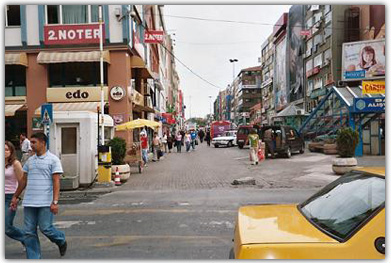
So far so whatever, left wing blogger and bulletin board people start pulling it apart, is it really Baghdad? To many latin letters not enough arabic, girl is wearing a tank top, holding hands, weird ads, something is funny, something is boring, politics as usual, collective journalism, smart mobs, yawn, we've heard this story before haven't we?
But then. Well here is where my brain skips a beat, someone, don't ask me how, digs up another photo. Not the same photo this isn't some blasé plagiarism story, but a different photo, from a different source of the exact same intersection in question. A random photo off some random website. And it turns out that intersection, that street scene is, surprise surprise, some random suburb of Istanbul. Here are the two photos, with Josh Marshall's annotations:
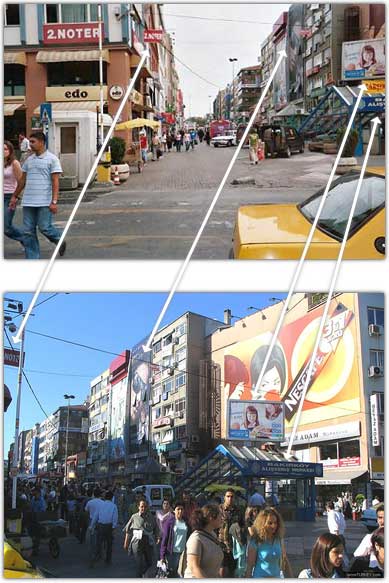
And I'll admit it the whole thing just boggles my mind. How many intersections are there in the middle east? How many photo web sites? How many photos? This isn't some famous square, it's some random street, how in the world did someone, or some-collective-thing, dig that up in a day? Maybe it's random, or maybe it's a precursor, lets see. In any case this particular story has one last twist, fittingly visual. So the politician got caught, claims a staffer made a mistake, lets move on right? So here is the real photo he just posted, you know the one that shows just how safe the Iraqi streets are and just how the media is lying to us:
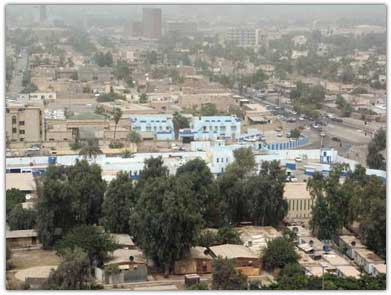
What more can I say, lets all move to Baghdad, the streets are safer than DC and for one the media has been driving real estate prices down instead of up...
September 24, 2005
The Pornography of Conservatism
now that's fucked up dot com, is about as well named a url as you'll ever find. It started out as a site for amateur "wife" porn, and evolved into one for quite a different sort of porn, war porn. Images of Iraqi's murdered by US troops, images of the aftermath of suicide bombers and lord knows what else, I could only stomach a couple clicks.
Billmon's pretty damn disgusted too, but his post leaves me wondering just what the difference is between a photo posted in a bulliten board thread titled "What every Iraqi should look like" (and don't visit that link after lunch please, you will lose it) and a similar photo plastered on the front page of the New York Times. I mean I can barely glance at those images, but maybe they belong on the front of every newspaper in town.
When a photojournalist snaps a shot its a horror story, when a soldier brags about the digital photo of the humans he's shot... I'm not really sure what's more sickening, photos, the people taking pleasure in viewing them or the newspapers to scared to run them. Conservatives would never function without war and sex, more bodies to fuel more hatred, but perversely they find it essential to hide the realities of both as completely as possible. Their broad talks of marriage, just wars hides a far less wholesome interior they obviously crave. And in an age where the media has given up on portraying the horrors of war, could it be that our only path towards realizing the reality of America's violence is through the internet back alleys of the war pornographers?
September 04, 2005
Anarchy, New Orleans Edition (bottom up)
The first warning sign I caught was in midst of the Hurricane build up. Can't remember where, but buried in some article was a line about long lines to get into the Superdome, the shelter of 'last resort'. Long lines because security at the door was searching everyone for drugs and guns.
The storm of the century is blasting towards New Orleans and police are busy searching people for drugs and guns, something was ajar, the record skipped a groove. The impact wasn't in yet the storm had not landed, this was supposed to be a story about a natural disaster and the human response, where the hell did the drugs and guns, the search and seizure, where did it come into the picture.
Welcome to New Orleans.
Beneath the jazz history, oil flows and 24 hour drinking establishments, is a city of deeply entrenched poverty, distrust and inequality. Its a city where a quarter of the population lives in poverty. A city where a largely white police force plays enforcer to a population that is 70% black. As liberated as the city may seem to a drinker, its never escaped the shadows of slavery and the equally insidious but far more subtle structures of racism that followed. As in much of the south the Civil War never quite ended in New Orleans. Beneath the Marti Gras facade of the city is a perpetual tension, a poverty that goes beyond economics, a poverty of communication, a poverty of politics, a poverty of trust.
The destruction of New Orleans began long before the hurricane hit. The looting, chaos and armed gangs began long before the levees broke. You could read it in the paper as Katrina approached, a storm is coming and what are the police doing? What they always are doing, searching the population, imposing their will. The city is being evacuated, but the police and general population can never work together in this city, the divides are so deep that they stand up strong and violent even as the levees fall.
In the intensely disturbing days that followed, that as I write this still appear to continue, two news items hit even harder, even nastier, then the rest. One was the stories of New Orleans police turning in their badges, their ties to the community had been severed by the waters, they no longer cared for the city they had sworn to serve and protect. Nothing could be a stronger indictment of just what a wounded community existed in New Orleans, of just how much the police force was their to protect property not serve the people of the city. Perhaps even more shocking and nearly entirely blocked from the news is the fact that troops (Louisiana National Guard?) where blocking the bridge out of the city, preventing thousands from walking out the disaster zone and the Red Cross from coming in. New Orleans had been turned into a prison, a war zone, an area not to be helped, but to be contained. If these reports turn out to be true, so far the only source I've found is of all places Fox New's Shepard Smith, then the story evolves from disaster and into one of crimes against humanity. And I suspect its damn true, I was wondering just why no one was walking out long before that report, and Nola.com was filled with reports of people being denied entry to rescue people at confirmed locations.
What this all builds up to goes beyond just the racism, repression and persistent
low level class warfare at work and into anarchy. Anarchy is a funny word, the mainstream news was full of it for the past few days. Anarchy as chaos, lose of control, the inmates running the prison while the lights stayed out. Anarchists however have quite a different definition of anarchy however, and completely out of step with their philosophy, are rather insistent that others use their definition despite the fact that a vast majority of people use a quite different definition.
My friend tobias c. van Veen provides a good example, in his other wise spot on essay "A Black Rainbow Over Downtown New Orleans", he makes the claim that no, New Orleans is not in a state of anarchy, but rather "the rupture of the facade of global capital". Which is all probably true if one follows one of the rigid definitions of anarchy favored by practitioners, but utterly incomprehensible to those of us who still are aware of word in its common usage. New Orleans was in a state of anarchy after the disaster, a state where the law was absent, a non force, a state of chaos.
What's really interesting to me though is that neither definition of anarchy, the anarchist's own definition or the common more frenzied one need to be contradictory. In fact both anarchies are easily contained within one definition, and both are in reality potential states of one concept, potential states of anarchism.
Anarchy is the social state free of political authority, and in the days after Katrina hit New Orleans is a clear example of what can happen in such circumstances. That "can" is essential though, it does not mean that is what will always happen and in fact there are plenty of examples quite to the contrary. New York after 9-11 is the one that immediately springs to mind, but perhaps Chalmette, Louisiana is even better, a small town seven miles east of New Orleans where the Katrina tied together rather then divide the community.
Anarchy is by its very nature an emergent system. What emerges does not necessarily need to be intelligent or organized, but since there is no direct centralizing force, whatever group behavior exists must be emergent in some manner.* But just how anarchy emerges is not predetermined in any manner, and in fact there are a variety of potential states that it might take. What determines what state anarchy enters into is largely determined by environment, culture and forms of energy circulating within the anarchistic space.
In New Orleans a culture of distrust and borderline warfare was long present in the environment. Poverty, racism and drugs where part of day to day life. As nearly all the white people, along with the black middle class and elite fled New Orleans what remained was largely two groups the helpless and the deeply repressed. Free of the persistent police presence, hungry, lacking water, plumbing and electricity anarchy emerged. Some of the anarchy was people breaking into stores for food and water. Some was people breaking in to obtain those material goods they never obtain in the political and economic climate that was New Orleans. And some of it was just plain people breaking. Pains and pressures snapping into the form of rapes, beatings and bullets directed at the police.
It was all there and apparent as the Hurricane approached. The police officers slowly and intensely searching every person as they entered the Superdome seeking shelter clearly illustrated the failure of this community and the vicious environment constructed to keep it that way. This was a community already at war, a long drawn out police action of a war. A community without trust. These are the force that directed the emergence of anarchy. The forces that pushed the anarchy towards its violent emergence, its most tragic form.
Anarchists, expect perhaps a few lunatics, want no part of this sort of anarchy, and in fact will go to great measures to redefine anarchy to exclude these realities. But in fact the anarchies of the anarchists are merely other potential states of the exact same anarchy that New Orleans produced. Far more positive potential states, and ones that can be glimpsed at in places like Chalmette during this disaster. There residents ignored by authorities for six days distributed food via boat, did their own rescuing and created their own shelter. Just as in New Orleans it was anarchy, the absence of political control, the parish officials had fled. But a very different state of anarchy, guided by an environment not nearly as oppressive as New Orleans.
Just who is responsible for the various police actions around New Orleans is still pretty clear, but its becoming evident that the various government agencies at work went out of their way to ensure the anarchy of New Orleans would be pushed towards a negative not positive state. The searches at the Superdome where just the prelude. The combat operations, "little Somalia" approach of the US Army was the most over the top. Most odious and damaging though was the sealing of the city, the turning of the city into a prison where people could not walk out. Volunteers with boats where turned away, people with confirmed locations could not enter to pick up relatives and friends. Even the Red Cross was kept out. The government it seems was far more concerned with containing the poor of New Orleans then in solving any problems. Its not a new story, its merely a wretched retelling of the same foul story of slavery in America and lord its not pretty. Its a story that will get told again and again too, perhaps never with the same catastrophic energy of Katrina pulsing through it, perhaps never with the same media attention, but the same old story, same old tragedy once again.
* This it should be noted gets directly at one of the biggest confusions surrounding emergence, there is a massive difference between an emergent intelligence, an emergent system and an emergent property.
August 27, 2005
Web 2.0
Are the internet hypelords getting a bit tired? There's this funny whiff of déjà vu that comes along with the latest and greatest buzzword: Web 2.0. Web 2.0? Wasn't that like 1995? Don't they remember that Business 2.0 magazine? Or remember how all the big companies have stopped using version numbers for software and instead hired professional marketers to make even blander and more confusing names? I hear "Web 2.0" and immediately smell yet another hit off the dotcom crackpipe...
But perhaps that's a little too harsh, while Web 2.0 might have emerged in a large part from tech publisher O'Reilly's PR, underneath it is a real feeling among some that there is something going on that makes the web of today different then the web of a few years ago. Blogs, open standards, long tails and the like. The most concise and clear definition I've found is Richard Manus', " the philosophy of Web 2.0 is to let go of control, share ideas and code, build on what others have built, free your data." Which of course doesn't sound that different then say the goes of the plain old unnumbered "web", back ten years ago. But the Web 2.0 are right, the web is different now, but the big differences aren't necessarily found in those prosaic "information wants to be free" ideals, which actually stand as one of the biggest constants in web evolution.
What really separates the "Web 2.0" from the "web" is the professionalism, the striation between the insiders and the users. When the web first started any motivated individual with an internet connection could join in the building. HTML took an hour or two to learn, and anyone could build. In the Web 2.0 they don't talk about anyone building sites, they talk about anyone publishing content. What's left unsaid is that when doing so they'll probably be using someone else's software. Blogger, TypePad, or if they are bit more technical maybe WordPress or Movable Type. It might be getting easier to publish, but its getting harder and harder to build the publishing tools. What's emerging is a power relationship, the insiders who build the technology and the outsiders who just use it.
The professionalization of the web has been a long and gradated process. The line between amateur and pro didn't exist at the dawn of the web, but over the course of the years, over the course of new technologies, a gap appeared and it continues to widen. There have been web professionals for a decade now, but where as the distinction between a pro and an amateur was once a rather smooth one, it is now a highly striated one. Early html took an afternoon to learn. Simple javascript, early versions of Flash, basic database usage, php, these are things that took a motivated but unexceptional individual a weekend to learn. All it took to transform into a pro was a weekend, a bit of drive and the ability to sell yourself to an employer. This is smooth separation.
Its 2005 now Ajax, the latest and greatest in web tech. If you want to build an Ajax site, you have two real options, be a professional or hire a professional. I'm sure there a few people out there who could teach themselves Ajax in a weekend, but they would have to be exceptional individuals. You can't just view source and reverse engineer Gmail or Reblog. You need to be a professional programmer who understands web standards, databases, CSS and dynamic html... These are apps built not just by pros, but often by teams of pros. The difference between a professional and amateur is no longer smooth, but striated.
The Web 2.0 is a professional web, a web run by insiders. In the larger space of the software industry as a whole these are still young brash upstarts pushing a somewhat radical agenda of openness and sharing. In contrast to the agenda's of old line software companies like Microsoft and Sun, AOL and Oracle, the Web 2.0 actually merits some of its hype. The world of RSS feeds, abundant APIs and open source code really is a major departure from the "own and control" approaches of an earlier generation of companies and something I'm personally in favor of. But just how open are these technologies really? And just how many people do they empower? Take a close look and Web 2.0 looks a bit more like a power grab and a bit less like a popular revolution.
Like the proponents of "free" markets, the pushers of Web 2.0 seem to have a quite an idealistic idea of just what "free" and "open" are, and how systems based around those concepts actually function. Peter Merholz is perhaps the sharpest and most thoughtful of Web 2.0 evangelists and his essay "How I Learned To Stop Worrying and Relinquish Control" just might be the best argument for the Web 2.0 philosophy around. But its also paints a radically misleading picture of what it means to "relinquish control". For relinquishing control doesn't just mean letting go, losing control, it actually means controlling just how you let go.
Netflicks is a great example. Merholz talks about how the company success revolved around giving up on late fees, unlike traditional video stores they did not control how long a customer could keep a video. A smart move for sure, but they didn't just relinquish control, but instead opted to control several other key factors. They gave up control on the length of the rental and instead opted to control how many videos a customer could have at any given time, and take control over the final decision as to what video a customer would get. Netflicks isn't giving up control, they are exchanging it, they built a highly controlled system in which enabled them to allow certain vectors, namely the length of video rentals, to fluctuate freely.
What Amazon.com's customer reviews, which Merholz prominently cites as an example of a company relinquishing control to its customers. And indeed if you write a review there is a good chance your words will show up in Amazon's page for the book. Amazon will cede control of that small section of the page to you. But just how much do they really give up? In submitting a review the reviewer grants "Amazon.com and its affiliates a nonexclusive, royalty-free, perpetual, irrevocable, and fully sub-licensable right to use, reproduce, modify, adapt, publish, translate, create derivative works from, distribute, and display such content throughout the world in any media." Even then Amazon requires you to follow their review guidelines and delays the publication for 5 to 7 business days, quite possibly so that they can review the review in some way. Once this is all done the review is then placed on a page that Amazon has complete control over the layout. The reviews go near the bottom, well "below the fold". So just how much control has Amazon given away? And just how much have they gained back in return?
At the technological core of the Web 2.0 ideology is another innovation that Amazon has been a early leader in, public APIs, or Application Programming Interfaces. APIs are tricky concepts to grasp, they are essentially ways in which on computer program can talk to another, or one part of a computer program can talk to another part. Until recently, until Web 2.0, talking about public APIs basically meant talking about computer operating systems. Most APIs where private, things that development teams used to build complex systems of interlocking programs, things like Amazon, Ebay and Google. Amazon and Ebay in particular have quite complex relationships with a certain subset of their customers who happen to run businesses that rely in part or entirely on using Amazon or Ebay services. Amazon has affiliates and zshops, while Ebay its power sellers and eBay stores. I haven't been able to track down a good history of public web APIs, but I suspect Amazon and Ebay released theirs mainly as a service to their power customers, as a way to help these customers make them even more money. Google on the other hand released its public API mainly as a geek toy, not as a revenue source. The sort of action that makes Web 2.0 devotees ecstatic. The public API is a way to share data, allow independent programmers to build their own applications using information collected and sorted by the likes of Google and Amazon, and allows users to access this data in any variety of ways not fully controlled by the data holder. The public face of the public API is that of openness and sharing, of relinquishing control. Look a bit behind that facade though, and once again, we find yet another system of control.
A public API is not what a companies internal developers are using to extend their systems. It doesn't give you full access to the data or full access to the functionality of the system. This is often a good thing, as an Amazon customer I'm quite happy that the Amazon public API does not include access to credit card data or purchasing habits. Despite all the Web 2.0 hype about open data I've never seen anyone argue for companies sharing this info. But the limits on what can be accessed via a public API go far beyond just protecting confidential user information. In fact the company creating the API has absolute control over what goes into it. They maybe giving up a degree of control, but they are controlling exactly what that degree is.
A company that allows you to access their databases and applications via an API is clearly more open than one with no API at all. But the API is also instrumental in establishing an asymmetrical power relationship between the API maker and the user. The user is free to use the API, but the creator has control over just what goes into the API. In addition the use of the API is almost always governed by a license restricting just how free a user can be with an API. Google's API for instance restricts the number of "automated queries" to 1000 a day. This essentially means that it can be used to prototype an application, but not to create any sort of commercial use beyond the smallest of scales. But just in case the license also clearly prohibits any commercial use at all. Is this a way to free the data or a way to implement another level of control over it?
Any user of a public API runs the risk of entering a rather catch-22 position. The more useful the API is, the more dependent the user becomes on the APIs creator. In the case of Ebay sellers or Amazon affiliates this is often a mutually beneficial relationship, but also inherently unbalanced. The API user holds a position somewhat akin to a minor league baseball team or McDonald's franchisee, they are given the tools to run a successful operation, but are always beholden to the decisions of the parent organization. You can make a lot of money in one of those businesses, but you can't change the formula of the "beef" and you always run the risk of having your best prospects snatched away from you.
There is another asymmetrical relationship at work in the public API system, an asymmetry of data. The public API rarely, if ever, gives full access to the data and the way an internal API can. Even the most open of public APIs will not give access to stored credit card numbers and passwords, at least not intentionally. Often though the gap between the two systems is far greater. Google's public API for instance allows you to do searches and dictionary lookups, but doesn't give access any of the data mining functions at work in Google's internal system. You can't use the API to find out what terms are searched for more, what sort of searches are originating from a particular address, or what one particular user (based on Google's infamous 30 year cookie) has searched for over the past year. That sort of datamining is reserved for Google employees and their associates. And not only is the API user denied access to much of this information, they also are gifting Google with even more data from which it can extract data. With every public API call the creator gives out information it already possesses, while gaining a new piece of information back, information on what people are interested in.
At the core of the API is a system of control, the API creator has a nearly limitless ability to regulate what can go in and out of their system. And it is precisely this system of control that allows the API to set certain vectors of information free. In Google's case the ability to obtain ranked search results, definitions and a few other factors. In Amazon's case its book data, images of the cover, author names, titles, prices, etc. Ebay's lets you build your own interface to sell via their marketplace. Flickr's lets you search photos. In no case does the public API give full access to the system. You can't find passwords, credit card info, users addresses, all of which is a good thing. Nor can you find much info on what other API users are doing, or what the people using the standard web interface to these systems are doing. Often the volume of your activity is restricted. Often access requires registration, meaning not only is the use of the API monitored, but its also possible to associate that activity to a particular individual. By design, and perhaps by necessity an API privileges the creator over the user.
Privilege is what the Web 2.0 is really about. What separates the Web 2.0 from that plain old "web" is the establishment and entrenchment of a hierarchy of power and control. This is not the same control that Microsoft, AOL and other closed system / walled garden companies tried unsuccessfully to push upon internet users. Power in the Web 2.0 comes not from controlling the whole system, but in controlling the connections in a larger network of systems. It is the power of those who create not open systems, but semi-open systems, the power of API writers, network builders and standards definers.
More then anything else the paradoxes of Web 2.0 "freedom" then the open standard. Open standards are freely published protocols that people voluntarily agree to comply with. Standards like html (for publishing web pages), css (for controlling the look and layout of webpages), rss (for subscribing to information feeds) and jpeg (for compressing and viewing photolike images). These standards are not nearly as open as their name might imply. Sometimes they are created and run by corporations (Adobe's pdf format), sometimes by nonprofits (the W3C which governs html standards), sometimes like with RSS there are public fights and competing versions. Implementing changes to an open standard at the very least requires considerable political skills, one can easily make their own version of a standard, but unless they can convince others to adopt their version, its not a standard at all. It is only by gaining users that a protocol gains potency, and to do so the standard itself must be politicized, and frequently institutionalized.*
The real hook to the freedoms promised by the Web 2.0 disciples is that it requires nearly religious application of open standards (when of course it doesn't involve using a "public" API). The open standard is the control that enables the relinquishing of control. Data is not meant to circulate freely, its meant to circulate freely via the methods proscribed via an open standard. In order to relinquish control over the data one first must establish firm control over how that data is formatted and presented. An action that increasingly requires the services of a professional, whose involvement of course adds another layer of control. This is the world of the Web 2.0, a world of extreme freedom along certain vectors, extreme freedom for certain types of information. It is also a world of hierarchies and regulations, a world in which a (new) power structure has begun to establish and stratify itself.
If we return to Peter Merholz's essay, this can be seen rather clearly. It's title indicates its about him giving up control, but of course its really an argument that others should give up control. But where should this control go? How should it be done? This is, in Merholz's words, "a scary prospect". In the end he's not just arguing that companies should relinquish control, rather he's arguing that they should relinquish control over to him, his company Adaptive Path, and others that share their philosophy. Reliquish control over to the professionals, those that know what they are doing, know how to control things on the internet.
None of this should in anyway be construed as a critique of the Web 2.0, rather it is a critique of those who push one-sided visions of what the Web 2.0 is. If pushed into an oversimplified judgment I would come out solidly in favor of public APIs, open standard and circulation of information along the passages these systems create. But these transformations do not come unmitigated, they do not come without hooks and catches. In many ways Web 2.0 is just another revolution. Like many revolutionaries the leaders of the Web 2.0 make broad promises of empowerment for their supporters. But history shows time and time again that dust clears and the dirty battles washed away, it is the leaders, the insiders, that are by far the most empowered. At its heart this is the Web 2.0, a power grab by the internet generation, the installation of a new power structure, a new hierarchy, a new system of control.
*for a much more detailed exposition on the standards process and the issues of protocol see Alex Galloway's .
August 15, 2005
The Power of Nightmares (bottom up)
Finally got around to watching The Power of Nightmares, or more accurately the final installment of the three part series. This BBC documentary is something of a fetish object among American Leftists, spoken about in hushed reverent tones as an object that will unveil the hidden truths. "Have you seen the Power of Nightmares? You must see the the Power of Nightmares". The object itself circulates via transcript and torrent, a little googling and you too can be an initiate...
Criticism often says as much about the critic themselves as it does about their target. Director Adam Curtis also directed a four hour documentary on Freud and his followers, so he surely must be aware of that fact. So is the autocratic tone of this film a deliberate maneuver or an unintentional slip on Curtis' part? This is a movie about politicians manipulating facts, but Curtis seems intent on mimicking them. Rather then raising questions it dictates an alternative history. Its clearly a successful tactic, but for me at least it deftly undercuts the purpose of the film. Is Curtis deliberately copping the style? Unconsciously aping it? Or is projecting his own paranoia and monomania onto his targets? Regardless of the truth, it makes the film a bit hard to take seriously, both Curtis and his targets want to tell stories without questions, when in reality the facts at hand are rather uncertain.
The most powerful and effective parts of the documentary where simply the clips of Bush and Rumsfeld selling the war. That they grossly distorted the facts shouldn't come as any surprise to just about anyone who has followed the story in any detail, but watching them in action with a few years of hindsight is quite revealing. These are characters who understand the power of authority and how to put it on television, and the left it seems has no counterpart, with perhaps the exception of director Curtis himself. During this build up the left was busy, working the web, trying to be bottom up, protesting in the streets. Some old ineffective tactics, some new ineffective tactics. Even with online fundraising a new effective tactic. But all the while the right kept pushing the tried and true, get on TV and say it with authority.
The more I look at it the more the rhetoric of emergence, "long tails", and "bottom up" begins to resemble a far older idea, divide and conquer. Only this time the dividing is self inflicted, praised even. That not to say I'm here to blanketly dismiss "bottom up", there is far to much unknown, and too much potential, to do anything of the sort. But until these theories come face to face with concept and application of power, they seem doomed to a particular ineffectiveness. In other words, a nightmare.
August 02, 2005
July 27, 2005
Norquist/Soros
The one thing that surprised Norquist about Soros's [sic] appearance, he told me later, what the revelation that Soros had spent only twenty-seven million dollars during last year's election. "That is so goofy," Norquist said. "The guy is worth, what seven billion dollars, and he tried to buy the Presidency on the cheap. He should have been in for two and a half billion dollars, for crying out loud. Twenty-seven million dollars--that should have been ante money. What were they thinking?"
- from "The Ringleader" by John Cassidy in the August 1, 2005 New Yorker (print version only)
so sad and so unfortunately true...
January 05, 2005
Legal Torture
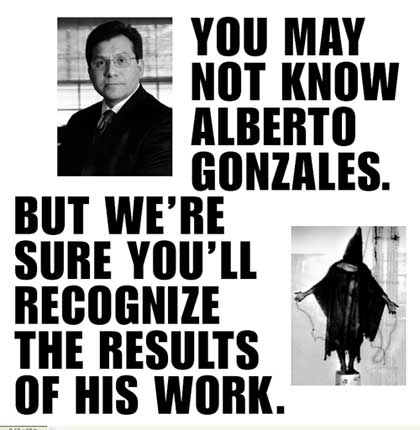
TrueMajority want's to run an ad with this theme in the New York Times, click to contribute to the cause, yes?
It's interesting to see the anti-Gonzales momentum pick up, particularly with the torture memo revelations. Honestly I was once ready to let him slide in, he's uncommitted on enough issues to make him seem like a Trojan Horse moderate, at least by Bushco standards. It seemed like energy might be best spent elsewhere, but I've been very nicely surprised at the way the attack on him has been emerging. Kerik was something of a warm up, hors d'oeuvres before the guests sit down, perhaps Gonzales can be the first real appetizer to Supreme Court battles to come.
January 04, 2005
December 15, 2004
Balanced Budgets
Whatever happened to that Balanced Budget Amendment idea that circulated in the Ross Perot era? Back in the day it seemed to be a radical right wing attach on Keynesianism and "tax and spend" liberalism. But its the Bush era now and the truth is nothing could destroy the Bushco MO faster then taking away their ability to wrack up debt. The borrow and spend, tax cut / wage war agenda would shatter in no time..
November 17, 2004
Rural Constructions
Mr. van Veen passes along this spirited postelection urbanist rant from the (Seattle)Stranger with a well merited request for comment. So here we go.
One part of me really wanted to hear what the Stranger had to say. Compared to 2000's red state vs. blue state, coast vs. center conceptions, the urban vs. rural rings far truer. A step or two towards accuracy. And as a lifelong urbanite, it makes for an easy fuck you explanation. But hating the rural America I all too rarely visit isn't going to win any elections, nor will it really help understand what's going on in national politics.
Fact is while the Stranger is essentially correct that cities voted for Kerry and rural areas for Bush, the line just isn't nearly as sharp as they slice it. Even in the "bluest" cities Bush still got 20% percent of the vote, and often he got more like 40-49% of it. And Kerry actually won a small but not insignificant amount of rural counties, especially in the Appalachias and Southwest. The urban/rural interaction is one of gradated tendency not sharp divide.
The same county by county map the Stranger writers use to craft their urban argument (a slightly better version is here), also shows large regions that just don't map to their ultra urbanist agenda. Most intriguing to me is what could be called the hidden coast, up and down the Mississippi River. A thin stretch as blue as either the Atlantic or Pacific coast. Then there's an echo of blue hitting the ports of the Great Lakes, and the hefty areas of Texas and the Southwest along the Mexico border. What about Columbus Ohio, Lawrence Kansas or that blue chunk of Idaho?
What's at work here is not as much a function of urbanism, but of a related but not attached concept of cultural flow. What ideas flow through a space? What sort of diversity is there? Does the world end on the horizon line outside of which are barbarians or does its spread out in a gorgeous meshwork? These are not thoughts bounded by geographies, rather they ideas that are attracted unevenly to geographies. Oceans, massive rivers like the Mississippi and populated national borders generate a natural flow of people that pushes the population towards diversity. But the same forces generate reactions and contractions, people who hide from or hate that cultural diversity.
Humans themselves can also generate these forces of flow. Universities circulate a world of people through them on a year by year, semester by semester. They become their own strange attractor independent of geography. Rural areas themselves have this capability, the ski resorts and idealized landscapes of Vermont and Sun Valley Idaho circulate people in a similar manner. And then again, one solo human can generate there own flow. A library, the internet, a DVD, or just a imagination can enough to enter a person into the space of cultural flow.
Now its essential to point out that I am NOT crafting an argument that maps the left to those open to cultural flow and the right to those outside or against it. Political leaders and funders on either side are almost by definition fully emerged in the flow of the world, tapped deep into the charges of capital, politics and resources. There are plenty of "conservatives" sitting deeply entrenched in the flows of culture. And plenty of "liberals" isolated from these flows (see again the Appalachias and Southwest). Rather what has happened over the past 30 years or so is that the right has realized that its far easier to construct new realities in the areas of low cultural flow. And all the meanwhile the left has forgotten these areas even exist.
This brings us to the infamous reality based community. The right wing has claimed large swathes of rural America as spaces that it can construct its own reality unimpeded. Spaces that once where constructed in . One space on the map that keeps calling my attention is the Appalachias an area I don't know enough about, but paints itself strongly blue. I suspect this is a remnants of a different reality, one constructed by the left. A reality born of hand me down marxism and populism in the hands of labor union organizers working the coal mines. A hidden reminder that the left once too played the reality construction game.
November 05, 2004
Ohio, Canada
Man what the fuck is up with people? Everywhere I turn people are talking about moving to Canada, despite the fact that they couldn't even make it to Ohio for a few days of election work. Which one is more work? Shit was sooooooooo freaking close. A few thousand more boots on the ground would have flipped the election, no lie.
I've got zero patience right now with my fellow New Yorkers talking about how depressed they are and looking for foriegn passports while blaming middle America instead of themselves. People don't magically vote how you want them too, but if you actually talk to them they just might. And god knows how many Bush voters I met in Ohio that where one conversation short of a Kerry voter. Everyone out there knew how bad Bush was fucking things up, they just didn't know how Kerry would be better. The misinformation and lies were so thick in the air it was sickening, but perhaps not as sickening as the various antidotes walking the blue states who never bothered to go where it counted and are now ready to flee.
update: Let me add that I'm in no way exempt from the above criticism, I was there in the home stretch, but I could have easily been there months before. Bottom line is we got out played and could have easily won this election if we where on point.
October 29, 2004
Four More Days
In Ohio via D4D. Things are hardcore, swift boat veterans on TV as I write this. I've met about as many Bush as Kerry supporters, true swing. Still there are a lot of us here on the ground working hard. The air is confident yet tense. We will win this thing.
More to come.
September 02, 2004
More RNC/Protest
Damn I love how the blogsphere routes around traditional media.
Speaking of which the Ruckus rnc sms feed is viewable online. Not the one going into my phone, but the content is essentially the same.
It looks like the police are using the trap and enclose tactic big time tonight. More people on the streets, lets see how far these tactics scale. Actually I suspect the scaling ability is close to directly proportionate to the number of trained police on hand.
And yeah, I think I finally figured out what was up with the Bush twins awful sitcom the other night.
Forgot where I saw it but the best line on that one was that the only way it could be worse is if they where triplets...
RNC vs NYC
Some notes from the Republican National Convention and the streets of New York. If all goes as planned a more essayish thing to follow...
- New York is just to big for these things to impact for real. Neither the RNC nor the protesters have the numbers to make more than a half skip in the patterns of the city that never sleeps. It now seems laughable that people actually bothered to leave town over this. None of this however is relevant to the unlucky few who happened to be at the precisely wrong spot as the NYP broke out the orange security fences trapping and arresting like deep sea fishermen.
- the police have fine tuned the art of using the physical form of the city against protesters. 1 city block + 100 cops on scooters and motorcycles = a mobile holding pen. The protests are divided and dispersed before they can even truly form. It takes active hard work to find an active protest. At the moment it seems the action is at 100 Center Street.
- the sms channels are marvelous sources of tactical news. Let us hope they refine further. The fact that police can listen in and in some cases post makes for a fascinating experiment in open systems. As a historical note, I first noticed these tactics in action during the post 9-11 Davos Economic Summit, held here in NY.
- many of the police seem to be without gasmasks of any kind. A clear indication they have dropped tear gas as a tactic. One wonders if the cops will soon be the ones getting tear gassed? Or perhaps the no tear gas rule is temporary, a gift to the poor Republican eyes, they clearly have enough trouble viewing reality already.
- on Tuesday the undercovers wore green bands around their arms or on their heads. Wednesday yellow. Today orange and red.
- has anyone ever seen a protester with a gun? if there was such a thing as a "violent protester" don't you think they would arm themselves?
- the standard tactic in anarchist channels now seems to be to blame any and all calls (and acts) to violence on undercover police provocateurs. One wonders if they get a different color armband. Maybe black?
June 17, 2004
The Corporation, Take 3 (of 3), Constructions:
The jewel of The Corporation is its conception of the corporation as being a psychopathic organization. I've previously mentioned its value (or invalue) as a propaganda tool. But this also stands as a key point from which to begin constructing solutions.
I'm not sure to what extent the filmmakers view the psychopath diagnosis as metaphor versus being the actual truth, but I'm fully in the metaphor camp. As a metaphor the psychopath construct's utility is basically constrained to its propaganda value. I don't think you can give a corporation the same therapy you would human psychopath. But right beneath the surface of the psychopath metaphor is an extremely useful analysis of the corporation.
Essentially the filmmakers look at the Corporation as an organizational form, one with a deep genetic flaw. Within the legal and cultural code of the contemporary joint stock corporation are serious flaws that influence the behavior of many, if not all corporations today. By locating and analyzing these flaws we unlock the potential to both alter the corporate legal code for the better, and to construct better organizations capable of replacing the corporate form.
The film underscores one particular flaw in the legal status of a corporation, corporate personhood, the fact that corporations have many of the rights of people under the law. Pretty much an absurdity, so much so that the law doesn't always actually follow the concept. Still a strong legal acknowledgement that corporations are not humans and thus subject to a completely different set of laws and rights could go a long way towards a better conceptualization of what roles these entities should play in society.
Ultimately though I suspect that corporate personhood is an effect of the corporate drive for power, not a cause. Is shifting the balance of power back towards another organization with repressive tendencies, the State, an answer to the problems posed by big business? In order for the answer to be "yes" the State must be ready to recode the corporate laws in a constructive manner. A dubious but not impossible prospect, and one that can be furthered greatly if the ideas on how to recode these entities are in existence. And this my friends is our job.
see also:
Abstract Dynamics: The Corporation, Take 1 (of 3), Propaganda
Abstract Dynamics: The Corporation, Take 2 (of 3), The Permanent Critique
plus a note: this piece was actually intended to be much longer, and might be updated, or might birth another piece. I'm putting it up now mainly because I dislike having an essentially negative piece as the first one on my site, my personal take on the Corporation is more positive then critical and hopefully the site will reflect that now.
June 16, 2004
The Corporation, Take 2 (of 3), The Permanent Critique:
The contemporary left has seemingly unlimited capacity for the negative. Their ability to find faults with world is match only with their in ability to offer viable alternatives to the awful picture of the world they generate.
An hour into The Corporation I'm fully convinced of the evil of this organization form, and I want to change things. Another hour passes, and I'd would like to thinking about the viable alternatives, the course of action. Instead I'm approaching the point of nihilism, of surrender, situation normal - all fucked up.
Its is at this point where point where one thread in my mind leaves the movies flow. If the world is really as awful as this movie paints it, then perhaps I am better off not caring? Would you rather be a medieval serf, toiling in servitude, or instead the king, living in luxury off the exploitation of the same serfs? Robber baron or the labor leader shot dead by Pinkerton guards? If the world is so bleak in helpless, perhaps you best of accepting that and living in ignorant pleasure.
Happily that is not my world view. I do not see world as half empty and out of resources for a refill. I don't see critique as a bludgeon or sword, but instead think it should be wielded more like a scalpel. With extreme precision and only when deemed necessary.
The king of the American left's materialist ubercritics is linguist Noam Chomsky. Now Chomsky occasionally is spot on. But I've never yet seen Chomsky acknowledge that life has room for pleasure. Chomsky seems to believe the overriding goal of most people's lives should be worrying about the world's atrocities. And from a propaganda standpoint that's a dud. Doesn't matter if he's right or wrong, few but the pessimists and sadists are going to subscribe to that world view. Critique as a bludgeon. Can someone please surgically remove this man from my mindscape?
It's not that The Corporation is 100% negative, there are a couple mild positives in the mix. Ray Anderson, CEO of Interface an industrial carpet company, pops in repeatedly through the film as a something of a hero. His Paul Hawkin inspired transformation of his company into a vision of sustainable development comes off quite well. Of course there is a certain violence between the possibilities he preaches and the filmmaker's "corporation as a psychopath" thesis, that unfortunately never gets addressed. Hmmmm.
The other hero is Oscar Olivera the Bolivian anti water privatization activist. And while I don't know his story other then through the film, he serves as a guide to what seems to be an old school marxist revolt against government privitization. Inspiring, yet hazily told, with no indication on how to reproduce or maintain such an action. More please!
Ultimately looking back on film (and bare in mind I have only had the opportunity to view it once, I will be rewatching once it is fully in the theaters), there is a clear junction of potentiality where the film could have run in any number of directions. The point is maybe an hours in, when the corporation is diagnosed as a psychopath. This could have easily been the climax of the film, a critical point, made sharply and strongly. Or it could have been the point of inflection, the diagnosis is in, time to develop a cure. Instead the filmmakers opt for more brutalist approach, they have diagnosed the corporation's illness and then proceed to kick the shit out it. And I'll admit I took some pleasure watching the god of neoclassical economics, Milton Friedman, hang himself with his own rope, for the most part the film criticizes endlessly into a cycle of despair. A cycle that seems perhaps perversely enjoyable to a certain breed of leftist. Count me out, I exit at the point of inflection. Critique ultimately breeds more critique and so its time to jump back and move on.
see also:
The Corporation, Take 1 (of 3), Propaganda
Abstract Dynamics: The Corporation, Take 3 (of 3), Constructions
June 15, 2004
The Corporation, Take 1 (of 3), Propaganda:
The Corporation - A film by Mark Achbar, Jennifer Abbott, and Joel Bakan is some damn good leftist propaganda. Be even better where it 40 minutes shorter (cut Noam no pleasure Chomsky please...) but well worth watching. The corporation as a psychopath is brilliant meme to propagate, let it spread. Propaganda is a good thing, Emma Goldman proudly produced it, todays left could gain a lot taking that perspective. Hopefully a couple kids with some free time and a copy of Final Cut Pro will do just that and make a good piece of propaganda even better.
see also:
Abstract Dynamics: The Corporation, Take 2 (of 3), The Permanent Critique
Abstract Dynamics: The Corporation, Take 3 (of 3), Constructions
April 29, 2004
Cartoon Subversive
So a while back I posted the Doonesbury strips from 1971 featuring John Kerry. That post gets lots of hits. There also seem to be a sizable handful of people who are serving up those images off my server and directly onto their own sites. Increasingly these people seem to be quite conservative...
So I'm tired of these cartoons, and I'm thinking maybe I can replace them. Something a bit more subtle and subversive. Something that won't immediately offend these conservatives, but will make them laugh and then seep into their conscious. I want to infect them with a dose of reality, not hit them with a sledgehammer. Subtly subversive.
So I need some cartoons, any suggestions? 3 strips, regular funny pages dimensions... Holler if you've got em.
April 17, 2004
John Kerry, President (Behind the Logo)
Presidential campaign logos may not be where design meets innovation, but it is where design meets power. While the campaign designs will flood around American's visual periphery over the next 6 months, they rarely receive any overt attention.

The logo above is officially for the "John Kerry for President Inc." organization. But you might notice a couple things missing. The "Inc." gets dropped for obvious reasons, but more interesting is the missing "for". The design team made a very conscious decision that the logo should read "John Kerry, President" not "John Kerry for President".
Its a subtle shift, but a tellingly important one. The goal is the get the reader/viewer to envision Kerry as actually being the President. To shift the publics mental image from wannabe to the real thing. When you think John Kerry they want you to think he's pretty much president already, that his credibility is already established, he can do the job.
Howard Dean actually used this same tactic in his speeches, although not in his atrocious design materials. A statement like "As president I will..." carries far more force then "If I become president I would..." Its a candidates job to convince people they are capable of the job, and it damn sure helps is a tiny part of people's minds is thinking they already are president...
Its even better if people start thinking of you as their favorite president though and John Kerry was born into the fortunate situation of having the initials JFK. Kerry has used this to his advantage for years, frequently allowing himself to be presented as John F Kerry. But in running for president he's deemphasized the "F", presenting himself as just "John Kerry". I suspect it was a conscious decision by his team, worried about charges of exploiting a dead legend. I also expect they are planning for the JFK angle to get pushed unofficially, by people "unaffiliated" with the official campaign...
Back to the logo though. The main graphic element is a flag like thing hanging out between "John" and "Kerry". Looking just a bit like a ghost of an "F". We'll probably never know for sure, I suspect this was quite intentional. Your conscious reads "John Kerry" plus a flag logo, but the designers, they want your subconscious to read "JFK".
So will it work? I don't know, why don't you give JFK some cold, hard, cash and we'll find out in November.
April 16, 2004
The Woodward Forecast?
comes out next week and rumors have it being quite critical of the Bush administration. I'm not betting on it though, but we'll find out soon enough.
I am however quite interested in how the book leans for a different reason, forecasting. Woodward has come a long way from the renegade young report who was instrumental in . He is now the quintessential insider, as a reporter he has then probably anyone. And that means he has a lot to lose.
When Woodward writes he needs to balance his journalistic instinct to uncover with his human instinct to protect the privileged access that gives him an advantage over all other reporters. And of course his personal friendships come into play too.
If Woodward comes out as highly critical of the Bush administration, he is in a sense placing a bet. A bet that they won't be in power by the end of the year. A bet that his privileged access to these individuals is not worth protecting, and perhaps better exchanged for access to the next round of fools with power...
April 14, 2004
Can Anyone Here Play This Game?
Just tracked down the story of the Afghanistan war games I mentioned previously. The nasty:
The army brass, Dr Johnson said, "were intent on fighting a variation of a war against large tank armies on the central plains of somewhere". At one point, the Pentagon officers involved became so frustrated with their elusive opponents that they asked for the game organisers to have a friendly government's armoured battalion defect to the other side. "They did it to give someone to blast," Dr Johnson said. "Everyone went away feeling viscerally satisfied."
As a result, they missed the point. The terror organisation still had most of its cells in place, and a functioning financial network.
"Within the contours of that particular game, the American forces and their allies simply weren't configured to deal with an enemy like the one we created," said Steven Metz, the head of the Army War College's regional strategy and planning department.
Guardian Unlimited | Special reports | Wargame exposed gaping hole in Pentagon strategy
Now of course that was just a game, but somehow it all sounds vaguely familiar...
April 13, 2004
Question
So who thinks Bush actually wants to be president for another four years?
Really if I didn't have to live in the middle of this it'd actually be a classic tragedy. The man grows up with silver spoons for all orifices, fails at everything he does, and still ends up president. And is miserable at it. His advantages become his flaws, circle complete, he falls. Well, god willing he fails to win. Another tragedy of course cause as much as he'd rather not be president he desperately wants to win the popularity contest.
Its 2004, Welcome to 19th Century America
I guess its ironic that "conservatives" never hide the fact that they want to roll back the clock and return America to some imaginary past era. But the way Bush administration is pulling us back to the 19th century damn sure ain't funny, nor is it particularly spoken of.
Much has been made of the Bush adminstration's mastery of media tactics, but what's left unsaid is that that mastery is about the only skill that distinguishes this administration from a government of robber barons. Take a look at the industries represented in the government and the picture emerges. Oil is a big one obviously, and defense as well. Railroads, metals, banking. This is a system of power rooted in 1800's with a mentality to match.
Back when the US first invaded Afghanistan, I read a bit about the regional wargames played by Pentagon in the years previous. Unfortunately I didn't archive the article, and have yet to track it down, so you'll need to rely upon my word (and memory) as to what it entailed.
Faced with a diffuse terrorist organization, spread out guerilla style across the mountains of central asia. The war gamers playing "red" the enemy were able to run circles around the generals. The pentagon planners had the advantage of overwhelming force and the latest weapons, but they proved worthless in the face of warriors capable of vanishing into mountains and blending with the local population.
Now beating a ranking general in wargames in the a particularly good political tactic and apparently "red" got beat in quite an unconventional manner. The generals forced the game organizers to make the "red" troops mass up over in Uzbekistan or someplace and fight like retards a traditional army. Finally the generals could blow them away and feel satisfied with their victory.
What's scary is just how this war game tactic has been actualized over the past few years. The first time was a lucky break for the US. Faced with the amorphous foe of Al Qaeda Bush and company where able to invade an actual country instead, and given the ties between the Taliban and Al Qaeda they actually were somewhat justified.
Now the country of Afghanistan, in as much as it actually existed as a cohesive whole, was a pretty easy target and easily broken. Which of course did nothing at all to solve the real threat of terrorism.
And Condi Rice's recent testimony is making it clear that the administration has never quite been able to conceptually grasp what terrorism is. It doesn't quite map to their 19th century mindstate of force and minerals. Rice repeated the mantra that the problems were all structural like her job depended on it. And in doing so she let the world know just how mentally unequipped she is to deal with
with terrorism. Did she ever see the videos of the twin towers collapsing, destroyed by a weakness in their own structure?
The terrorism of Al Qaeda is the antithesis of structure. It swarms through the rigid constructions of westernism, searching for points of weakness. Points where the very tensions of structure can be deftly turned against themselves. It's no coincidence that Bin Laden, born into a family of engineers, was obsessed with the World Trade Center, attacking it once in 1993 and again in 2001. He saw the weakness in the structure and knew he could topple it. And knowing that what are we supposed to make of Rice relentlessly screaming for more structure?
Its clear that Bush and co, need structure to attack, they can't quite comprehend the way terrorism and guerilla war is conducted. Instead they insist on Daily Kos || personifying the enemy, and reducing reality down to soundbites. Rumsfeld talks of a test of will, and he's right, this is administration trying to will into existence a reality to match their unrealizable philosophies.
Rumsfeld himself is a former RAND director and he seems determined to realize the RAND/Air Force dream of virtual wars, run by satellites, robots and statistics,
free of those dirty, fuzzy, unpredictable humans. Bush focuses instead on isolated leaders, dreaming they might have the potent control of their people he so desperately dreams he has over his. And the National Security Advisor frantically tries to will into this world a scenario where she some how can be unaccountable for the tragedy of 9-11 that ran straight into her job description, making it clear to all just how poorly she did her job.
At the basest point this is an administration determined to maintain the 19th century belief that a small set of individuals can run the world based on raw power and minerals. And shockingly enough they've managed to take over America. Now as they blunder through Iraq, let Afghanistan fall to pieces and prepare for elections in the US we are about to learn just how much reality can retribute.
update: Finally found the article on the Afghanistan wargames referred to above, here is the juicy quote:
The army brass, Dr Johnson said, "were intent on fighting a variation of a war against large tank armies on the central plains of somewhere". At one point, the Pentagon officers involved became so frustrated with their elusive opponents that they asked for the game organisers to have a friendly government's armoured battalion defect to the other side. "They did it to give someone to blast," Dr Johnson said. "Everyone went away feeling viscerally satisfied."
As a result, they missed the point. The terror organisation still had most of its cells in place, and a functioning financial network.
Sound at all familiar?
April 11, 2004
August 6, 2001
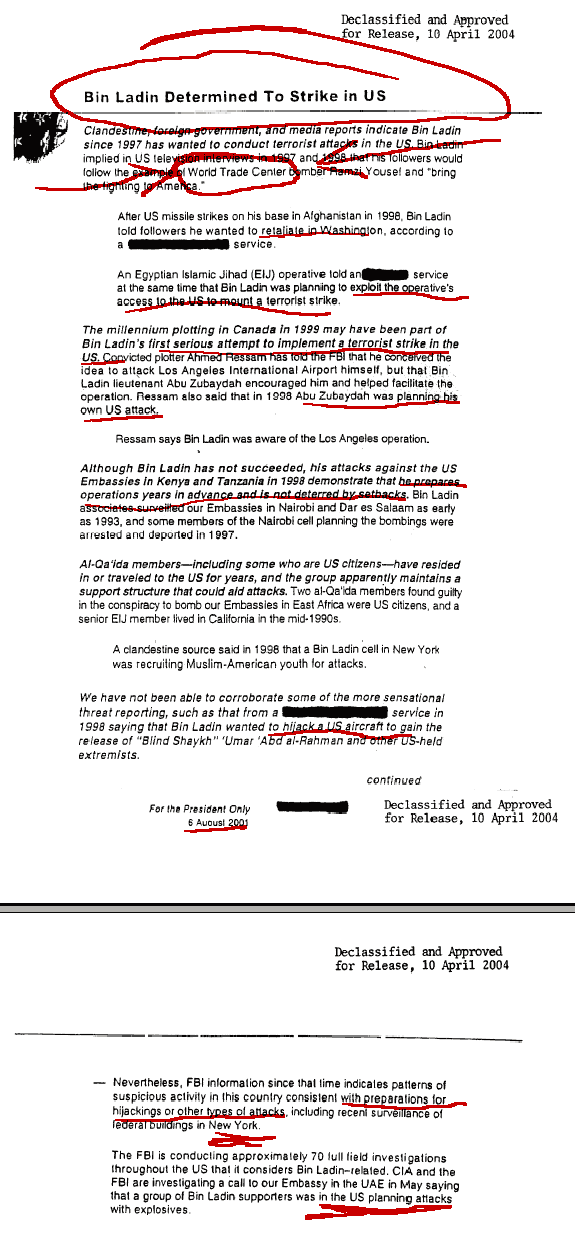
I should note I stole this idea completely from the brilliant Max Speak and merely redid it with a graphic designer's/propagandist's sensibility...
April 09, 2004
Your Government Would Rather You Not Look at These Pictures
and to be honest you probably don't want to look at these pictures either, cause they sure ain't pretty.
They are? Images from Aljazeera from inside the besieged city of Falluja. You can see them on their site, and I've also archived them below.














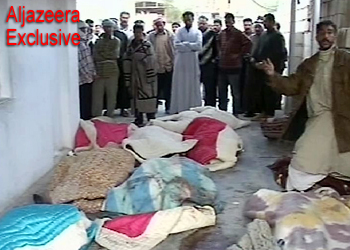
So If You Vote For Bush He Will Take Away Your Porn...
And if Kerry knows what's good for him he'll hammer this home. He want's the "Nascar dads"? Imagine if in October every porn mag in America endorsed Kerry on the cover and warned that Bush wants to make them illegal...
[via Submunition]
Vacation Time!
This is Bush's 33rd visit to his ranch since becoming president. He has spent all or part of 233 days on his Texas ranch since taking office, according to a tally by CBS News. Adding his 78 visits to Camp David and his five visits to Kennebunkport, Maine, Bush has spent all or part of 500 days in office at one of his three retreats, or more than 40 percent of his presidency.
War-worn troopers heading home from Iraq got a chilling order from Secretary of Defense Donald Rumsfeld yesterday: Not So Fast!
Rumsfeld said G.I.s scheduled to rotate home after a year's hardscrabble duty in Iraq will now be held over for awhile, even after their replacements arrive, to give military commanders more combat punch to counter this week's savage uprising against the American occupation.
...
The first casualties of what Rumsfeld called "taking advantage of the overlap" were a few hundred soldiers from the Army's First Armored Division. Pentagon officials told the Daily News those troops were at Baghdad International Airport preparing to return to their home base in Germany this week when the plug was pulled.
"They were on the tarmac waiting for their plane when they were told to pick up their gear, head back to camp and get ready to go back into the field," the official said. "Can you imagine the effect on morale that had?"
April 08, 2004
Structural
Caught 20 minutes of Condi Rice's testimony to the 9-11 commision today. Her tactic is clearly to filibuster on and on about "structural" problems. A polite way to blame Clinton essentially.
But in truth she is right, there is a huge structural problem that lead to 9-11. And it's that Condoleezza Rice was the keystone of our national security apparatus.
Meanwhile...
Sorry for a lack of "daily" of late, its springtime in NY... That and I'm trying to restrain the amount of politics here and possibly move them to another location. A hard task and one I'm willing to admit to failure, unlike some. But yeah for now I'll try and keep it on the side of humor, dark as it may be.
So the worst aspect of the evolving disaster in Iraq is how much it resembles all of the fears of those of us who opposed the war over the past few years. Meanwhile the administration continues to try and will their own fantastical reality into existence, and even the NY Times is off the program while the BBC provides the visuals:
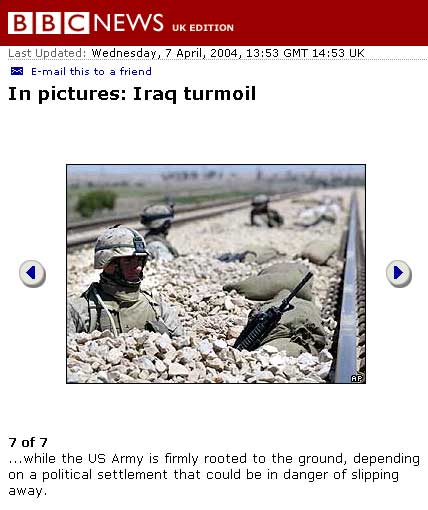
April 05, 2004
Michael Teague(s?)
Update: The questions raised by this post apparently have been answered. There does not seem to be any connection between the men in question although as far as I can tell the possibility has not been conclusively dismissed. The original post is available for reference however, by following the link below.
One of the "contractors" killed in Fallujah Iraq was named Michael Teague. Perhaps coincidentally so was a former head of security for Aryan Nations. But they appear to be of similar age and in the same profession, could they be the same person? Kathryn Cramer has been trying to work it out. So far the results are inconclusive.
What isn't inconclusive is that her investigations have set off a small invasion of her site by wingnuts of questionable character. If you've got a minute maybe go a lend some support to her, ok?
Now if you've got some more time and some journalistic/private eye training, maybe you could help answer the real questions here, I for one would like to know the story...
April 02, 2004
JFK 2004!
Beautiful Readers,
Ok, I know everyone has a flaw or two hidden somewhere. And while you, my readers are obviously exceedingly intelligent, charming and delightful, I am beginning to suspect you might be a touch cheap. Well at the least the American's among you?
Why? Well not nearly enough of you seem to be donating to Mr. JFK. He's running for president of the United States you know and one Mr George Bush has a hell of a lot more money in his pocket right now. So would you rather have an extra $50 in your pocket and four more years of Herr Bush, or do you think you'd be happier a small touch poorer in the now, with a brand spanking new JFK in the White House come next year?
So come along now, don't be shy, give the tall fella a few greenbacks, will you please.
all my love,
A
ps. if you donate with these links then you'll help turn Abstract Dynamics into its very own special interest group! A scary thought, but worry about that one later, ok?
March 24, 2004
The al-Zawahiri Fiasco
Like oliver craner I am somewhat in awe of reporter Pepe Escobar. Here is some more:
"As in most latitudes in the tribal areas, most people carry a tribal-made Kalashnikov and have been raised in madrassas maintained by the JUI. Musharraf may now call them terrorists, but the fact remains that every mujahideen is and will be respectfully regarded by the locals as a soldier of Islam. Moreover, al-Qaeda jihadis who settled in Waziristan have managed to seduce tribals young and old alike with an irresistible deluge of Pakistani rupees, weapons and Toyota Land Cruisers.
"The Pakistani army is regarded as an occupation army. No wonder: it entered Waziristan for the first time in history, in the summer of 2002. These Pakistani soldiers are mostly Punjabi. They don't speak Pashto and don't know anything about the complex Pashtun tribal code. In light of all this, the presence of the Pakistani army in these tribal areas in the name of the "war on terror" cannot but be regarded as an American intervention. These tribes have never been subdued. They may even spell Musharraf's doom."
Out on the left people are convinced Bush will capture bin Laden in an October "surprise". And there is no question Bush and co would love to do just that. The question is are they competent enough? No way would I ever bet on these uncertainties, but if forced to I think I'd go for the "surprise" coming from the opposite side of this "war".
March 19, 2004
Austin PD vs. Ozomatli and Fans
The Austin American Statesman reports on the Ozomatli police confrontation. (may require really invasive registration) Some photos are here.
I was there with front row seats to it all, and needless to say the police statements are far from accurate. Ozo walked out into the street and the vibe was all love.
Any and all provocation came from the police who charged the crowd. And their actions where way over the top. As in half a dozen cops violently slamming a man, who can't have weighed more then a buck ten, onto the hard concrete. Any violence and tension in the crowd came straight from the police and the Mace. And now percussionist Jiro Yamaguchi is facing 10 years in the pen for absolutely nothing. Damn.
Anyone else who was there should contact Ozo's lawyer to identify themselves as a witness. His office can be reached at (512) 476-7373. Their recommendation to me was to write everything down exactly as remembered and send it as a letter to:
Bobby Earle Smith
1108 Nueces
Austin, TX 78701
March 17, 2004
Al Qaeda Endorses Bush
The statement said it supported President Bush in his reelection campaign, and would prefer him to win in November rather than the Democratic candidate John Kerry, as it was not possible to find a leader "more foolish than you (Bush), who deals with matters by force rather than with wisdom."
In comments addressed to Bush, the group said:
"Kerry will kill our nation while it sleeps because he and the Democrats have the cunning to embellish blasphemy and present it to the Arab and Muslim nation as civilization."
"Because of this we desire you (Bush) to be elected."
[via atrios]
March 04, 2004
March 02, 2004
You Can Start Calling Him JFK Now
Baring a wild shock to the system, it looks like John Kerry is definitely the Democratic nominee for president. Its 2004 and that means I'm supporting whoever the Democrats nominate against Bush. So it John Kerry for me. No scratch that. John Forbes Kerry, known in this space from here till eternity (or maybe December 2004) as JFK.
Why? Cause who the hell is going to vote against JFK? Mr Kerry had some luck with his initials and I'm going to milk them for whatever propaganda value they are worth. I hope you can join me please, because the last thing we need is more Dubya.
March 01, 2004
Haiti 3: Did Aristide Resign Freely or Was He Kidnapped at Gunpoint?
More on the murky events surrounding Aristide's fleeing Haiti.
update: AP now reports that Aristide has told them he was abducted. If true, it directly contradicts statements by both Colin Powell and White House spokesman Scott McClellan. Its hella messy in Haiti, and it might just get messy in Washington DC... Stay tuned.
Haiti
Haiti, in chaos. President Aristide has fled the country. The US approves, and was involved at least to the extent that it did not intervene to stop his ouster, and quite likely even more actively.
Most disturbing however are the reports that US troops actually showed up at his house to force his removal.
My information networks are bit weak on all this. I've dug up a bit of background, but it'd be great to find a site that covers this and other latin american issues extensively. Anyone know of one?
February 26, 2004
Dividing Democrats
I wrote about attempting to divide the Republican party a couple days ago. But the sad truth is that the Democrats have always been easier to divide*. And it makes me worried. Gay marriage should be a winning issue for the left, its an inevitability unless some radical shift in social directions occurs. But so far no one seems to have the balls to pick up this issue and hit it out of the park. No one except SF mayor Gavin Newsom, who I have a new found respect for.
Now I haven't been in SF for a couple seasons now, so I'm not 100% on top of the politics. But I highly suspect that Newsom's stance is at least as much driven by politics as it is by any real conviction. Newsom is left of most of the country politically, but in SF he was the conservative candidate for mayor, and he almost lost to an opponent on his left. There's a bit of Nixon in China in this story, but there's also a bit of Newsom moving to the left in order to sure up his political support.
This is exactly why I'm giving my 100% support to the Democrats this year. The task at hand is to shift the center ground to the left. The social conservatives need to be stripped out of their position of leverage inside the Republican party. once that occurs the stage is set for pushing more progressive/radical agendas in forth coming elections.
And with the proposed Hate Amendment, the right wing has given us the perfect tool to split their party. But someone needs to step up and use it. And the risk right now is that the Democrats might actually use it on themselves. Not pretty.
*note: I should add I don't agree with Kos' characterization of Kerry's support of Massachusetts amendment. I don't agree with Kerry's stance, but his anti-marriage but only with strong civil unions support position is a reasonable enough compromise. And like it or not, democratic politics is all about reaching these sorts of compromises. In fact in some ways that's the tragic flaw of democracy, often all of no one gets exactly what they want...
February 24, 2004
Gay Marriage and the Un-American Bush
Not only is George Bush's proposed amendment to the US Constitution repugnant, immoral and misguided, but it also strikes as fundamentally un-American. Listen to out national anthem and the words that ring loudest are "home of the free". This is a country founded on "life, liberty and the pursuit of happiness". The raw hatred, intolerance and cultural restriction that Bush is pushing has no place in this country, and come election day 2004 I think we'll find a vast majority of America agrees.
But at the moment I just feel ill, this is not the path our country needs to travel.
February 23, 2004
2 Party / 3 Party Dynamics
update: The piece below was written one day before US President Bush backs constitutional amendment prohibiting same-sex marriages. With that one move the piece takes on a whole new dimension as Bush moves strongly towards the social conservative side of the Republican party, while alienating large masses of fiscal conservatives who once supported him. With any luck this is the beginning of the end of the Republican party. But it also may be the beginning of large scale cultural warfare. Two month in and 2004 is already proving to be a crazy year.
In any case here is the original piece:
It has come to my attention that there are a bunch of candidates running for president that don't belong to the two dominate US political parties. In other elections I might pay attention to them. However in this particular election they are no better then gnats and will be ignored as such.
In the past two elections I voted independent (Nader in 96, Browne in 00) and I truly would like to see a different political structure in place in the country I love. However at the present I think the best way to achieve this is not by voting for a "3rd" party candidate, but instead by destroying the Republican party.
At the present there is a deep rift inside the Republican party between the fiscal and social/religious conservatives. Of the two the social conservatives are by far the more odious. They also have effectively used the Republican party apparatus to gain far more political power then they merit. In addition there is a third conflict, one that is present in almost every political party, a conflict between the special interest groups who see politics as a means to their personal ends, and those that take a broader view of governments roles (or lack of roles).
George W Bush took office promising to be a "uniter not a divider", and he's failed miserably in that task. Any unity between the two parties has be cast absurdly into the wind, and more importantly to the issues of this essay, the unity of the Republican party has also been jostled by Bush's reign. The special interests of the investment banks, defense and natural resource industries have been given by far the highest priorities. The social and religious conservatives have gotten a good amount of attention, but at the same time the broad trends of American society are stiffly against their agenda. In their eyes Bush has failed to stem the growing acceptance of gay rights, abortion and other acts of social liberalism.
The fiscal conservatives however have basically been reamed by Bush. The only thread holding the two together is an anti-tax stance that some fiscal conservatives hold tight to. Bush's constant pandering towards special interest groups and causes he hopes will help him come election time is sending fiscal conservatives into conniption fits. And they have no love at all for the religious conservatives dreams of using government to enforce a regressive social agenda.
While 9-11 has allowed Bush and company to place the Republicans in a position of seeming dominance, the fact is they are internally weak and in a position of hubris that might just set them up for the fall. As the Democrats mobilize to try and reclaim the presidency, they are in a position to weaken the entire Republican party network, and in the process they could well do the whole country a world of good.
The key is to wrest away the leverage the social conservatives wield inside the Republican party. The Democrats need to push and push hard against the religious agendas currently welded into the Republican platform, while simultaneously reaching out towards the fiscal conservatives, many of whom have a lot in common with the centerist wing of the Democratic party. If the Republican party can be polarized between fiscal and social conservatives its going to find itself in a lot of trouble.
The key is driving an actual rift. If the social conservatives dominate, then the Republican party will find itself diving toward the margins. The fiscal conservatives will either head to the Democrats or try and form a centerist party with moderate Democrats. If the fiscal conservatives join the Democrats, then its move towards the center will have reached an apex (hopefully the last one). If that happens then the task is to make the Democrats into the right/center party and build and then build a new second party to their left.
If a centerist party somehow rises, either out of a fiscal conservative / moderate Democrat movement or by having the social conservatives leave/get kicked out of the current Republican party, then the Democratic party is going to be forced left. Again the result is a political shift leftward, with the two dominate political forces being centerist and leftist.
The current rightward political swing of the county is sustainable only by the unholy alliance of the fiscal conservatives and religious right. The leverage held by the fundamentalists far outweighs the percentage of the population they represent. Its unlikely that the fundamentalists could wield much voting power outside of the Republican machine. Thus the left has everything to gain by putting tension on the existing stress inside the GOP. Split the machine and the whole political apparatus shifts leftward. Lets go, time for tactics and strategies.
February 19, 2004
Grey Tuesday
Grey Tuesday is Tuesday February 24th. Its a coordinated act of civil disobedience to protests EMI actions to shut down the distribution of Danger Mouse's The Grey Album. Abstract Dynamics will of course participate since we actively called for just this sort of action. We urge you to participate as well.
[via hiphopmusic.com: Civil Disobedience for the Grey Album]
Texas Bush Perspective
One of the best aspects of travelling is the way it opens you up to new perspectives, new opinions and new world views. I've spent the better portion of the past year in NY and SF, hardly the best vantage points to gauge the opinions of this fine nation. Now I'm in Austin, which has a well deserved reputation as being the Berkeley of Texas, so its hardly better. But on the way there I swung through the Dallas airport and snagged a copy of Texas Monthly in the procedure.
Now I have no idea what the politics of this mag are, but all indications point to a bland upper middle of the road regional lifestyle mag. If you live in America I'm sure your region has one of these things. Solid reporting mixed with guides on how to be a good au courant yuppie eating in the slinkiest new restaurants.
The cover of this particular Texas Monthly however is a picture of one Dubya Bush with a big blue and red lettered "Maybe" splayed across him.
The article, by Paul Burka is not online yet, but it should be archived on the site in a few weeks. Well worth the read. Burka covered Bush as governor of Texas and he's known the man personally. The story he tells is both far more balanced and far more damning then the knee jerk opposition has ever written it.
Burka is a veteran political reporter, but he takes this story with a refreshingly personal and frank air. He voted for Bush in 2000, he liked him as governor. And now he's not so sure what happened. A story of betrayal.
I've never been 100% comfortable with the Bush as dumb puppet line of thinking. Truth is in there for sure, and the "born on third base and thinks he hit a triple" snipe rings truer then ever. But you still don't become president without some degree of talent. Burka knew Bush personally and he paints the best picture of his upside I've read. He knew the Bush that was able to win votes in 2000.
That Bush apparently is gone. In Texas Bush was a moderate consensus builder, the ultimate old boy network kid. Not sure he did much positive, but he certainly wasn't fucking up big time either. But now its 2004 and suddenly he's hard right. A man whose best talent is bringing people together, yet he's tearing the country into love and hate. And if the reports from the Daytona 500 are on point its mostly hate...
Burka concludes that he might, just might vote for Bush again in the upcoming elections. But its sure not a convincing close, and one wonders how many readers are even more sure they will not cast that vote. Especially after the flip a few more pages to the obligatory unemployed white collar article... Yep, even here in Texas things don't look so up for Mr Bush.
February 12, 2004
The Kerry Sex "Scandal"
So there is a brewing John Kerry sex "scandal". Details are unclear as of yet, but it may well have occurred while he was single...
No idea what's going to emerge, but unless it involves the proverbial live boy or dead girl, odds are that this scandal will not harm Kerry, and may well help him. The moralists in DC never can seem to get their heads around the fact that Americans like sex. And so does nearly everyone else in the world for that matter. And while sex might create "scandal" in the press and amongst the chattering classes, it does little to decrease a persons ability to get votes. Anyone check Clinton's approval ratings post Lewinsky? Or think about how popular JFK remains?
Lets face people like people who are getting laid. As anyone ever ran on a "I haven't gotten any in 20 years, vote for me platform". Maybe Nixon would have if he wasn't physically incapable of telling the truth, but he was probably to smart for that anyway. This is America, sex sells. So lets hope Kerry brings on this scandal with open arms, and remembers not to let the coverup trip him along the way.
update: apparently the scandal just doesn't exist.
February 10, 2004
John Kerry
Its funny, before Bush and the neocons took power I never associated myself with the Left. I'm straight independent and have serious problems with the political orthodoxy on both sides. But its clear that Bush needs to go and that means backing the left for a spell.
But then sometimes I remember just how annoying the left can be. Last night some nutjob left a comment on my site calling Mr John Kerry a "Bush clone", before ranting a bit about the "New World Order".
Say what?
Now Kerry's got as many problems as any other politician with enough ego to think they should be president, no doubt. But I'm trying not to be negative on the Dem candidates, so we'll skip that for now. But to call him a Bush clone, that's just absurd. But oddly enough I need to go the the site of the conservative ProfessorBainbridge in order to learn that:
He (Kerry) has a lifetime ADA (Americans for Democratic Action, a liberal group) rating of 92 (two points higher than Ted Kennedy). Kerry's lifetime ACU (American Conservative Union) rating is a mere 5. Between 1992 and 2000, the average ADA rating for US senators was 42, while senators averaged 56 on the ACU's scale.
Bainbridge's conclusion? "In sum, Kerry is so far to the left that he can't even see the mainstream from where he's standing."
Now I disagree with the rhetoric in that last line, but it's damn clear that Kerry is about as far from a Bush clone as you'll get in DC. Well in the white parts of DC at least...
So please, lighten up on the self hating on the left please? Kerry's got leftist credentials from hear to Vietnam, a leader of the Vietnam Veterans Against the War, arrested in demonstrations, had Nixon looking for dirt on him...
I'm not endorsing any of these Democrats until one wins the nomination, so go on and pick the best one. But don't hate on the frontrunner without looking at the facts, OK? Please? They all have their strengths and credentials, go pick a winner.
February 09, 2004
The Pro Terror Republicans
I didn't watch Bush's State of the Union Address earlier in the week and thus missed this very fscked up moment (avi video file, may not work on macs).
Whoa.
The Democrats clapping at the mention of the Patriot act expiring is great, but it also served to distract from the nastier side, the Republicans applauding the fact that the "terrorist threat will not expire".
Damn. Remember that come November.
[via Atrios]
February 08, 2004
The Graph Evolves
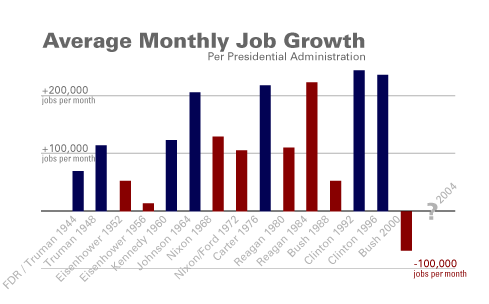
download the pdf, suitable for printing
designers, both amateur and professional are encouraged to download the Illustrator source file
February 06, 2004
the Graph
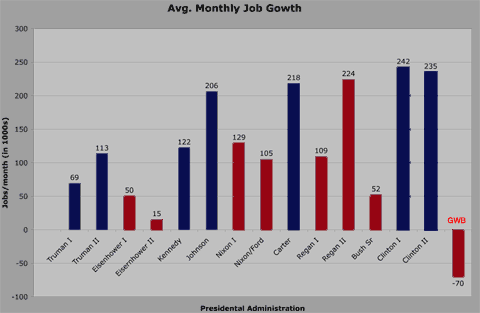
this is a slightly modified version of a graph created by one Outlandish Josh. I'll be making a printable pdf version soon.
A Time For Fear
Joshua Micah Marshall brings us another shudder from the daily press gaggle at the White House:
QUESTION: All these countries that do have nuclear weapons, they're not a threat at all? But the intent, and you're a mind-reader as to what was going to happen? It wouldn't hold up in court.MR. McCLELLAN: Helen, I know that you do not feel that we are safer because we removed Saddam Hussein from power. I think most people believe the world is safer and better because we removed Saddam Hussein from power.
QUESTION: A lot of people are dead, thousands.
MR. McCLELLAN: And the President remembers those who lost their lives on September 11th. That taught us that we are living in a different --
QUESTION: They had nothing to do with September 11th, the Iraqis.
MR. McCLELLAN: Oh, I beg to differ. September 11th taught us that we are living in a dangerous new world. September 11th -
QUESTION: So you attack somebody who is innocent?
...
QUESTION: I guess what I'm asking here is how long has the United States known of the nuclear weapons fire sale being run out of Pakistan and -
MR. McCLELLAN: Terry, like I said, there's a lot of -- there are a number of success stories in the intelligence community that often go unseen or unreported or are not reported until quite some time after the fact. You heard from Director Tenet --
QUESTION: Well, tell us.
MR. McCLELLAN: -- you heard from Director Tenet, in terms of what he said on Pakistan. And you've seen, by the actions of the government of Pakistan, that they are committed to stopping proliferation.
QUESTION: It just raises a question. The United States went to war against a leader that we said had these weapons, turned out not to. We're confronting North Korea over what we think are their weapons. Libya is an issue. And, yet, on Pakistan, it sounds as if we've known for a while that they were running this black market on nuclear weapons and haven't done anything.
and yeah, if you are not reading a time for fear, well then you probably sleep a bit better then I have lately. But its essential reading on dark geopolitics of renegade nuclear proliferation.
February 05, 2004
The New DFA
Howard Dean's bid for the US presidency may be down to a hail mary pass to win Wisconsin, but his bid to become a powerful American leader looks like its on some strong ass legs. His Dean for America, or DFA organization has just had a remarkable day, and it looks a lot like the DFA is going stay around regardless of what happens in this presidential race. The name perhaps will evolve, Democrats for America or something of the ilk, but the organization is there. And Dean will be the nominal leader with the weight of several million voters and a large cash flow behind him. Presidential nomination or not, there is no way that strength can be ignored.
Regardless of who gets nominated, any Democrat is going to need the nominal support of Dean or they risk losing it all. Like some of the smaller parties in coalition style parliamentary systems of Germany or Israel, the DFA may well be the critical weight needed to craft a winning candidate. America of course resolutely structured for two political parties though, and Dean's strength comes from organizing within one of those parties. Attempts to organize third parties perpetually fail in the US, most recently with the Green and Reform parties. But by finding a way to organize inside the Democratic party Dean has built a far more potent machine, one with far greater chance of lasting power then Nader or Perot could ever build.
The precedent for this strategy is ironically on the other side of the political spectrum, in the world of Christian fundamentalism. Over the past 20 odd years right wing Christians have built a network that wields inordinate power, forcing the Republicans to carry unpopular positions like their opposition to legal abortion.
Howard Dean has already had remarkable success setting the issues that the Democrats must follow, particularly with his aggressive anti-Bush stance. Now with the DFA it sure looks him or at least his organization will be in a position to keep on setting the agenda for some time now, for better or worse. And quite thankfully its looking for the better at the moment.
February 04, 2004
February 03, 2004
The Race
I really like how the Democrats are running this race for the presidency like a relay, passing off the front runner baton every couple weeks. Kerry still seems to have it, but now Mr Edwards is inching up.
So who gets to run the final sprint? Might not know for a while now my friends.
January 30, 2004
To All My Fantastic Readers Who Would Prefer a New President of the United States
I've been hearing too many nasty rumors about the Democratic presidential nominees of late. Some of them might even be true. But I don't want to be hearing them and I suggest you don't go round spreading them. Even if you don't like some particular dude, really just keep it on hush, ya hear? If you got a favorite, hype him up ok? Keep it positive. And get your ass in gear behind who ever wins this nomination. Cause I want a new president bad, and if you agree lets keep it moving positive. We can work out the differences once this election jammy is won, yaknowwhatimsayin?
and yeah, stay beautiful, I love you all,
A
January 29, 2004
Don't Let the Door Hit You on the Way Out Mr. Trippi,
and good luck staying out of jail while you're at it...
Buried in the bottom of this NYT article is this factoid:
Some questioned the arrangements by which Mr. Trippi forfeited a salary as a campaign manager but collected commissions — said to be as high as 15 percent in some cases — based on advertising buys.
Say what?
The Mr. Trippi in question was until a couple days ago Howard Dean's campaign manager. He lead the internet hype, and he also blew threw $40 million dollars. And here he is getting 10-15% of each and every ad buy? Holy shit, wake up Mr. Media, that's a freaking story.
I've been wary of Trippi ever since I read (and posted) this article. The man was way to deep in the daytrading biz, alarm bell ringing in every direction. But the Dean campaign was blowing up er, an internet stock, so I held back. Part of me just wanted to be wrong. The other part hoped the bubble wouldn't pop until after the presidential election, after all the Bush team blows even more hot air then Trippi. But now that the Dean campaign seems to be doing about as well as the last stock Trippi hyped, its clear I hoped too much.
And Trippi? I don't know but it looks to me like he just scammed Dean big and hard. "I'll take the job, no salary" cool, but "all I want is a cut of the ad buys" ok sounds fair if you don't think too hard. Think again. Mofo is in charge of the ad buys. The more he buys the more he pockets. Repeat after me, the more ads Trippi buys the more money he makes. I sort of feel sorry for Dean cause he just got played and played hard, but damn that's just dumb.
The upside? The other candidates hopefully haven't made the same mistakes. And Dean/Trippi showed them how to raise more cash then they ever could before. Onward to November my friends, there will be plenty more drama for your enjoyment along the way.
January 28, 2004
Kerry Cools Dean Dot Com Off
There is an awful lot of discussion about dean and the internet, especially in light of his disappointing finishes in the Iowa and New Hampshire primaries, and today's departure of campaign CEO and former internet stock speculator Joe Trippi.
Personally I'm more intrigued in John Kerry's rapid rise from being written off to top of the ticket. But Dean's decline and Kerry's rise are quite likely linked to each other. And while I'm not a huge McLuhan fan, I think there is actually a lot to be gained from looking at this campaign with his infamous hot media / cool media construction.
Kerry success I think has a lot to do with just how cool he is. Or perhaps Outkast puts it better, Kerry is straight up ice cold. No emotion, no expression, no action. Kerry is practically running his campaign leaning against the wall like James Dean.
McLuhan of course saw TV as the ultimate cool medium. Diffuse, low resolution, low information. Once Kerry found his stride he became the ultimate TV candidate, and lucky for him he caught his stride just as the ads started running and TV coverage picked up. Its not that people like Kerry, its just that his cool personality means they don't dislike him. Media season is on and Kerry is the tallest and coolest on TV. Mix that up with a good ground operation and the result is his victories.
Howard Dean in contrast is pure hot, passion and intensity. He fires up his people for sure. Back in the days of barnstorming and radio campaigns Dean would have blown away Kerry. But times are different and his main medium is the internet.
McLuhan never got the chance to put the internet into his hot or cold spectrum. It's a tricky case to figure out. On one hand inside a Dean chat room or a mailing list flame war, the internet feels like a blazing hot medium. Text is hot and internet has massive amounts of it flying back and forth at high speeds. But at the same time it's a low resolution, distributed medium, and that's cool not hot.
So is the internet hot or cool? Perhaps like light being photon and wave, its both at the same time. Isolate an individual point and odds are its going to be hot. Loads of focused, intense and detailed information. Hot. But look at it as a pattern and its different. There are plenty of scattered points of intense heat around. But they don't radiate, and the space in between is dead cold, there is nothing hot in 404 messages, fiber optic cable and blogs with just one year old entry.
So here we have Howard Dean and his sites are 4 alarm hot. The hot candidate fires up his people and the media notices and catches the intensity. But when it comes time to vote that intensity just doesn't radiate. Its diffuse, spread across the internet, spread across the country. Click on another web site and the energy is gone.
I suspect as voters walked into their primaries and caucuses, that they started to forget how hot Dean was for a second. The heat was localized and there's no internet in the voting booth. Kerry's cool on the other hand was just starting to reach them.
There's a little "dated Dean, married Kerry" meme percolating but I'm not sure that's on point. Its more like had a passionate fling with Dean, followed by a bit of an argument. Once you're out the room you can't quite remember why he seemed so hot. And there's Kerry, leaning against the wall, acting cool, ain't saying nothing. Never really noticed him before but all sorts of respected politicians seem to be down with him, talking him up while he just kicks it. Cool Kerry up against the wall, not a marriage, more like a crush. Lets see how long it lasts...
Why the Democratic Nominee's War Minutia is Irrelevant
Tom Schaller has an interesting piece on Daily Kos on Kerry and Dean's Iraq war stance. And while it maybe interesting its also a big time red herring. Schaller seems convinced that the Democrats individual stances on this war are some how relevant.
News flash, they aren't relevant at all, except to the political fringe. Why? Because minutia aside the fact is that NONE of these candidates, with the exception of one of the irrelevant ones whose name is not worth typing, would ever have lead this country into this bullshit war. Kerry and Edwards voted on some bill leading up to it, so what? If either where president there is no way this war would happen. Not a chance. And most voters no this fact as well as they need to. Which is why Kerry can pick up so much of the "anti war" vote. Course the pundits can't quite figure this out as it involves common sense rather then analysis, but hey at least the voters know. And now you do too, spread the word for me, ok?
January 27, 2004
To All My Wonderful Dean Loving Readers
Hey, I understand your boy got outscored something rough by John Kerry tonight, it's a bit harsh. But you just hang tight and keep cool. The rumors them spreading about ya ain't doing anyone any good. Write in Dean for president, do anything to take down Kerry. Badness buzzing in my ear.
First off this thing is far, far from over. Two states have votes, two little states. Second off there is no question at all that John Kerry is a better man then George Bush, as are all the other Democrats, and about 95% of the rest of the population. And now he's proven he can win elections. That's good shit, respect him, learn from him and keep on campaigning. Just don't do Karl Rove's dirty work for free please?
It's a long road to November and the goal is to beat Bush, not beat each other, you hear?
I love you all,
A
January 25, 2004
Finally
Atrios and his readers have done us the great service of summing up every Tom Friedman NYT op-ed piece ever in one concise haiku, hours of reading have been saved!
If we had some ham
We could have some ham and eggs
If we had some eggs.
January 23, 2004
The New Political Economy
No, there is no new "political economy" in the academic sense, although I'd love to see/create one. Instead what we are looking at a potentially new economy of US elections.
Howard Dean of course laid the ground work, using blogs and email to forge a low threshold fundraising network that has made him the best funded candidate in this race, on the Democratic side of the game. But he may well have also laid the ground work of his own demise. He has a bigger bank to play with then his competitors no doubt, but they have the momentum. And unlike elections path, there is now a working model for turning momentum into donations quickly. And it looks exactly like Howard Dean's online fundraising model.
Both John Kerry and John Edwards have raised over $700,000 each online since Iowa's caucuses on Monday and that might be exactly the funds they need to keep in the game. The annuls of American presidential elections are filled with candidates that get hot for a state or two then die due to lack of funds in the next states. John McCain being the most recent examples.
But if a hot candidate can now turn a strong showing into a million dollars a week in new funds, momentum suddenly means real dollars. And in a tight campaign that might make all the difference.
The Dean, The Dead
Don't know why Rob Walker doesn't publish his sporadic email blast, The Journal of Murketing, online. But its free and well worth subscribing too. From the latest:
I was interested to read, post-Iowa, a Dean media adviser comparing his man's events to Grateful Dead concerts. This strikes me as a more realistic assessment of Brand Dean's DNA than the earlier hype. The business of the Dead was built on fanatical loyalty, intense community -- and total indifference to the fact that most of the world can't stand the Grateful Dead. You can build a brand around that, but not a mass one, and you pretty much have to go mass if you want to be president.
posting the whole entry below since its unclear how else to send anyone to it, and it captures my own thoughts on the matter better then I ever did.
The Journal of Murketing shuns politics, but this whole Howard Dean thing can't be avoided. What has happened to this one-man brand? He was so hot, a champion murketer! Recently a business-magazine columnist (who presumably had a pre- Iowa Caucus deadline) pointed to Dean's grass-roots cultivation skills as a model for forward-thinking businesses, since "everyone knows" that his "web-driven campaign is a huge factor in his success." And just a month ago a heavyweight pundit said Dean's brilliantly viral, buzz-building use of the Internet was schooling the "political establishment" just as file-sharing and The Blair Witch Project "blindsided" the music and film industries. The meetups, the stealthy fund-raising -- it's like flash mobs, it's like Friendster, it's changing the paradigm! "The Internet," Dean campaign mastermind Joe Trippi lectured, "puts back into the campaign what TV took out — people."
It's true, people are a big deal in elections, something Trippi was no doubt thinking of while his candidate was being crushed in Iowa. One reporter hanging out at a caucus center wrote: "The precinct captain for the Dean campaign said he was hoping for 25 to 50 Dean voters between the ages of 18 and 25, but only one showed up. 'I think if we could blame [Dean's loss] on anyone, blame it on the 18- to 25-year-olds, because they were nonexistent,' he said."
Ouch! So is (was) Dean just a youth-driven fad? Or will he come roaring (or howling) back in New Hampshire? The Journal of Murketing does not make predictions. Instead, here are three thoughts. First, I suspect that a lot of the early buzz around Dean had little to do with him and much to do with the vague idea that he presented a "challenge to the status quo." Which can mean almost anything. Mystery and curiosity might help sell movie tickets or a trendy product, but it doesn't really work in politics.
Second, I was interested to read, post-Iowa, a Dean media adviser comparing his man's events to Grateful Dead concerts. This strikes me as a more realistic assessment of Brand Dean's DNA than the earlier hype. The business of the Dead was built on fanatical loyalty, intense community -- and total indifference to the fact that most of the world can't stand the Grateful Dead. You can build a brand around that, but not a mass one, and you pretty much have to go mass if you want to be president.
Third, the celebrated Trippi says he learned about the power of Web community as a participant on Raging Bull, a site for day-traders, in the heyday of the tech-stock bubble. He was entranced with some traders' devotion to a company called Wave Systems. I've read "Wavoids" explaining how "word of mouth" built a "loyal following" of investors who "kept the company afloat." Yeah? I'd never heard of Wave Systems, so I looked into it. It turns out that at the market's peak, WAVX traded at $50 a share. Today it's around $2.18. And even that price seems wildly optimistic: For the 12 months ended September 30, Wave had revenue of about $183,000 (that's thousands, not millions), which of course is not even enough to cover the annual salary of its president and CEO ($411,000); losses for that period exceeded $23 million. Last month the company disclosed that it is under S.E.C. investigation. This suggests that those Wave true believers Trippi was so impressed by were not so much a movement as a feedback loop. Again, no prediction is implied, but Dean fans better hope that his current viral, network-building efforts have a more solid foundation.
January 21, 2004
The Ever Evolving WMDs
Kevin Drum provides a handy guide the ever changing Weapons of Mass Destruction:
March 2003: Weapons of mass destruction.
June 2003: Weapons of mass destruction programs.
October 2003: Weapons of mass destruction-related programs.
January 2004: Weapons of mass destruction-related program activities.
and from that we can predict a bit of the future:
April 2004: Weapons of mass destruction-potentially related program activities
July 2004: Weapons of mass destuction-potentially related imaginary program activities
November 2004: Weapons of mass destruction-potentially delusional related program activities
and lets hope it ends there with a new president, cause if not is going to get deeply newspeak...
John Kerry, Last Hope for Sex in the White House?
Still not sure what to make of John Kerry's recent comeback capped with a victory in the Iowa. He was dead in the water 10 days ago, and then what? Best explanation I can come up with is that it some how involves the Stephan Marbury coming to the Knicks, cause they both happened at the same time and both involve a little bit of magic. Actually this article gives a hint, but one operative in Iowa is not the answer.
The eeriest aspect of Kerry's turnaround, to me at least, is how its effected my opinion of the man. I pretty much dismissed him from the get go, one of my least favorite candidates. The man looks like a giant shrivelled penis for christ's sake, how the hell is he going to get elected president?
Suddenly though I like him, he looks a little more like a cross between Keith Richards and Ronald Reagan. And the penis bit? perhaps that's actually a good thing. Maybe that's exactly what this country needs, someone to bring some sex back into the White House. Might keep us out of a couple wars. And shit, who wouldn't vote for the sex candidate? We all know that Clinton's approval ratings jump way up once it was clear he was pimping in the oval office.
Of course the core conservatives and religious right would start squealing louder then Dean with a gerbil up his rear, but they're only 30% of the vote. Plus elections occur behind closed doors and we all know damn well how dirty the deeply religious get under those circumstances.
Course Kerry isn't exactly the ideal candidate, but consider the alternatives. The way Dean has been acting lately you'd think Judy hasn't broken him off a piece since their freaking honeymoon. And someone should let Kucinich know that Friendster is still free, and there for a much cheaper way of finding a date then running for president. Gephardt proved his impotency as House Majority leader, and Clark would never consent to something as human as intercourse, would he? Perhaps Edwards is an option, but he doesn't look like he's past the age of consent. Sharpton, hell I love the mofo, but whether we like it or not this country just ain't ready to go black...
So there you have it, John Kerry the only option to bring sex back into the White House. Make what you want of it, I just write this shit.
January 19, 2004
A Brief Guide to the Democratic Primaries
The Iowa caucuses are hear heralding the start of the Democratic primaries. To aid any Democratic readers in their choices, Abstract Dynamics has produced a brief guide to the candidates:
Howard Dean: Finally some one figured out how to make money off this blog interweb thing!
Wesley Clark: Very smart, not a politician, also probably not born on this planet.
John Kerry: Tall, initials are JFK.
Dick Gephardt: Caught in his own private, once every four years, version of groundhog's day.
John Edwards: Go back to the future babyface, maybe they'll let you play with the pros in 8 years.
Dennis Kucinich: The Berlin Wall fell 15 years ago pappi, and no one really wants to build it again in DC.
Al Sharpton: This man needs a daily radio show not some white house.
That other guy whose name is vaguely familiar from the last time we played this game: Doesn't like movies, doesn't like video games, doesn't like hip hop. But somehow he wants people to like him.
January 16, 2004
Martin Luther King
I am not unmindful of the fact that violence often brings about momentary results. Nations have frequently won their independence in battle. But in spite of temporary victories, violence never brings permanent peace. It solves no social problem: it merely creates new and more complicated ones. Violence is impractical because it is a descending spiral ending in destruction for all. It is immoral because it seeks to humiliate the opponent rather than win his understanding: it seeks to annihilate rather than convert. Violence is immoral because it thrives on hatred rather than love. It destroys community and makes brotherhood impossible. It leaves society in monologue rather than dialogue. Violence ends up defeating itself. It creates bitterness in the survivors and brutality in the destroyers.
- Dr. Martin Luther King Jr.
Body and Soul: Dreams and Nightmares has the best sum up of Bush's annual MLK day hypocrisy.
Imaginary Campaign Ads, First in an Occasional Series
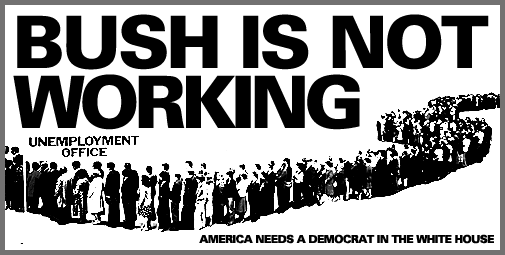
Its election year in the US and in honor of it Abstract Dynamics will be presenting an occasional series of imaginary campaign advertisements. Feel free to use and abuse the images at will.
This first one is a "remix"/parody of an ad once used quite effectively, in another country, to put quite a distasteful lady into power. Time to repurpose it for a better task.
Would like to alter this one to have a nice picture of Mr. Bush fishing, but I couldn't find an image, even though I'm pretty sure on recently went out over the wires. If you have one please send it my way.
January 15, 2004
RIP MLK
Seventy five years ago today, Martin Luther King Jr. was born. He should be resting in peace but instead he is probably rolling in his grave. Protesters and the Secret Service are apparently squaring off over Dubya Bush's attempt to visit the great protest leader's grave on route to a GOP fundraising event.
Atrios hits on the hypocracy with his usual crispness:
From what I've been told, there are people in Atlanta who are refusing to obey police and leave the area so that Bush can go lay a wreath at MLK's crypt without having to actually see anyone.
Apparently, CNN, based in Atlanta, is unable to get a camera there. Odd - they always have cameras at Bush's appearances.
January 14, 2004
Move On the Super Bowl
So MoveOn wants to run their Bushin30seconds commercial during the Super Bowl, and CBS is poised to deny them.
A spokesman for CBS said the Viacom-owned network has received the request from MoveOn to run the ad in the Super Bowl, but added that the ad has to go through standards and practices before CBS will say if it can run an advocacy ad during the game. The spokesman said he didn't think it was likely that the spot would pass standards and practices.
Make what you will of it, and don't be afraid to let CBS know:
CBS Television Network
51 W. 52nd St.
New York, NY 10019
Main Number:
212-975-4321
National CBS Television advertising sales:
newmediasales@cbs.com
January 10, 2004
Preemptive Preemption: The Planning of the Iraqi War From Day One of Bush's Presidency
Former Bush Treasury Secretary Paul O'Neill is dropping his from inside the Bush cabinet. It don't look pretty. Apparently Bush and friends were looking for an excuse to invade Iraq
from nearly day one. Never even questioned why. Wonder if this has something to do with Cheney's tooth and nail fight to prevent his energy task force records from going public? Where the oil company execs parceling up Iraq back in the summer of 2001?
O'Neill will be on 60 Minutes tomorrow, if you do that TV thing check it out.
January 06, 2004
Dumb Political Prediction
Clark has pulled up to Kerry in the New Hampshire polls. For those unfamiliar with US politics, New Hampshire is where the convoluted and archaic process of choosing the next US president starts getting turned into actual votes. There are about a million steps after that... But New Hampshire is the beginning of a major threasholding where the field narrows quickly.
Kerry was once the leader in this whole race, but his campaign has been going nowhere downhill since about day 2. New Hampshire was supposed to be his first trophy but now it looks like his grave. That's not the news though. Clark is the news. And if he wants to win he needs to keep making news.
Making predictions is generally a dumb move, so if I end up wrong expect me to ignore the fact... But I'm predicting Clark to get a sudden bump in his support. He's going to walk out of these contests with the surprisingly larger vote totals.
Why? He quite simply is far better at using mass media then any other candidate. Dean has the grassroots advantage and when it comes to backroom politics Dean and Clark seems pretty even. Clark has better cards with the tacit backing of former president Clinton and a lot of DC insiders, but Dean is playing his weaker hand way better, grabbing ex-VP Gore's support.
But both those games are pretty well developed, although certainly not over. The media game however is heating up like a Ford Pinto. And as a former TV commentator with team of Clinton/Gore vets, Clark seems to understand how to use the mass media far better then any other candidate. Whether that will be enough to win is another story...
update: on the other hand if enough people read this story Clark's campaign is going absolutely nowhere but to pieces.
January 05, 2004
Quarantining Bush
The extent that the Secret Service is going prevent President Bush from encountering any protestors is becoming clearer. The motivations are not. Are these efforts made to tailor Bush appearances for the media, or are they made to protect Bush's frail psyche from the knowledge that nearly half the country hates him? Or perhaps it all just stems from power tripping handlers?
One thing is for certain, it has nothing to do with national security. Anyone truly out to harm the president can just pick up a pro Bush poster and get in close. The Bush bubble is there for another reason, and I for one would like to know why...
January 02, 2004
Lula
WorldChanging: Another World Is Here: The Continuing Story of Lula is a pretty good update on what's going on in Brazilian politics and why its important.
Permission to Speak? Rove
The Valerie Plame affair is heating back up in DC and Time magazine manages to shout that Karl Rove is guilty without actually saying it. First they run this quote which names Rove and no other official:
FBI investigators looking into the criminal leak of a CIA agent’s identity have asked Bush Administration officials including senior political adviser Karl Rove to release reporters from any confidentiality agreements regarding conversations about the agent.
Then to top it off they run Rove's photo with the tag line "Permission to speak? Rove". You can feel the Time editors just begging release the info. Word is that the identity of the leaker is an "open secret" among the Washington press, but they can't release the info publicly as its all "off the record".
But now everyone with half an interest in politics will know that Karl Rove is almost certainly guilty of the criminal act of revealing the name of an undercover CIA operative. An act that's criminal btw, because George HW Bush pushed for the law for half a decade until Reagan signed it into law.
More over at Atrios and Talking Points Memo.
Zapatista! + Nafta
Social Design Notes reminds us that 10 years ago yesterday the Zapatistas declared war on the Mexican government. On the same day Nafta (the North American Free Trade Agreement) went into effect. I'd be really interested is seeing some evaluations of what the effects have been over the past decade. From all sides of the issue of course.
In theory I'm all for free trade. But in practice it's a lot dicier. For one 'free' trade is generally used to indicate a freeing of borders for capital and goods, without a corresponding freeing of the borders for labor. Which is not really free trade at all. Its also really easy to see why that sort of action gets interpreted as threat to jobs, by keeping the borders closed to labor its possible to force and enforce a strafication of the labor market, with one country maintaining a lower level of personal income then the other.
That doesn't mean that "free" trade without free flows of labor is inherently bad. It's the situation we currently have with Nafta and quite honestly I don't know enough about its effects to evaluate its impact. So if you have the info, please send it along.
December 29, 2003
Troop Rotation, Regime Rotation
So its pretty obvious that the US troops in Iraq have been there far too long. But whose great idea was it switch out nearly every troop all at the same time? The Times harps on the issue of military preparedness if some geopolitical problem arises elsewhere in the world. Quite frankly I'm not too worried about that, if a problem arises that truly requires a military response then there are plenty of other nations around who can pick up a month of slack for the US. What worries me is the problem that the US built all by its lonesome, Iraq.
Am I the only one who sees a massive swapping of nearly all experienced troops for inexperienced as the geopolitical equivalent of tacking an arabic "shoot me" sign on the back of each soldier's uniform? Assuming of course the Army can find enough soldiers with any knowledge of the language. Guess that's what the infinite servitude clause is there for.
It's bad enough that Bush has lead us into this conflict, but is it too much to ask for his team to show the slightest bit of preparedness or foresight in its organization? Of course the conservatives are busy rewriting history to inexplicably make lack of preparedness a positive...
There is only so much history you can rewrite though, its about time the Bush administration take some responsibility for their repeated blunders. Troop rotation? the warnings where in the NYT, we are watching to see how it goes down.
December 26, 2003
A Note to the Dean Campaign
First off let me offer a big congratulations Jim Moore, who is now Director of Internet and Information Services for the Dean campaign!
Now, as an independent I've decided not to offer any recommendations on who the registered Deomocrats pick as their nominee, but damn Dean continues to impress. Can't help but like the relentless energy he brings. He's been doing remarkably well not just in well covered opening up of internet campaigning, but also in the traditional political games of endorsements and handshakes. That's two thirds of new school politics right there.
It's the other third where I'd like to see Dean spend some real energy. The realm of pop culture and mass media. Sometimes I get an impression the campaign just wants to route around the media via the internet, and that seems like the path straight to failure. Compare Dean and Clark's Rock the Vote ads. Dean is better then the also rans for sure, but it's a play to his base, not a play to win. Clark's ad on the other hand is a masterful piece of editing, with a punch line that sticks. That's how the media game gets played. And if Dean can't step up to the Clark level in this arena, then Bush/Rove can cakewalk over a Dean nomination.
With that in mind I highly recommend the Dean team get their hands on Danny Goldberg's . Hopefully they already have some dogeared copies, but I haven't seen the evidence yet... Goldberg's book is probably only going to be enjoyable by political junkies, but his core argument is damn strong.
Despite the fact that a majority of pop culture players are quite liberal in their politics, the left is alienating itself from the pop culture audience. Schwarzenegger in California being the latest example of how the right wing completely out plays the left in this area. The left has an infinitely larger pool of pop culture stars that could be transformed into winning politicians. But it's the right wing that takes people like Schwarzenegger and Reagan and actually turns them into political players. And all the while the left allows fools like Joe Lieberman alienate masses of Americans. Goldberg tells the long story in his book. Lets hope team Dean is paying attention.
More then anything I'm worried that Dean's people might mistake internet populism with a broader breed of popularity, when in fact it might well be another form of snobbery. The connections formed through blogs and Meet Ups are quite remarkable, but at the same time they also alienate outsiders. Quite honestly the site of someone wearing one of those blue Dean pins (is that really the best design the campaign can muster?), triggers a fight or flight instinct in me similar to being approached by a Moonie or Hare Krishna. No way can that be good for winning the general election...
But the games just picking up, lets hope the Democrats settle on a nominee without beating each other (themselves) too much. The Democrats can win 2004 and they can win it strong. And as I've said before, for just this one election they have the guarantee of my vote.
December 22, 2003
Fog Of War
Fog of War is quite simply devastating. Devastating in a you really need to see this movie sort of way. Don't expect to walk out in anyway uplifted though. Quite frankly its painful.
It's about Robert McNamara, btw, the man in a large part responsible for the Vietnam War. Mostly its voice over but, from time to time we see him awkwardly framed in camera, and its his eyes that bring the pain back home. This man is still living with the mistakes he and a tiny group of men (and yes I believe they were all male) unleashed upon the people of both Vietnam and America. It's a painful lesson he has quite come to grips with, but its one we all probably should be learning, as individuals, a nation and a world.
The villain of the film is quite a one, statistics. A man (and the camera) pours over sheets upon sheet of data. The math speak... Bombs drop. Soldiers die. Civilians die. Nearly 40 years later, McNamara's descendent Donald Rumsfeld calls out for more metrics in the "war" on terror.
Time perhaps to reread .
December 19, 2003
Vote Number 1
Have to admit when MoveOn announced their Bush in 30 Seconds campaign for distributed ad creation I was skeptical. And when I headed over I expected to watch maybe one or two. Ended up hitting the daily limit (designed to keep the site from crashing) of 20 videos voted on. There are over a 1,000 total. Some are damn good. Some actually would help Bush more then hurt him. None of the 20 were as savvy as say Clark's Outkast ad, but I'm still pretty impressed.
Go vote. It's good practice for November 2004...
December 14, 2003
Fakester?
So does anyone still have a photo of the once infamous now deleted Friendster profile for God Almighty?
Curious cause he sure looked a lot like Saddam with his beard...
And yeah if you haven't heard they got the fucker. Alive. Time for a very public trial.
One tyrant down, Bush is next, you hear?
December 11, 2003
Gbin'
unelectable, miserable failure, and for good measure retarded.
In case you are wondering what is going on here this is a small bit of electronic tactical maneuvering, also known as google bombing. Not going to change to the world, but at least its nice to see what happens when you type "miserable failure" into google.
December 10, 2003
Low Points in American History
Winning their hearts and minds. Warning, not for the weak.
If the video doesn't play for you here is the sequence:
Iraqi lying wounded on the ground. Marines 50 feet away taking sniper shots at him. One hits. Everyone cheers like they just made a crucial first down. Cut to interview with soldier. "those guys are dead now. But it was a good feeling, afterwards you're like, hell yeah! lets do it again".
Repulsed and at loss for words. Is this what my country represents now?
[via American Samizdat where I now will be posting some of my more political stuff]
December 09, 2003
Gore v. Clinton
So Al Gore endorses Dean for president. Shrug.
Wait, hold up. Gore endorsed Dean at a campaign even in Harlem. At a campaign event practically around the corner from Bill Clinton's offices. There is some nasty politics here and I'm not feeling it.
The endorsement has advantages and disadvantages for Gore, sources close to the former vice president told NBC News Andrea Mitchell.
The sources described the endorsement as a way for Gore to maneuver himself to challenge former President Bill Clinton and his wife, Sen. Hillary Rodham Clinton of New York, for supremacy within the Democratic Party. Sources close to the Clintons said Monday that they would not make endorsements in the primary race.
Of course everyone knows that Clinton is behind Clark. This race is close to Dean vs. Clark, which now means its close to Gore vs. Clinton. Squash it please, this doesn't help anyone defeat Bush.
I'm implementing a 100% positive policy on the Democratic nomination race. Not going say anything negative about any of the candidates from here on in. Feel free to call me on it, cause its hell of tempting...
In any case Democrat voters, please pick a winner, ok? I'll support whatever you throw up. Good for one election only.
[quote via Mark A. R. Kleiman]
To All the Beautiful Voters of San Francisco
Today is the day that you go vote for Matt Gonzalez for Mayor. Many thanks and love to you all. Might be out there in a few.
December 06, 2003
Dean People
My friend Samantha Shapiro has an article on the charged people behind Howard Dean's campaign in this weeks NYT Magazine.
December 03, 2003
SF Greenery
Peter Merholz has an excellent run down of the current SF mayors election. For those of you in SF who are not yet aware of it Gavin Newsom is a scumbag, please make sure you get out and vote for Matt Gonzalez next week. Many Thanks -A
December 02, 2003
Unverified Iraq
Two unverified stories about what's going on in Iraq, make what you will of them:
"It seems to many of us this is more an act of desperation, rather than a well thought out tactic."
November 30, 2003
Blake Ashby
Blake Ashby is running against Bush for the Republican nomination for president in 2004.
"I am running because the extreme social conservatives are taking over this party-and it is time for freedom-loving moderates to take it back."
He's basically a moderate libertarian, and a hell of lot better then Bush. My dear friends, if you happen to have the misfortune of being a Republican then please vote for this man.
Abstract Dynamics of course remains independent of all American political parties.
November 24, 2003
Politics
Whiskey Bar: One Big Occupation, ouch "U.S. Seeks Advice From Israel on Iraq", I think that says it all. If there was any chance of Iraq somehow not being a disaster it all over now...
Thankfully this Bill Clinton interview is a bit more positive in out look, good for clearing the pallette perhaps.
November 22, 2003
Mr. Media Will You Please Follow Up?
"So do you use sleeping tablets to organize yourself?" Al-Rashed asked.
bq. "Yes. Well, I wouldn't call them that," (Colin) mPowell said. "They're a wonderful medication -- not medication. How would you call it? They're called Ambien, which is very good. You don't use Ambien? Everybody here uses Ambien."
So that's from the Washington Post almost 2 weeks ago. Am I the only one who wants to know more?
Well here is a bit more about that med:
Side effects include:
Common: abnormal dreaming, abnormal vision, amnesia, daytime drowsiness, depression, dizziness, double vision, drugged feelings, euphoria, fatigue, insomnia, lethargy, light headdress, vertigo, headache or confusion.
Rare: abnormal thinking, aggression, delusions, dementia, feeling of unreality, feeling strange, hysteria, illusions, intoxicated feelings, manic reactions, neurosis, panic attacks, personality disorder, speech impairment.
More from the warnings:
A variety of abnormal thinking and behavior changes have been reported to occur in association with the use of sedative/ hypnotics. Some of these changes may be characterized by decreased inhibition (eg, aggressiveness and extroversion that seemed out of character), similar to effects produced by alcohol and other CNS depressants. Other reported behavioral changes have included bizarre behavior, agitation, hallucinations, and depersonalization.
And a little bit from the products own site:
AMBIEN is classified as a Schedule IV substance by government regulation. Potential for abuse and addiction is a primary consideration of a drug’s classification. Please ask your doctor or pharmacist if you have questions about this.
Addiction, or dependence, can be caused by sleep medicines, especially when they are used regularly for longer than a few weeks or at high doses. All people taking sleep medicines have some risk of becoming dependent on the medicine. However, people who have been dependent on alcohol or other drugs in the past may have a greater chance of becoming addicted to sleep medicines and should be under their doctor’s careful observation when receiving AMBIEN or any other sleep medicine.
Yow, this is our government my friends. You'd think a few more questions would be asked...
November 20, 2003
November 19, 2003
Somewhere Outside the Media Focus
via email:
...the recent unprovoked assault of over 100 attendees at a fundraiser for the Anarchist People of Color (APOC) this past Saturday.... The peaceful event, held at the Brooklyn headquarters of community activist organization Critical Resistance, turned to chaos after police officers, responding to a complaint that there were people outside the event drinking out of open containers, stormed the venue with pepper spray and other chemical agents and began harassing the attendees. The incident ended with the savage beating of dozens of people and the subsequent arrest of eight people, including members of BAC, Critical Resistance, the Prison Moratorium Project (PMP), and the Malcolm X Grassroots Movement.
Read more at the Critical Resistance Home Page.
November 15, 2003
Topless Bush
Prez in Topless Tabloid (washingtonpost.com)
You know, for once I actually think the Washington Post is being a touch too harsh of our president. Perhaps Bush granted an exclusive interview to the Sun because its the only paper he actually, "reads"?
November 14, 2003
Cash Rules Everything Around, Cream Get The Money
The Money Map shows us where all that presidential money is coming from.
November 11, 2003
Pay to Play Politics
Unconfirmed and potentially explosive. Stay tuned.
Incidentally isn't Neil Bush the Bush who was a close friend to the family of would be Reagan assassin John Hinckley? Its the ones who get the least media play that are scariest...
D Divided
Is there something in the DNA of the Democratic Party that ensures it will divide itself from the inside?
November 08, 2003
November 07, 2003
On John Edwards
Is it true that presidential hopeful John Edwards once played a used car salesman in Back to the Future? It sure would explain a lot.
November 05, 2003
Clarkast?
Anyone have a copy of the Wesley Clark campaign ad where he mentions Outkast?
update: here it is, thanks to one Steve Garfield for the info. Anyone have any links to the other candidates Rock the Vote ads?
update2: Rock the Vote has all the candidates videos from their debate. Quality is crap, both in terms of the actual files and that actual ads. Damn, no wonder Bush is president, apparently no other candidate knows how to make a TV commercial. If this is what we can expect from the rest of the campaign Clark is going to steamroll everyone except maybe Dean...
November 04, 2003
What up Russia
Matt Taibbi has some crazy things to say about what's going down in Russia. No idea about the writer or the situation, so I can't verify any accuracy, but it sure as hell sounds like some real shit and it ain't pretty. Need to know more. Gangsta capitalism has been in effect, go get a late pass.
[via atrios]
November 02, 2003
Barlow 2: Bush 1 quote
Barlow also has a great email sig:
Trying to eliminate Saddam...would have incurred incalculable human and political costs. Apprehending him was probably impossible.... We would have been forced to occupy Baghdad and, in effect, rule Iraq.... there was no viable "exit strategy" we could see, violating another of our principles. Furthermore, we had been self-consciously trying to set a pattern for handling aggression in the post-Cold War world. Going in and occupying Iraq, thus unilaterally exceeding the United Nations' mandate, would have destroyed the precedent of international response to aggression that we hoped to establish. Had we gone the invasion route, the United States could conceivably still be an occupying power in a bitterly hostile land.
- George Herbert Walker Bush, from his memoir, A World Transformed (1998)
October 29, 2003
Victory?
Joshua Marshall points out an important fact. Wars don't end when the "winner" says they are over. They end when the "loser" says they are over, or at least stop fighting. Too bad Bush doesn't read the press, he might learn something important one day...
October 28, 2003
Justice
We are pretty used to Bush sticking his foot in his mouth. And we are pretty used to him talking out his ass. But this might be the first time he's managed to stick his foot so far in his mouth its come out his ass...
"The ambassador and the general were briefing me on the-the vast majority of Iraqis want to live in a peaceful, free world. And we will find these people and we will bring them to justice."
October 27, 2003
Yet Another Small Step Towards 1984
It doesn't stop does it? What doesn't you ask? The Bush administration's war on reality of course. Perhaps one could even call it a desperate war.
The latest?
The White House web site changed one small file recently. A file called robots.txt. Robots.txt is used mainly by search engines like Google. The White House changed it in a what that Google will no longer index any story on the White House about Iraq.
The purpose? No one really knows, but the best guess is they want to prevent Google from caching the pages. Why? To rewrite history of course. They got caught once before, changing all references to the end of combat in Iraq, to read the end of major combat. Now it seems they are prepping to change whatever they want. Guess pretending to own a country makes you think you can do these things...
October 25, 2003
$2 a Day
in America, to clean Wal-mart floors. Disgusting. What can you eat on $2 a day, Bazooka Joes?
Body and Soul: Wal-Mart's agenda has more.
October 22, 2003
A New Military?
Whiskey Bar: Looking for a Better Body Count deconstructs the latest Rumsfeld follies and asks us is Donald Rumsfeld the new Robert McNamara?
October 18, 2003
"Do You Have A Minute For Greenpeace"
The Greenpeace street soldiers have one of the most insidious selling tactics around. They swarm a neighborhood asking everyone "do you have a minute for Greenpeace?"
And what are you going to say, no? Its a hard call, your traditional instincts are thrown off, to just say no is like saying "no, I don't have even a minute for Greenpeace, because I'm scum who doesn't care for the environment". But if you say yes they are going to beg for money and take your time. Over and over again. They've been at it for a couple years now, I assume that means its quite effective.
Me, I've developed a rote response, a substitute for no. "Not at the moment", works like a charm. Of course I have a minute for Greenpeace. I used it to put a link at the top of this post. But I sure don't have that minute on the street, love.
October 17, 2003
A Couple (Black) Soldiers a Day is OK...
Holy shit...
"You have to go where the target audience is," says Col. Thomas Nickerson, director of strategic outreach for the U.S. Army Accessions Command, who says that the Army just reached its recruitment goal of 100,200 enlistees this year. "Our research tells us that hip-hop and urban culture is a powerful influence in the lives of young Americans. We try to develop a bond with that audience. I want them to say, 'Hey, the Army was here -- the Army is cool!'"
Salon.com Life | The Army be thuggin' it
In other words, the Army's target market is young poor males. They are recruited with visions of pimping in a Hummer, then shipped off to Iraq where they become a different sort of "target market". And its ok if a couple of them die a day, cause they make great flypaper for terrorists. You know those people we are trying to trap in Iraq, the country that really doing better then the media tells us.
At least they are honest for once.
I think I'm going to be sick, have a great weekend everyone.
[via S/FJ]
October 16, 2003
Escape from Woomera
The Game is the ultimate piece of art, capable of incorporating all forms of art and expression known to humanity, expressed using all forms of technology, from the ancient to the bleeding edge, without compromising its identity as a game.
Now that's a touch extreme, but you can see where they are coming from, there is a lot of potency in video games.
Case to point the second political video game we've seen in as many weeks. Once again via Ashley Benigino's wonderful site.
You are a refugee, you've travelled ages across oceans for a better life. And now all that's left to do is ESCAPE FROM WOOMERA. Woomera being the place where the Australian government is keeping you prisoner. For you and me its a game, for many its a reality.
Why Escape From Woomera?
The videogame is the most rapidly evolving, exciting, subversive and feared cultural medium in the world today. It's akin to graffiti on the cultural landscape. As such it is ripe for an injection of interesting and progressive ideas that can effect social change. We are a team of game developers, digital artists and media professionals, committed to the videogame medium - not merely as a vehicle for conceptual new media art or profit-driven entertainment - but as a free, independent art form in its own right. The creation of Escape From Woomera is part of a larger goal: the rise of a counter-culture of developers and gamers who create and engage with game art outside the mainstream corporate industry.
October 15, 2003
Your Digital Vote...
The computerized voting scandal hits a mainstream paper. And it smells just as rotten as it did when only the fringe covered. Is this a real issue about to break into the big time? I think we'll find out in the next year my friends.
October 12, 2003
Stupid Predictions Time: Dean v. Clark
Ok, here is the deal. I'm going to make some dumb predictions on the eventual Democratic nominee for president next year. If I some turn out to be right you give me lots of respect and props. If I turn out to be wrong, we just forget the whole thing. Sounds fair? Good, I love you all.
So baring any crazy twists and turns (note this is an escape hatch) I think its Clark vs. Dean for this presidential nomination. Which sort of makes it a traditional top down approach vs a new school bottom up emergent technique, although I'm sure Dean has plenty of top down in him. Doesn't matter Clark's top down is going to win it. He's got Gore's veteran team, without its two major flaws; Al Gore himself, and the need to distance
the campaign from Clinton. Good shit, note how quickly Clark was able to grab first tier status.
Now if this goes down the really interesting stuff comes if Dean rolls in second place with a healthy amount of delegates. And more importantly a very potent bottom up team. A team that isn't exactly going to be under control by Dean and his advisors. The Clark people might not want Dean involved in their campaign as VP or whatnot. But they will want his machine supporting Clark. Only problem is that Dean isn't building a political machine, he's growing a political organism. Its living and breathing on its own, and its big and dangerous. The Clark people will be scared shitless of it turning against them in the general election, and they don't exactly have any precedent to base their actions on. Its going to be interesting...
Dean is developing a whole new political model for the US. Should he win outright it will be the new way to wage a campaign, bottom up all the way. But somehow I doubt he's going to win it all, I just don't see his model scaling large enough. But if he does well enough to have major impact on the results, something he's pretty much done already, then a whole lot of interesting crossbreeding is about happen. I'm keeping my eyes open.
Its pretty damn hard for grassroots to grow up to the height of the trees, but it might just attract some animals that can significantly shift the ecosystem...
Plame Gaming
Whiskey Bar: Latest on the Plame Game parses the latest info on America's little spy political scandal. This one is far from over kids. Nothing new, but a lot of clarification going on, looks like the original leaker (George Tenet head of the CIA?) is out to shear away all the various defenses the White House is using to cover over the crime.
One thing that struck me big time. If Tenet (or who ever this leaker is) wanted to he(or she) could just drop the full factual bomb into the media. Next Sunday's Washington Post might have a story with all the names and dates in it if the leaker wants it to. "Dick Cheney called Novak at 12:15 on July 13th" or whatever. In other words at least one side in this fight has a nice load of ammo left. The politicing continues, same as it ever was.
October 10, 2003
Narrative Politics
Its always nice to see an idea you've been pushing for a while achieve some real coherence and media. Well sort of...
Anyway the Guardian give a phenomena I've been dancing around a proper name and explanation. Narrative Politics. This is important pay attention if you care who runs your government:
The key to the election of Governor Arnie is a phenomenon which might be called narrative politics. American electoral campaigns have tended to be driven by the theory of retail politics the candidate made as many speeches, shook the maximum number of hands, accrued the largest air-mile account as possible. Races were won by imprinting a face and a few simple policies through ceaseless repetition.
But, in recent American elections, the centrality of chapped hands and battered soles to a candidate's chances has been balanced against the quicker, simpler power of narrative politics. The victor was likely to be not the man who put in most hours but the one who told the most extraordinary story about himself.
Hence George W Bush - a notoriously indolent campaigner - was able to match the more assiduous Gore because his candidacy was a better yarn: a son following his dad into the Oval Office, a drunk sorting himself out, a child taking revenge on the administration that beat his father.
Previously, the election of the wrestler Jesse Ventura as governor of Minnesota was an extreme example of narrative politics - voters bored with the process waking themselves up with an unlikely plot twist - but even Clinton can be seen as a beneficiary of this electoral mentality. In 1992, the entry into the White House of a womanising, draft-dodging poor Southern boy whose father had died before he was born was simply a better story to tell history than the re-election of the patrician George Bush senior.
A rough rule of narrative politics is that the candidate whose life story makes the best Hollywood movie will win the race. Which is why Schwarzenegger represents the greatest triumph of the theory to date. In the past, narrative politics has had to be combined with retail politics: Clinton, like Reagan before him, had spent years shaking hands and practising legislation.
Schwarzenegger, who had done the retail part unknowingly in multiplexes over decades, relied during his campaign entirely on his narrative: his pitch. Beginning with the neatness that a man who had made a film called Total Recall should be competing in a recall election, his run for governor was such a bold and ridiculous tale that you kept thinking it needed a script editor.
There is a lot more too it though. Narrative politics is a big part of the reason Dean did so well this year, his story is more interesting. Its the reason so few Senators win presidential elections, a life in DC is about as boring a story as there is. Its the reason Wesley Clark is leading polls for Democratic Presidential nominee after being in the race for only seconds, he's got a better story then the rest of the fools.
Of course there is more to it. You need to appear trustworthy and competent. You need to at least have vague stands on push button images. But more then anything a good candidate needs to tell a story. A good one. One that people can tell their friends.
Their is a nasty flip side to it of course. A boring ass candidate can win by telling negative stories about the other candidate. If you can't be the hero, turn your opponent into a villain. Dirty politics, but that's how the game gets played.
So who is the hero of 2004? I'm listening, tell me some stories and maybe I'll tell my friends.
[digsby has more and provided the original link]
I Love Me Some Angry Ass Jesus
has a blog and of course its fucking brilliant.
The Roman Catholic Church is talking about how condoms don't block AIDS. I don't know what to say about that. And taking the vow of celibacy doesn't prevent pedophilia. What is wrong with them? If they oppose all forms of birth control, then when do we get to actually fuck? Or how do we get to fuck?
...
I am so angry, I don't want to just rip up a picture of the pope. I want to rip him a new asshole, wearing a condom, and I don't even have a dick, but this is the one time I wish I did. Fuck you John Paul whatever the fuck your fucking name is you fucking gold vestment tall ass hat wearing shit head. Why don't you just fucking die already? Doesn't God need a personal assistant? Fuck Fuck Fuck you. No seriously. Fuck you. You are not God's representative. God would not do that to people. God loves unconditionally. All are welcome in the true House of God. We need Angry Jesus to storm the Vatican right now, kicking out the money changers and the temple prostitutes and the child molesters. I love me some Angry Ass Jesus. Make your own loaves and fishes muthafucka! Get out of my Father's house!!!
October 09, 2003
A Noose Tightens
White House to Overhaul Iraq and Afghan Missions
Was the headline on Monday. The story, Condi Rice is taking over responsibility for Iraq from Donald Rumsfeld and the Department of Defense. That sounds sort of major, no? It sure isn't getting coverage like its a big time story. Perhaps that has something to do with it coming out the day before the big California recall election? Perhaps the Bush administration timed it very deliberately?
I for one would like to know more. By all appearances Rumsfeld is deep in the presidents doghouse. But still with his job. That leaves very few people with power hanging around our dear leader. Are they circling the wagons? Or perhaps tightening the noose around their own neck?
There is more story here, lets not let it go forgotten, ok love?
Harlan Ellison on Gov Arnold
I thought, early on, that it was a great slate with Gary Coleman and Schwarzenegger both running: remember in MAD MAX: BEYOND THUNDERDOME, the behemoth called "Master Blaster" - this seven-foot-tall brain-damaged, muscle-bound giant, with the midget strapped to his shoulders? Wow, what a terrific Governor we'd have if we just cranked Gary Coleman down onto Ahnuld's shoulders!! As long as nobody blew a high-pitched dog whistle, we'd be in sweet milk an' honey.
October 08, 2003
Some Things Never Die
The trailer for Tupac Resurrection is up and its hot. Shit, if he's still alive he best get visible again and run for president... could have used him in that Cali recall race. Speaking of which the antic muse puts in some good last words. Except of course its far from over...
[Tupac news via Move the Crowd]
Conal on Arnold
A little dark of an image for my site at the moment, but ace political poster artist Robbie Conal has a new Arnold poster.
[via Mercurial]
California Tearing
To all my fabulous Californian friends,
I heard about what happened last night, and I'm writing you to express my deepest condolences. Don't worry, I forgive you. These are troubled times and we all make mistakes. This recall thing is a funny drug, no? I hear they might get another shipment in the spring. Fear not, I won't tell on you.
Lets look on the bright side ok? The inaugural orgy should be a blast! A couple girls I know in Austin are already planning a trip, but you didn't hear that from me...
Remember, its going to be ok.
All my love.
A
October 07, 2003
Cali
To all my beautiful friends in California,
Today is a special day, and I hope you don't mind if I ask you to do a small favor for me. Somewhere in your sunny state are these small dark holes known as polling places. Could you possibly find the time to visit one for me? You can look at it like an exciting trip to the seedier side of life, sort of like Tijuana, only closer to your house. Once you get there please vote NO on this recall thing, will you? I know you like drama out there but really it works better on the studio lot then in the governor's mansion. After that vote then maybe check off this Bustamonte dude's name on the ballot. He's a bit of a sleazy politician I know, but it'd be pretty cool to have a Mexican governor, yes? And if you don't vote for him, this rapist dude is going to win and raise your electric bills again, not cool.
So yeah, can you do this one for me, I'd appreciate it. New York is a blast, but I hope to be out your way sometime soon. Hope this mess is all cleaned up you know.
All my love,
A
October 05, 2003
Action
Day 1: Nothing
Day 2: Nothing
Day 3: Nothing
Day 4: Nothing
Day 5: Nothing
Day 6: Nothing
Day 7: Nothing
Day 8: Nothing
Day 9: Nothing
Day 10: Nothing
Day 11: Nothing
Day 12: Nothing
Day 13: Nothing
Day 14: Nothing
Day 15: Nothing
Day 16: Nothing
Day 17: Nothing
Day 18: Nothing
Day 19: Nothing
Day 20: Nothing
Day 21: Nothing
Day 22: Nothing
Day 23: Nothing
Day 24: Nothing
Day 25: Nothing
Day 26: Nothing
Day 27: Nothing
Day 28: Nothing
Day 29: Nothing
Day 30: Nothing
Day 31: Nothing
Day 32: Nothing
Day 33: Nothing
Day 34: Nothing
Day 35: Nothing
Day 36: Nothing
Day 37: Nothing
Day 38: Nothing
Day 39: Nothing
Day 40: Nothing
Day 41: Nothing
Day 42: Nothing
Day 43: Nothing
Day 44: Nothing
Day 45: Nothing
Day 46: Nothing
Day 47: Nothing
Day 48: Nothing
Day 49: Nothing
Day 50: Nothing
Day 51: Nothing
Day 52: Nothing
Day 53: Nothing
Day 54: Nothing
Day 55: Nothing
Day 56: Nothing
Day 57: Nothing
Day 58: Nothing
Day 59: Nothing
Day 60: Nothing
Day 61: Nothing
Day 62: Nothing
Day 63: Nothing
Day 64: Nothing
Day 65: Nothing
Day 66: Nothing
Day 67: Nothing
Day 68: Nothing
Day 69: Nothing
Day 70: Nothing
Day 71: Nothing
Day 72: Nothing
Day 73: Nothing
Day 74: Nothing
Day 75: Nothing
Day 76: "I want to know the truth."
from :Brian Flemming's Weblog: 76 Days
That's the good Mr. Bush's sequence of action after a top White House official apparently committed a felony and blew the cover of an undercover CIA agent in a nasty political maneuver. Great to see such a decisive former CEO in the White House.
[via Whiskey Bar: Manhunt]
October 02, 2003
Move On the Plame Affair
MoveOn.org: Investigate the White House
yes MoveOn sends me too many emails, but this one seems pretty worth it. A criminal act was committed when the wife of Gulf War 1 hero Joseph Wilson identity as an undercover CIA operative was leaked. The White House has already stonewalled the investigation for two months. Time for an independent investigation.
Slime and Defend
"It's slime and defend," said one Republican aide on Capitol Hill, describing the White House's effort to raise questions about Mr. Wilson's motivations and its simultaneous effort to shore up support in the Republican ranks.
"So far so good," the aide said. "There's nervousness on the part of the party leadership, but no defections in the sense of calling for an independent counsel."
- White House Looks to Manage Fallout Over C.I.A. Leak Inquiry
no comment...
October 01, 2003
Joseph Wilson Gulf War Hero
I'm think we need start addressing Joseph Wilson properly, people seem to be getting the wrong ideas. From here on in I'll be referring to him as "Joseph Wilson, Gulf War hero" or "Joseph Wilson the hero of the first Gulf War" The evidence:
...Wilson was one of the key players. As the acting US ambassador on the ground in Baghdad in the weeks leading up to the war, the White House consulted Wilson daily. In those weeks, he was the only open line of communication between Washington and Saddam Hussein... Furthermore, Wilson was formally commended by the Bush administration for his bravery and heroism in the weeks leading up to the war. In that time, Wilson helped evacuate thousands of foreigners from Kuwait, negotiated the release of more than 120 American hostages and sheltered nearly 800 Americans in the embassy compound.
"Your courageous leadership during this period of great danger for American interests and American citizens has my admiration and respect. I salute, too, your skillful conduct of our tense dealings with the government of Iraq," President Bush wrote Wilson in a letter. "The courage and tenacity you have exhibited throughout this ordeal prove that you are the right person for the job."
- Amy Goodman and Jeremy Scahill: Does a Felon Rove the White House?
[link via The Right Christians]
19th Century Chess in DC
Talking Points Memo has an interview with Wesley Clark. Guess Clark sees the Bushco as a 19th Century flashback of sorts as well:
CLARK: But, in the odd kind of geopolitical chess board game this administration seemed to want to play, they seemed to assume that you could get your forces into Iraq, and, like a game of checkers, you could skip across the Middle East--plop, plop, plop--as though in some metaphysical sense, it was easier to come ashore up through the Euphrates and Tigris valleys into the heart of the Middle East and southwest Asia, and then cross into the mountains of Iraq--excuse me, of Iran--or pivot and go towards Syria. It was analytically, geometrically satisfying, even though those of us who understood the situation at the time said it made little sense. It was old-think. It was 19th century geostrategy--
TPM: So, the Great Game? A sort of a new version of the Great Game?
CLARK: It was the Great Game with modern equipment, and hypermodern risks. And, in reality, the problems with Osama bin Laden were not problems of states. They were problems of a supranational organization which alighted in states, used states, manipulated elements of states, but wasn't going to be contained and destroyed by attacking and replacing governments.
September 30, 2003
Why Plame?
Why? Why is a "Senior Administration Official" going ballistic in leaking the Plame affair to the press? I first wondered about the motive a couple days ago. Billmon is wondering in some other directions now.
Motives. I'm not wondering so much anymore. Sure it might not be Tenet leaking. There are other motives, stories untold and such. But there is one glaring, obvious, screaming in your face motive and it points straight to Tenet.
If the White House leaked Plame's identity as a undercover CIA agent, and they can get away with it, they will have set a precedent. They will have set precedent that they can leak any CIA agents identity on a whim, for a blatantly political motive no less. And that means they can do it again.
Now imagine you run the CIA, and you don't like the White House guys much, but you try and work with them. And they come over and say, "you know that we can blow your cover and take your jobwhenever we want?" Is that something you take lightly? Especially when having an operatives cover blown might mean they die, and could very easily mean their sources get imprisoned, tortured or killed? Not to mention that intelligence networks cultivated over years can disintegrate in days?
If the White House can get away with a leak like this then every CIA agent needs to wake up every morning wondering if Karl Rove and Dick Cheney have let them live another day. Now I just can't imagine that being pleasant or productive.
If this leak went down the way it seems to have, then the White House just stabbed the CIA in the gut and they want to twist the blade. Is it any wonder that the CIA is fighting back with a vicious vigour? Motives? They are all in the open now my friends. The CIA is fighting for its life here, I don't expect them to pull many punches.
Treason
"Truman initially rose to prominence as a fierce crusader against war profiteering, which he considered treason."
Yep, Krugman is back at the NYT and he's got another gem of a column: Who's Sordid Now?
Is ripping off the US government for the sake of profit an act of treason? The thought has been on my mind for a few weeks now. Honestly I'd be all for the US rebuilding Iraq if I had any faith is would be done properly. But it seems to be getting done in order to fill the pockets of a very select few friends of Dick and Bush. Illness. Yes I think there are executives committing acts of treason against our country, and they are doing it from high places. How long will we let this stand?
September 29, 2003
The Plame Affair Continues
The Plame Affair continues to evolve, straight into some territory. Here is a bit of the White House spokesperson talking to reporters today:
QUESTION: But is the President getting his information from you? Or did the President and Karl Rove talk, and were there assurances given that Rove was not involved?
McCLELLAN: I've already provided those assurances to you publicly.
QUESTION: Yes, but I'm just wondering if there was a conversation between Karl Rove and the President, or if he just talked to you, and you're here at this --
McCLELLAN: He wasn't involved. The President knows he wasn't involved.
QUESTION: How does he know that?
McCLELLAN: The President knows.
QUESTION: What, is he clairvoyant? How does he know?
as usual Whiskey Bar and Talking Points Memo have the best dirt. Lots of it, with more to come.
September 28, 2003
Is Powell Leaking?
Josh Marshall is keeping up on this White House CIA leak scandal. He's of the opinion that the person leaking the scandal details to the press is CIA director George Tenet. Makes sense on a lot of levels, but something is missing, a motive. Well Tenet has a few, but they are a bit nasty, revenge and power. The Washington Post article cites "a senior administration official" as fingering "two top White House officials" in releasing the agents name to the press. Which opens up a question:
Which senior administration officials have a vested interest in pushing this story to the public?
Tenet does as head of the CIA, but he started the inquiry, does he need to push it further?
Lets also look at this quote:
It is rare for one Bush administration official to turn on another. Asked about the motive for describing the leaks, the senior official said the leaks were "wrong and a huge miscalculation, because they were irrelevant and did nothing to diminish Wilson's credibility."
Now Tenet is right to be furious about the leaking of a CIA agents identity, but would he really be saying he's talking because the actions "were irrelevant and did nothing to diminish Wilson's credibility"? Maybe, not going to rule it out, but it sounds like some other sort of political operation going on...
So who else has motives? Allow me to suggest Colin Powell. Earlier this week a video surfaced of him in 2001 talking about how the sanctions on Iraq had worked and there was no WMD threat in Iraq. And they were edging into the mainstream media. His credibility was potentially about to take a hit. On top of that he's a bit a of a victim of the Bush administration. Its pretty clear he was against the Iraq war and only joined up in the media campaign due to political pressure. The neocons got him to support a cause he didn't believe in and his political credibility is shot because of it. If the WMD videos became a big time story he'd be close to his political deathbed. Its not exactly hard to see how he might be angry at the likes of the head political strategist Karl Rove.
By pushing this story Powell could get some real revenge. More importantly there is a good chance that the scandal around the WMD statements might fade away. The CIA leek is juicier then the WMD video, way juicier. It buys Powell some time, makes him look better, and if he's lucky his blatant lies will be forgotten.
Its just a theory of course, the good money is still on Tenet leaking. But lets not rule out Powell. Could be someone else too, perhaps there is another angle?
High drama in DC, life is stranger then fiction, no?
addendum:
There maybe even more to this. This story has been circulating in slightly less credible journalistic circles for a while now. I first saw it written up by someone named Al Martin, just reread his article from September 2. Please note I have no idea how credible this guy is, but he's got lots of info that indicates that Powell would have access to all the necessary info know what went down:
When Ambassador Wilson was asked how he knew it was Rove, he had documents in his possession identifying Rove as the leaker from a secret investigation of the State Department’s Internal Security Unit. It was from a small clique, four Clinton holdovers in that department of the State Department that were sympathetic to what had happened to Wilson.
These investigations could not have possibly been made without at least the tacit acquiescence of Secretary of State Colin Powell.
Very Hypothetical
So lets say, hypothetically of course, that Bush for some reason does not run for a second term. Who do the Republicans put up? Schwarzenegger?
Seriously though, they haven't built any alternatives at all have they? Schwarzenegger is the only person they seem to be pushing right now and as an immigrant (illegal?) he's not qualified. Who steps up, Giuliani? DeLay? Jeb Bush? McCain? Its not exactly a star studded field...
When You Fsck With the CIA...
Something is breaking in Washington DC. This tastes like big time my friends. The massive hubris of the Bushco administration has them back peddling like a mofo and they might just trip and break their backs.
The skinny?
Early this summer some White House officials thought they could pin the blame for some lies on the CIA, which is headed by a Clinton appointee George Tenet. Dumb move. You don't fuck with the CIA. Poppy Bush used to be the head of the CIA, his son should have known better. Tenet fought back, basically taking the blame for a minor issue and in the process letting it be known that he was untouchable from here on in. As todays Washington Post says: "Bush's aides said they believed in retrospect it had been a political mistake to blame Tenet."
So that's the start, it gets nastier. During that whole summer mess, a "senior White House official" leaked the name of a CIA operative, basically as an act of political revenge. When the Washington Post says "senior White House official" they mean someone major, its journalistic code and its taken seriously. All indications are the person is Karl Rove, Bush's campaign strategist, the dude in charge of getting him reelected.
Now the delicious irony here is that leaking the identity of a CIA operative is a very specific felony, and it carries a mandatory prison sentence. Why? because the law was a pet project of the first president Bush, father to the bumbler now in the White House. Papa Bush was CIA director when a high profile operative was killed after his name was leaked. Bush then spent 6 years fighting to get this law passed, finally succeeding while he was Reagan's VP. Perhaps he was fighting to plant the seeds of his son's downfall?
We'll learn more soon. The CIA is asking for an investigation. More to the point they are very publicly asking for an investigation. The Justice Department is run by Bush people so they can try and avoid investigating, but they will be doing so in the public eye. And that my friends would raise even nastier questions. It looks like the White House has lost its ability to feed the press faster then the press can investigate. And the press smells blood in the Bushco administration, will Bush feed them someone or will the press hunt their own victim?
Something is about to break. Lets hope its in the right direction. Lets not forget that Bushco is going to fight back, and try and lead the press elsewhere. Lets hope they don't use big bombs to do that. Stakes are high, drama is ramping up, the stories have just started. Stay tuned.
September 26, 2003
Welcome to the 3rd World
Every once in a while I'll find myself in a conversations with someone who is of the opinion that the Bushco Republicans are the "party for big business". Its usually meant as criticism, but ironically it doesn't really go the distance. Truth is the Bush Republicans are not for big business at all, have you seen the stock market over the past 3 years? Reality is they have no interest in promoting business, big or small and in fact they seem to have almost no knowledge of economics at all. What Bush and friends are out to do is turn America into a 3rd world country. One where ironically enough the government is a prime redistributor of wealth. From the hands of everyone into the hands of a select few.
Its got nothing to do with business at all really, except in that you need a front, preferably a corporation that could have existed in the 19th century (guns, construction, metals, railroads, more weapons, oil, etc). Once you have the front business, then you get to work, its all about who you know and who slips you the cash. Free Iraqi money is the way to go nowadays. The government borrows the cash in the name of the American people, then slips it to your firm for consulting on rebuilding the country we just tore apart. Nice work if you can get it. All you need to do is be part of the inner circle. Pay $2,000 at the door in the form of a fundraiser and see how far you can go...
Talking Points Memo's Josh Marshall shows a bit of how it works. Here's the kicker to an article showing the connection between a new "company" devoted to helping other companies find opportunities in Iraq and a big time republican lobbyist's office:
For one thing, the Vice President and Director of New Bridge is Ed Rogers --- the same Ed Rogers who is Barbour's partner in Barbour Griffith and Rogers.
Then there's the third partner, Lanny Griffith. He's Director at New Bridge and Chief Operating Officer at Barbour Griffith & Rogers.
Then there's former Ambassador Richard Burt. He's 'Director' at New Bridge and 'International Director' at Barbour Griffith & Rogers.
Needless to say, Allbaugh's wife Diane is 'of counsel' at Barbour Griffith & Rogers.
Isn't it weird how that happens when you apply for a second job and all the dudes from your first job work at the new place too? Anyway ...
Actually, you can see why it's so convenient to work at both of these two places since they both happen to be located on the 10th floor of 1275 Pennsylvania Avenue.
Shit, when you have a good hand, why not double down? Especially if the dealer happens to be a good friend...
September 25, 2003
Frontrunnin'
When Wesley Clark entered the race for Democratic nominee for president Joshua Marshall ran some words by an unnamed but highly regard source:
I don't think fundraising is that important now. I'd look for how [Clark] deals with the press. Is he comfortable? Is he brittle?... If he wins over the national press, everything else will fall into line.
So now its barely a week later and Clark is very close to being the front runner. Wonder why? Here is a taste, the NYT, online front page blurb for their debate article:
The newest entrant to the race, Gen. Wesley K. Clark, stood on the sidelines and was largely ignored for much of the debate.
Hmmm, stand on the sidelines and get ignored, is that how he got to be the only one of 10 candidates mentioned on the front? Interesting.
Not Even About Oil
Riverbend is the girl blogger supposedly from Bagdad, very well written, obviously from the wealthier side of the Iraqi spectrum. Hadn't read it in a while and what a shame, its chock full of interesting stories:
My father has a friend with a wife and 3 children who is currently working for an Italian internet company. He communicates online with his ‘boss’ who sits thousands of kilometers away, in Rome, safe and sure that there are people who need to feed their families doing the work in Baghdad. This friend, and a crew of male techies, work 10 hours a day, 6 days a week. They travel all over Baghdad, setting up networks. They travel in a beat-up SUV armed with cables, wires, pliers, network cards, installation CDs, and a Klashnikov for… you know… technical emergencies.
Each of the 20 guys who work with this company get $100/month. A hundred dollars for 260 hours a month comes to… $0.38/hour. My 16-year-old babysitter used to get more. The Italian company, like many other foreign companies, seems to think that $100 is appropriate for the present situation. One wonders the price of the original contract the Italian company got… how many countless millions are being spent so 20 guys can make $100/month to set up networks?
Plenty more stuff like this, including the infamous $50 million bridge story (in reality I believe a $5million bridge which is still far more then it would cost to get an Iraqi company to repair it). This is the story of how American taxpayer dollars are getting skimmed off by the Bushco. More like getting bulldozed off actually. Shit, this war wasn't even about oil it was just about stealing tax dollars for a few military contractors...
Here's another story, isn't this great?
The whole neighborhood knows about S. who lives exactly two streets away. He’s what is called a ‘merchant’ or ‘tajir’. He likes to call himself a ‘businessman’. For the last six years, S. has worked with the Ministry of Oil, importing spare parts for oil tankers under the surveillance and guidelines of the “Food for Oil Program”. In early March, all contracts were put ‘on hold’ in expectation of the war. Thousands of contracts with international companies were either cancelled or postponed.
S. was in a frenzy: he had a shipment of engines coming in from a certain country and they were ‘waiting on the border’. Everywhere he went, he chain-smoked one cigarette after another and talked of ‘letters of credit’, ‘comm. numbers’, and nasty truck drivers who were getting impatient.
After the war, the CPA decided that certain contracts would be approved. The contracts that had priority over the rest were the contracts that were going to get the oil pumping again. S. was lucky- his engines were going to find their way through… hopefully.
Unfortunately, every time he tried to get the go-ahead to bring in the engines, he was sent from person to person until he found himself, and his engines, tangled up in a bureaucratic mess in-between the CPA, the Ministry of Oil and the UNOPS. By the time things were somewhat sorted out, and he was communicating directly with the Ministry of Oil, he was given a ‘tip’. He was told that he shouldn’t bother doing anything if he wasn’t known to KBR. If KBR didn’t approve of him, or recommend him, he needn’t bother with anything.
For a week, the whole neighborhood was discussing the KBR. Who were they? What did they do? We all had our own speculations… E. said it was probably some sort of committee like the CPA, but in charge of the contracts or reconstruction of the oil infrastructure. I expected it was probably another company- but where was it from? Was it Russian? Was it French? It didn’t matter so long as it wasn’t Halliburton or Bechtel. It was a fresh new name or, at least, a fresh new set of initials. Well, it was ‘fresh’ for a whole half-hour until curiosity got the better of me and I looked it up on the internet.
KBR stands for Kellogg, Brown and Root, a subsidiary of…
Bush League Bets
So anyone want to give me some nice odds on a bet that Bush becomes the first president to commit suicide in the White House?
Serious though, odds are nothing of the sort will happen, but mofo has been so sheltered from the truth and it will probably pretzel him in the face sometime... Something strange will go down, lets hope its not another war.
And while we are on the gambling subject, anyone have odds on the fact that Bush will somehow find a way not to have to debate the Democratic nominee at all?
[inspired by Daily Kos: NBC/WSJ poll has Bush at 49]
September 23, 2003
The Emperor has a New Suit
Bush said he insulates himself from the "opinions" that seep into news coverage by getting his news from his own aides. He said he scans headlines, but rarely reads news stories.
"I appreciate people's opinions, but I'm more interested in news," the president said. "And the best way to get the news is from objective sources, and the most objective sources I have are people on my staff who tell me what's happening in the world."
note that I added the italics, but AP put the quotes around "opinions"...
September 22, 2003
September 20, 2003
Activist Clips

RiniArt.org has loads of activist clip art from the late activist illustrator Rini Templeton. Free for non commercial use, but feel free to support them.
[via the always excellent Social Design Notes]
September 15, 2003
MoveOn Moves Again (updated)
looking good, looking good. Could it be that Dubya Bush's biggest legacy will be getting the "left" to remember how to organize again?
One of the interesting things about this campaign is that Move On is clearly taken a logic driven approach to this particular propaganda effort. Its all about the facts, making it a fact that Bush is a liar. There is a real problem with this tactic though, it utterly fails on those who trust* or *believe in Bush. You can yell liar all you want, and its irrelevent to those with the trust in the man.
Now thankfully for Move On there is a sizable group of logical Republicans, ones open to the facts argument. Fiscal conservatives and libertarian leaners mainly. They already show signs of doubting Bush, so they are good targets. But I still think this is the wrong way to really go after Bush. Rather then making a hard accusation it be better to just raise doubts.
Instead of saying "Bush is a liar", ask "is Bush a liar?" Instead of stating "Bush can't be trusted", wonder "can Bush be trusted?" Be inclusive, bring in everyone to the discussion and let them decide on their own. The first pair of statements attack, they cause Bush fans to go on the defensive, and once they are there its going to be damn hard to convert them. But if they let their guard down and start to think, to ask questions, then they can decide on their own whether he can be trusted. And the seeds of doubt will be planted. Even if they still like Bush they'll be second guessing the choice. Worried perhaps they are wrong.
The facts will speak for themselves in the right circumstances. But challenging Bush fans with them in a head to head manner is not much of a winning tactic. It just puts people at odds, ready to defend and dying for some cognative dissonence, a denial of reality in order to maintain a belief system. So yeah, I'm here to take the other tact. To ask the questions and open up the doors. Meanwhile I wish Move On the best in their campaign.
Oh Shit
created by the razor sharp Billmon of the Whiskey Bar. Give him the credit he is due, I've been given more credit then I deserve on a few things lately.
September 13, 2003
Bush Killing Questions
There are couple Bush killing questions out there I'd like to see propagated more. One is for the people of the United States, and its just "can we trust this man?" The answer honestly doesn't matter, if enough people ask it the damage will be done. Just having people wonder if he's trustable will plant seeds of doubt that will sharply undermine his no turning back style of politics.
The second question could use an answer, but again its more important to ask. Its for the man himself, but should be broadcast to the public too. "Who will pay for this war and deficit?" Who indeed. I want to see him waffle those answers every time he faces the camera. More to read about it at: Prometheus 6: Oh, what to do, what to do.
September 12, 2003
Illness
So somewhere in my comments is a little thread about whether there is a problem with racism against Muslims and Arabs in the United States. Well I still find it hard to believe people can think its not an issue, and unfortunately I had to get my thoughts proven this morning by reading this:
I remember the day I took out the Koran from my bag in order to read it on the way to work. It was, I am ashamed to admit, my first and last day. It took only a couple of stops for someone to make a comment. "You’re making people uncomfortable". I turned to find a man scowling and a couple of people staring blankly at me. I asked the owner of the voice what exactly I was doing that was making people uncomfortable and he told me straight out that it was the Arabic "shit" I was reading and that I should put it away. Anything written in Arabic has to be a threat of course. I did not quite know how to respond to him. I looked around and saw the clutter of newspapers declaring war on innocent Iraqis (is there even such a thing?) I saw women reading their bibles in English, Spanish, Cantonese, Polish. Were the other commuters going to put away the newspapers that make me as an Arab uncomfortable? Were the women around me going to put away their bibles, symbols of the Christian fundamentalist thought that only a holy crusade would save America from the evil of the Arabs?
I was told by friends and family not to read the Koran in public anymore. "No sense in provoking people," they said. And as I mentioned before, I am very ashamed to admit that I have not read it in the subway since that day. I have developed a certain kind of self-censorship that I am not proud of and try to fight daily. My war zone scares me because I do not know what I am fighting against. I do not having anything tangible to battle and do not even have allies. How can I protect myself against something I cannot grasp? How can I reclaim my space?
I am scared. I will not deny it... What one considers a simple subway ride I have begun to consider a daily struggle. I struggle to maintain my identity, struggle to find the strength to stop hiding. I do not want to live in a war zone. I do not want to feel terror. Every moment I spend on the subway I spend FIGHTING for my existence. I have not taken out my Koran; I have not been able to be quite that defiant yet.
The author is Sherien Sultan and you can read the whole essay here.
Let me also add that this is New York City we are talking about, the second most liberal city in the US, and world renown as a cultural melting pot.
The neocons can call it Terrorism all they want, but the truth is its nothing more then a neat remixing of the red scare and racism tactics that have done the right wing so well in this country over the last hundred plus years.
[via Prometheus 6]
September 10, 2003
blackSpots
blackSpot sneakers: rethink the cool
Yes! Finally, this is something that's needed to happen for a long time. Activists love to go after Nike like the company is sitting on a mountain of cocaine and the activists need a fix. I agree strongly with these activists on some issues and disagree with them just as strongly on others. Regardless I as so damn down with what they are doing with blackSpot.
This is protest as it should be done. There is a space for criticism, especially of the constructive sort. But bitching and moaning will only get you so far. And boycotts and protests will only get you another inch or two farther. If you have a problem with a product or company then the constructive path is to build a better product.
Now I have certain doubts and issues with their approach, and similar issue with their parents at Adbusters, but that is for another post. Right now I am here to praise them. I once spent an entire day researching alternatives to Nike. The short version? There are Nike's on my feet right now.
The Longer? Well, most sneakers are built in sweatshops and even if they aren't the products they are made of probably are. Even if they aren't its almost impossible to prove it given the messy chain of suppliers involved, information that is often not publicly available anyway.
The only really sweatshop free sneakers are made in the US or Europe, and personally I like my money going all over the world, even if it risks funding a sweatshop or two. Plus the two US made sneaker brands are Sausony and New Balance. Now Sausony makes great shoes, but every pair I've owned has warn out at the rear inside corner of the sole within a few months. They just aren't made for my feet. As for New Balance, lets just say you couldn't make an uglier sneaker if you wrapped an insole in plaster then ran over it with a tractor while a dog humps it. I'll take my Nike's instead please, size 11 thank you.
But now we have an alternative in the mix. More importantly it sets the stage for a whole new breed of protest and transformation of the world. Finally activists might start waking up and realize that capital is a tool not the enemy. I'll be writing a lot more about this in the near future.
September 09, 2003
September 04, 2003
Recall Davis
America's favorite cuts loose on the California recall. As disturbing as ever, and as always points to (and exaggerates) real serious problems in our society.
The big question with Mike Davis is always "just how much is he exaggerating?" There is no question in my mind that the world as not quite as dark as Davis' neo-Marxist visions, but that doesn't mean he's not right sometimes...
[via Hit & Run]
September 01, 2003
The Postmodern President
Got to love"The Post-Modern President" by Joshua Micah Marshall.
That has created a strong incentive to delegitimize the experts--a task that comes particularly easy to the revisionists who drive Bush administration policy. They tend to see experts as guardians of the status quo, who seek to block any and all change, no matter how necessary, and whose views are influenced and corrupted by the agendas and mindsets of their agencies. Like orthodox Marxists who pick apart mainstream economics and anthropology as the creations of 'bourgeois ideology' or Frenchified academic post-modernists who 'deconstruct' knowledge in a similar fashion, revisionist ideologues seek to expose "the facts" as nothing more than the spin of experts blinded by their own unacknowledged biases. The Bush administration's betes noir aren't patriarchy, racism, and homophobia, but establishmentarianism, big-government liberalism, and what they see as pervasive foreign policy namby-pambyism. For them, ignoring the experts and their 'facts' is not only necessary to advance their agenda, but a virtuous effort in the service of a higher cause.
Of course Marshall's intellectual bias is self evident there, but you've got to love the skilled put down. Personally I've got no problem with revisionists as long as they are on my side...
Noney

Noney is a new currency. Each Noney note is a hand drawn, hand printed and hand signed piece of art. Each note can also be traded for things. Like all money, Noney is for people to circulate. The result is a combination of public art, performance art and printmaking.
...
Each Noney note has the same denomination: zero. This doesn't mean each note has no value... just relative value. There's no fixed exchange rate or area of operation. Noney's worth as both art and currency is something to negotiate through each individual transaction - anywhere.
[via Boing Boing who also point out the obvious precedent set by JSG Boggs]
August 28, 2003
Who's Making the Killing?
Arms And The Man is the site. "Who's Making A Killing On Killing In Iraq?" is the theme. Warning: this is not a positive site. Unless of course you own stock in Halliburton, Bechtel and the like...
[via Daily Kos]
Guerilla Peace
"It's not a guerilla war that's killing us," Rumsfeld explained. "It's guerilla peace."
August 26, 2003
Terminate with Extreme Prejudice
Schwarzenegger on power:
'My relationship to power and authority is that I'm all for it,' he once explained. 'People need somebody to watch over them.... Ninety-five percent of the people in the world need to be told what to do and how to behave.'
and freedom:
bq. 'The only thing that makes me nervous,' he has said, 'is when I don't get my own way.'
como se dice nazi en California?
August 25, 2003
"we never had Al-Qaeda before this occupation"
I'm so angry and frustrated. Nothing is moving forward- there is NO progress and this is just an example. The media is claiming Al-Qaeda. God damn, we never HAD Al-Qaeda before this occupation... fundamentalists kept their heads down. Now they are EVERYWHERE- they 'represent' the Iraqi people on Bremer's puppet council...
those are the words flowing from Iraq. God damn, how fucking retarded are Bush and the neocons. How could they plan a war without planning in the least for the occupation. Its pretty clear now that this invasion is a colossal failure, WMD or no WMD. Before war, no Al Qaeda. Now Al Qaeda. America is less safe, Bush failed once again, same way he's failed in most every other venture he's been in. I mean this is the man who traded away Sammy Sosa. Bush = Failure, its a simple equation, let it be known.
And since this is making me a bit upset, lets cut to some humor:
Today President Bush said the situation in Iraq had deteriorated to the point where he had no choice "but to declare war on that country."
"I've just become aware that good people are dying out there. Terrorists run rampant, killing people, blowing up oil pipelines, wreaking havoc, maybe just plain reaking. They've got to be stopped."
Bush said that he had recently learned that since May 1, 2003, Iraq has become the "number one nexus of the terrorist activities in the world," and he called it "the nexus of the axis of evil," speaking from his ranch in Texas.
He said that it was a difficult decision but he had "no choice" given the state of the country at this time.
"Whoever is running that country has allowed it to turn into a hornet's nest that threatens the stability of the Middle East, and with it, the safety and security of the United States, and of the world."
August 23, 2003
August 20, 2003
War + Video Fog
CBSNews has some stunning video footage filmed during the bombing of the UN headquarters in Iraq the other day. RealVideo unfortunately, if anyone knows of a QuickTime version please let me know.
The footage captures the fog of war as good as anything. Noise, blackness, smoke, confusion, blow out to white as they get outside and figures shift in and out of view on the overexposed film. If it wasn't so tragic you could call it beautiful. Instead its a disaster.
August 18, 2003
August 16, 2003
antics and gang rape

hallucinations & antics . tobias c. van Veen .. ./ /. . ./ .. /. /. /. . .. . ./ ./ . /. .. . .. / /. has been playing fast and loose with its text size and now has the best looking weblog around.
On a more serious note tobias also brings ill news: 'Polish artist DOROTA NIEZNALSKA was sentenced to 6 months of confinement in her community for "violence to religious feelings."'
Among the suggested punishments *GANG RAPE*. An ill world indeed. Damn.
August 13, 2003
August 09, 2003
The Technoarchy
Technoarchy: a form of oligarchy where society is controlled by those who use technology the best. Unlike traditional oligarchies technoarchies are generally emergent. For the most part they are not created deliberately, but rise out of the properties of the dominant technology of the time, ie the networked computers of the 21st century.
According to google it was used with a potentially similar meaning once before, in an essay I have yet to get my hands on. If anyone knows of any other prior uses, please let me know. Same goes for other words with a similar meaning.
Expect an essay in the near future.
August 05, 2003
What the Wha? Bush Admits He Destroyed the Economy
George W Bush: Yes. No, to answer the last part of your question. First of all, let me -- just a quick history, recent history. The stock market started to decline in March of 2000. Then the first quarter of 2001 was a recession. And then we got attacked in 9/11. And then corporate scandals started to bubble up to the surface, which created a -- a lack of confidence in the system. And then we had the drumbeat to war. Remember on our TV screens -- I'm not suggesting which network did this -- but it said, "March to War," every day from last summer until the spring -- "March to War, March to War." That's not a very conducive environment for people to take risk, when they hear, "March to War" all the time.
Damn. you read it. He said it. Could it be he can't make the connection that his drive to war is what was producing that "not a very conducive environment for people to take risk"? And he lets his scapegoats in the media off the hook before even dropping the bomb. Whoa. I usually try and give the fool a little credit, he can't be as dumb as it seems if he got to the White House, inbreeding and all. But this is retarded. Can someone give him an IQ test so we can know the real answer once and for all?
[via Eschaton + original source]
August 03, 2003
Terrifyingly Ambiguous Headlines
The headline reads: U.S, Officials Preparing for New Terror Attacks
So does that mean Bush administration is preparing to terrorize us some more? I'm certainly more afraid of John Ashcroft then "terrorist"...
Readage
Post I'm back to my usual read a lot of books at once style. Here is the state:
Wolfe slices through the bs of modernist architecture with his usual flare and wit. It came out in the early 80's which probably added a cocaine fueled bitchy edge to all. Quite enjoyable, even if the targets are damn easy ones. Read it course with a grain of salt of course, not all the modernists are as bad a Le Corb...
A good 2 hour scifi read to cleanse the palette. Ignore the fact the "deep philosophical questions" are a silly bore and its an entertaining read.
Its a collection of essays by various authors so its a bit hard to judge the whole book at this point. The intro however is an excellent introduction to the current state of thinking on the organization of firms. The whole field is still too deeply interwoven with free market capitalist thinking, but its ripe for a divorce. And that's the exciting part. There is a new approach to political economy in the making and some the roots (rhizome?) are nicely traced in this book.
July 31, 2003
Smoke, Mirrors, War, Economy
So I read the headlines today, GDP grows 2.4%, finally some good news on the economic front. And unlike some I don't hate Bush so much that I don't want the economy to recover. We can get rid of him anyway. Anyway the good news last a whole couple of hours before the good Billmon set it strait:
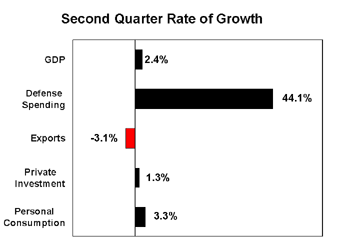
Whiskey Bar: War, What is it Good For?
Shit, damn, motherfscker... At least the economy grew 0.7% that's better then nothing. But damn can Bush get anything right besides putting money in his friends pockets?
addendum: if that wasn't bad enough, Calpundit points out that the 2.4% number is projection for the whole year! It takes about 3.5% a year in growth just to the country from losing jobs. So were looking at something more like 1% growth this year, in other words a hair better then a full on recession. Like father, like son, only bolder and dumber, great.
July 30, 2003

July 27, 2003
Armies of Money
As usual Billmon brings the sharpest political insights to the web. In the process he shows what's really going on with the Dean campaign and fundraising. Dean has empowered the managerial class. He's used the internet to bring campaign finance to the level where $200 matters. That's a half order of magnitude change from the previous level, where you really needed to give $1000 to make a difference. And for that he should be commended.
So its a change for the slightly better, but only slightly better. Instead of the top 2% running things its the top 10%. Its still an oligarchy. Power is still concentrated at the top. We can do better.
July 25, 2003
Just One

Apparently this photo has been circulating the web for a month now and just got mentioned in the NYTimes. Funny but sad. For those that don't get it the reference is to a long standing ad slogan of the Army Reserve, and perhaps the ROTC, and various National Guard units. They promise that you if join one of these programs you'll be obligated to be on duty for 'as little as one weekend a month'. Of course the 'as little as" gets very little emphasis. Bottom line though, is that US government seriously underestimated how much manpower they would need in Iraq. The blame falls almost entirely on Rumsfeld for this, he was well warned. A lot of the men in Iraq are reservists and National Guard units. The National Guard is actually just militia (as enunciated in the US constitution) from the 50 states! Pitiful.
Wonder what Bush, Cheney and co where thinking when they disrespected almost all our allies in the war build up? That they'd suddenly want to send their troops to Iraq to get killed off one by one a day after the "war" ended and occupation (aka war part 2) started?
[via the excellent Social Design Notes]
July 24, 2003
Simplify Your Life: Let Your Computer Vote For You
The noise in the system about problems with computer voting machines continues to rise. Nothing on the scandal level yet, but I'm listening. Anyway this looks like an excellent resource: Verified Voting - Campaign To Demand Verifiable Election Results
July 15, 2003
Bush's Grip on Reality Loosens Further
The larger point is, and the fundamental question is, did Saddam Hussein have a weapons program? And the answer is, absolutely. And we gave him a chance to allow the inspectors in, and he wouldn’t let them in. And, therefore, after a reasonable request, we decided to remove him from power, along with other nations, so as to make sure he was not a threat to the United States and our friends and allies in the region. I firmly believe the decisions we made will make America more secure and the world more peaceful. (Emphasis added.)
That was Bush speaking yesterday. And what? Did he really say Hussein wouldn't let inspectors in? You know those ones lead by Hans Blix that the Bush team continually tried to undermine. Yeah, the ones that where in Iraq, and as it turns out did an excellent job given that the WMD they were trying to find are virtually nonexistent. What meds are they feeding Bush anyway? Guess delusions must be a side effect.
[via Back In Iraq 2.0]
July 14, 2003
Organized Labor (in the 21st Century)
Had an interesting discussion with Josh On over the weekend. If you haven't checked out his They Rule project yet, run on over. Its one of the best visualizations of the concentration of power in America out there.
Josh happens to be a dedicated socialist party member and a really smart one to boot. Now I'm not very open to Socialism as a concept. How can you reliably implement social change and balance using an institution that will almost certainly be controlled by people opposed to your views at some point in time? But that's a topic for another day.
What was exciting talking to Josh though was his interest in labor unions. Now labor unions get almost no attention in the 21st century, at least here in America. Josh however seems them as a crucial avenue for social change. And I'd have to agree. With all the internet hype its easy to forget that there are tried and true techniques that still work. Organized labor still has the potential to be a vital force in the world. They can present a strong counteracting force to maneuvers of corporations, governments, and other mass groups. Of course an abuse of labor power can potentially be as damaging as an abuse of any other sort of power, but that's a given.
Have more questions than answers at the moment:
Is there a movement to reconstruct labor in a more 21st century form?
How wedded to socialist and marxist ideas are most unions? Is there a way separate unions from their early 20th century governmental fantasies? Or from their pragmatic late 20th century attachment to the Democratic Party (in the US)?
Is the "internet democracy movement" really just a way for the upper middle class to wield power like unions and the true upper class?
How many libertarians support labor unions? The US party supports them, but I suspect many members break from the ideology on that one.
More soon.
Yellowcake Words + History + Literature
Bill "king of quotes" mon, comes up with another gem. This one puts George Tenet's statement from Friday, and puts it into some historical context. That's the statement where Tenet takes the blame for George Bush's lies in the State of the Union address leading up to war in Iraq. Yet another scary chord gets hit.
That story of course still might have life. Tenet took the blame, but he did it in the manner of a man kissing his enemy on the cheek while stabbing him in the back. No one has answered who actually was pushing these known lies into the President's big speech. There is high drama in the halls of power, and while CIA director Tenet has taken the blame for part of it, the games are still on. The key thing is that Tenet did not resign. And Bush leapt up like a puppy and restated his "confidence" in Tenet. In other words Bush took the message, if his people push Tenet more they are going to get hurt. Tenet is now off the hook, either the scandal disappears or someone else gets tagged. More soon I hope.
July 11, 2003
Bush vs. the CIA
The Niger Uranium story gets even more complex. CIA director George Tenet (a Clinton appointee I believe) has technically taken the blame, but he's tossing hints at way more too. Fucking with the CIA is usually a bad political move. Did Bush and co. win this battle, or does the story continue to grow? We should know soon. My gut says the CIA starts leaking interesting and incriminating things all over the place. So far the Bush PR team has been masterful at staying inside the media's OODA loop, allowing them to manipulate the news easily. But that might be changing. Stay tuned.
July 10, 2003
W Knew
CBS News | Bush Knew Iraq Info Was False | July 10, 2003 21:04:30
hmmmm, things get bigger...
And little Howie Dean is calling for some administration heads to roll too. (no permalink) Interesting. We might have a real story here. As in something the media covers intensely. Maybe.
Dean's got a petition rolling too. You can't say he's not creative...
July 08, 2003
Vote Rigging
Scoop: Inside A U.S. Election Vote Counting Program
unconfirmed. unverified. treat as suspect.
that's about the article, but if the article is correct if will be about our election results. there seems to be growing noise in the system about computerized voting machines built by for profit corporations that do not leave proper audit trails. potentially very scary. be on guard, I suspect there is more to come.
July 07, 2003
Open Government
"Knowledge will forever govern ignorance, and a people who mean to be their own governors, must arm themselves with the power knowledge gives. A popular government without popular information or the means of acquiring it, is but a prologue to a farce or a tragedy or perhaps both."
- James Madison (Fourth President of the United States)
Open Government Information Awareness
nice, very nice, this looks like an excellent resource.
July 04, 2003
July 4th: Declaration of Independence
When in the Course of human events, it becomes necessary for one people to dissolve the political bands which have connected them with another, and to assume among the powers of the earth, the separate and equal station to which the Laws of Nature and of Nature's God entitle them, a decent respect to the opinions of mankind requires that they should declare the causes which impel them to the separation.
We hold these truths to be self-evident, that all men are created equal, that they are endowed by their Creator with certain unalienable Rights, that among these are Life, Liberty and the pursuit of Happiness. --That to secure these rights, Governments are instituted among Men, deriving their just powers from the consent of the governed, --That whenever any Form of Government becomes destructive of these ends, it is the Right of the People to alter or to abolish it, and to institute new Government, laying its foundation on such principles and organizing its powers in such form, as to them shall seem most likely to effect their Safety and Happiness. Prudence, indeed, will dictate that Governments long established should not be changed for light and transient causes; and accordingly all experience hath shewn, that mankind are more disposed to suffer, while evils are sufferable, than to right themselves by abolishing the forms to which they are accustomed. But when a long train of abuses and usurpations, pursuing invariably the same Object evinces a design to reduce them under absolute Despotism, it is their right, it is their duty, to throw off such Government, and to provide new Guards for their future security. --Such has been the patient sufferance of these Colonies; and such is now the necessity which constrains them to alter their former Systems of Government. The history of the present King of Great Britain [George III] is a history of repeated injuries and usurpations, all having in direct object the establishment of an absolute Tyranny over these States. To prove this, let Facts be submitted to a candid world.
The Declaration of Independence
He has refused his Assent to Laws, the most wholesome and necessary for the public good.
He has forbidden his Governors to pass Laws of immediate and pressing importance, unless suspended in their operation till his Assent should be obtained; and when so suspended, he has utterly neglected to attend to them.
He has refused to pass other Laws for the accommodation of large districts of people, unless those people would relinquish the right of Representation in the Legislature, a right inestimable to them and formidable to tyrants only.
He has called together legislative bodies at places unusual, uncomfortable, and distant from the depository of their public Records, for the sole purpose of fatiguing them into compliance with his measures.
He has dissolved Representative Houses repeatedly, for opposing with manly firmness his invasions on the rights of the people.
He has refused for a long time, after such dissolutions, to cause others to be elected; whereby the Legislative powers, incapable of Annihilation, have returned to the People at large for their exercise; the State remaining in the mean time exposed to all the dangers of invasion from without, and convulsions within.
He has endeavoured to prevent the population of these States; for that purpose obstructing the Laws for Naturalization of Foreigners; refusing to pass others to encourage their migrations hither, and raising the conditions of new Appropriations of Lands.
He has obstructed the Administration of Justice, by refusing his Assent to Laws for establishing Judiciary powers.
He has made Judges dependent on his Will alone, for the tenure of their offices, and the amount and payment of their salaries.
He has erected a multitude of New Offices, and sent hither swarms of Officers to harass our people, and eat out their substance.
He has kept among us, in times of peace, Standing Armies without the consent of our legislatures.
He has affected to render the Military independent of and superior to the Civil power.
He has combined with others to subject us to a jurisdiction foreign to our constitution and unacknowledged by our laws; giving his Assent to their Acts of pretended Legislation:
For Quartering large bodies of armed troops among us:
For protecting them, by a mock Trial, from punishment for any Murders which they should commit on the Inhabitants of these States:
For cutting off our Trade with all parts of the world:
For imposing Taxes on us without our Consent:
For depriving us, in many cases, of the benefits of Trial by Jury:
For transporting us beyond Seas to be tried for pretended offences:
For abolishing the free System of English Laws in a neighbouring Province, establishing therein an Arbitrary government, and enlarging its Boundaries so as to render it at once an example and fit instrument for introducing the same absolute rule into these Colonies:
For taking away our Charters, abolishing our most valuable Laws, and altering fundamentally the Forms of our Governments:
For suspending our own Legislatures, and declaring themselves invested with power to legislate for us in all cases whatsoever.
He has abdicated Government here, by declaring us out of his Protection and waging War against us.
He has plundered our seas, ravaged our Coasts, burnt our towns, and destroyed the lives of our people.
He is at this time transporting large Armies of foreign Mercenaries to compleat the works of death, desolation and tyranny, already begun with circumstances of Cruelty and perfidy scarcely paralleled in the most barbarous ages, and totally unworthy the Head of a civilized nation.
He has constrained our fellow Citizens taken Captive on the high Seas to bear Arms against their Country, to become the executioners of their friends and Brethren, or to fall themselves by their Hands.
He has excited domestic insurrections amongst us, and has endeavoured to bring on the inhabitants of our frontiers, the merciless Indian Savages, whose known rule of warfare, is an undistinguished destruction of all ages, sexes and conditions.
In every stage of these Oppressions We have Petitioned for Redress in the most humble terms: Our repeated Petitions have been answered only by repeated injury. A Prince whose character is thus marked by every act which may define a Tyrant, is unfit to be the ruler of a free people.
Nor have We been wanting in attentions to our British brethren. We have warned them from time to time of attempts by their legislature to extend an unwarrantable jurisdiction over us. We have reminded them of the circumstances of our emigration and settlement here. We have appealed to their native justice and magnanimity, and we have conjured them by the ties of our common kindred to disavow these usurpations, which, would inevitably interrupt our connections and correspondence. They too have been deaf to the voice of justice and of consanguinity. We must, therefore, acquiesce in the necessity, which denounces our Separation, and hold them, as we hold the rest of mankind, Enemies in War, in Peace Friends.
We, therefore, the Representatives of the united States of America, in General Congress, Assembled, appealing to the Supreme Judge of the world for the rectitude of our intentions, do, in the Name, and by the Authority of the good People of these Colonies, solemnly publish and declare, That these United Colonies are, and of Right ought to be Free and Independent States; that they are Absolved from all Allegiance to the British Crown, and that all political connection between them and the State of Great Britain, is and ought to be totally dissolved; and that as Free and Independent States, they have full Power to levy War, conclude Peace, contract Alliances, establish Commerce, and to do all other Acts and Things which Independent States may of right do. And for the support of this Declaration, with a firm reliance on the protection of divine Providence, we mutually pledge to each other our Lives, our Fortunes and our sacred Honor.
July 03, 2003
Is Howard Dean Electable?
Is Howard Dean electable? This could well be the question of 2004. The Economist has weighed in.
So would Mr Dean be able to repackage himself as a centrist if he won the nomination? Hardly. His views on guns count for little compared with his strident opposition to war in Iraq and his determination to repeal “every dime” of Mr Bush's tax cuts. For good or ill, Mr Dean has decided to climb on the back of the leftist tiger. He cannot climb off without being eaten alive.
I'm so sure, but I certainly not going to say they are wrong. Howard Dean is a centrist, but will he be able to communicate it? What's more is will he be able to connect with the majority of voters in a general election? Hard questions to answer. I think he has a strong shot at winning the Democratic nomination, but what then? He shuns the press, looks like crap on TV and hates to do the Bill Clinton handshake routine. That bodes poorly. If he doesn't improve his TV skills tremendously he's in big trouble. Nixon 1960 trouble. The good news for him is that he's got time to learn the ropes of communicating well on television.
But beyond that is the question of the big switch. Dean is appealing to the leftist side of the democratic party. I think its deliberate. And I think that part of the plan involves a switch. Win the left wing and then transform back into the centerist he's been all along. Can he do it? So far I've been impressed with every aspect of his campaign that doesn't involve Dean in front of a TV camera. Lets see how they perform over the next year.
[Economist link via WatchBlog]
July 02, 2003
"Bring 'Em On!": Bush Invites Iraqis to Attack Americans
Bush Press Conference Video (realVideo)
"Bring 'em on"
What? What the fuck? Wasn't the justification of the war to prevent further attacks on Americans? Is Bush of his meds or something? The cowboy tough guy schict is only going to go so far. Sure some violent mofo are always going to be turned on my it, but the "average" American. This bullshit won't last.
"Bring 'em on"
Yeah, go tell that to the mother's of the 50+ soldiers who have died in Iraq since Bush declared the fighting over.
"Bring 'em on"
Yep, yep, we're coming, we'll see you in the streets everywhere you go Mr. President. And we'll see you out the door come November 2004.
And yeah it anyone knows where I can get a QuickTime version of this, let me know. Actually I've been looking for any QuickTime version of Bush's speeches, if you got 'em pass em on.
July 01, 2003
Cash, the Concrete and Political Abstractions: Towards a New Economy of Ideas
did $100 million in book sales just last weekend alone. A successful Hollywood movie does $100 million in a few weeks.
The reason that political giving does not reach these sorts of totals —in a nation of over 280 million people—is not that people don’t value the presidency—but that the conventional mechanisms for political donating don’t scale. George Bush’s money is raised through small networks of wealthy individuals who tap their friends, family, and business associates. While this network is effective up to a point, it cannot compare to the scalability of a nationwide system of theaters, retail stores, or the Internet.
That's from Moore's post linked previously. And he's entirely right. But there is another dynamic at work here as well, one that politicians and non-profits have never successfully addressed. These groups are in the business of selling abstract ideas. A politician is selling the idea that he can improve the nation, community or world. An non profit sells the idea that they can fix a particular range of problems. They are selling intangible products.
Corporations on the other hand sell tangibility. A soda you can drink, a service that effects you quickly. These are easy sells. People are willing to drop $100 million on because they walk of with a book in their hands, or at least in the mail.
What do you get when you give to a politician or non profit? Its hard to say, maybe a t-shirt or mug if you are lucky. And then if things work out you get the reward way down the road, when you read the paper and hear you're candidate or group is doing a good job.
Now there is a massive amount of support for political and social action in the abstract. But cash is concrete. Credit cards and the internet make it a bit less tangible, but we still feel the flow of money. Its finite and has concrete effects. The problem facing candidates is that they need to transform abstract support into cold hard cash. Right now they use a few techniques, the main being face time with the candidate (for the wealthy only). They also throw in those mugs, stickers and t-shirts. You know the ones no one really wants unless they are obsessive...
The internet solves some of the problem by making the flow of money less concrete. Its easier to part with money by clicking on a link then by handing over cash or writing a check. But it still takes motivation to click that link. And how often do you wake up and say I feel like giving some money away to a candidate?
What politicians and non profits need to do is provide a more concrete method for abstract supporters of the cause to transfer their money. Here's one potential way it could work.
Suppose you are thirsty and walking down the street. You walk into the nearest store and head to the bottled water section. The usual corporate brands are there, Crystal Geyser, Poland Spring, Arrowhead, etc. But there is also bottles of Howard Dean and George Bush water on the shelf. They are well branded and taste great. (And whoever says water has no taste is just wrong). You can give your money to some corporation or you can give your money to a political cause. What are you going to do? I'd say most people would support a cause they care for.
So someone buys a Howard Dean water, and the campaign makes 20¢. 5 million supporters buying one bottle a day equals a million dollars a day in campaign funds. $350 million a year. More then the whole presidential election is expected to cost, for all the candidates combined... And that wouldn't even put a dent in the multi-billion dollar US market for bottled water.
Now this raises a lot of issues I don't have time to get into at the moment, but the bottom line is that opening up new paths for people to express their political views could transform politics dramatically. For the better and for the worse, but more for the better. More soon.
June 30, 2003
I'll Trade you Two Pinochets for One Franco
Remember the Friendly Dictators? Well America want's you to forget them. But way back in the day (1990) one of my favorite comic artists illustrated a set of Friendly Dictator trading cards. Beautiful in that twisted dictator sort of way. Not sure if I used to own them, or just got to rub my grubby hands on them at some point, but they seem subtly pertinent in this day and age. How? Well, now we don't need to hire freelance friendly dictators in other countries, we just keep them in house. You know, the white one... Anyway enjoy em you sick mofos.
[via Social Design Notes]
and since we brought up Franco, lets make it positive by mentioning the other . A true master musician. Hopefully he's remembered far longer by history.
June 29, 2003
Politics is So Gay...
Daily Kos: The culture wars have begun
Shit, damn, Kos is right the culture wars have begun and they are going help us take down the Bush/neoconservative regime. We all know Bush has failed at everything he's ever done. And he's failing at being president too. And not just from a liberal perspective. The past week has shown that he's effectively destroyed the supreme court majority that won him the 2000 election, through his madness. Justice's O'Conner and Kennedy are must be in shock over what their votes in 2000 brought on our country. And they conscience has risen to the surface. The Gay Rights and Affirmative Action decisions make it clear.
And as Kos points out in the above post the legitimization and constitutional protection of gay rights is going to polarize American politics. The arch conservatives are freaking out. They are going to demand Bush make a statement. If he's for gay rights he lose the Christian right. If he is against them he loses the moderates. He'll try and avoid the issue or play the middle, but its time for war and he's going to have to take some side at some point.
A shit, the time for homophobia is over in America. Not that its going to disappear entirely, but its just not a popular position. A decade of outing and the tide has turned. The old conservatives can hold onto their assholes in fear of sexuality, but pushing homophobic legislation ain't going to win them elections. This is a administration of fear, and nothing going to show that fear better then the irrational fear of gay men that clouds the minds of the right wing. So lets bring this issue to the forefront, and bring the conservatives back to reality the harsh way.
June 27, 2003
MoveOn Primary Results
MoveOn.org PAC has posted the results of its primary. Dean comes in strong with 44%, but he needed 50% to get the nomination.
That's all good though. What's not is the 2nd place finish of Kucinich with 24% of the vote. WTF where they thinking? MoveOn of course represents the firmly left, but Kicinich? You could not build a better parody of the worst aspects of liberal America. Its like his sole purpose is the make the left look bad. Look at him, he's half man half rat. And filled with retarded ideas to boot. Didn't Cleveland go bankrupt when he was the mayor? Not to mention he was firmly anti-choice until about a minute before he announced his candidacy... Get this clown off the stage before he embarrasses us all. Please.
Kerry came in 3rd and he's not much better. All you need to do is look at him to know he's not fit to be president in the 21st century. You know, that time period where people have TV and actually have to look at candidates? I'm firmly convinced that if Kerry gets the nomination then the next 4 years are Bush's to lose. Thankfully Bush seems to be pretty good at failing, but I'm not counting on anything.
Sharpton came in dead last, which is sort of surprising. These are liberals voting, thought he go overwell. Course the voting is online, which means these are mainly white liberals. Bet there is a lot more unconscious racism then they'd like to admit...
Bush on 9-11 Video
The Memory Hole: 5-Minute Video of George W. Bush on the Morning of 9/11
It shows Andrew card telling Bush about the second plane hitting the World Trade Center and then staying the class room for 5 minutes. Pretty boring. But the conspiracy freaks seem to be interpreting this as signs of foreknowledge. What a bunch of crap. Not that it can't be true, but there are plenty of other interpretations. Perhaps its shows that Bush has full confidence in his advisors to take care of things (which of course usually means they fuck up our country). Or maybe it just shows that Bush is so medicated he has no clue what is going on. Sounds pretty likely actually. Anyway I like this video circulating, its not as damning as some may claim, but it doesn't make Bush look so good, that's for sure.
June 25, 2003
Breaking Down the Bush Fear
AlterNet: A Nation of Victims byRenana Brooks, PhD
George W Bush is generally regarded as a mangler of the English language. What is overlooked is his mastery of emotional language – especially negatively charged emotional language – as a political tool.
To create a dependency dynamic between him and the electorate, Bush describes the nation as being in a perpetual state of crisis and then attempts to convince the electorate that it is powerless and that he is the only one with the strength to deal with it.
Bush is a master at inducing learned helplessness in the electorate. He uses pessimistic language that creates fear and disables people from feeling they can solve their problems.
All political leaders must define the present threats and problems faced by the country before describing their approach to a solution, but the ratio of negative to optimistic statements in Bush's speeches and policy declarations is much higher, more pervasive and more long-lasting than that of any other President. Let's compare "crisis" speeches by Bush and Ronald Reagan, the President with whom he most identifies himself. In Reagan's October 27, 1983, televised address to the nation on the bombing of the US Marine barracks in Beirut, he used nineteen images of crisis and twenty-one images of optimism, evenly balancing optimistic and negative depictions... George W Bush's October 7, 2002, major policy speech on Iraq, on the other hand, began with forty-four consecutive statements referring to the crisis and citing a multitude of possible catastrophic repercussions.
Bush's political opponents are caught in a fantasy that they can win against him simply by proving the superiority of their ideas. However, people do not support Bush for the power of his ideas, but out of the despair and desperation in their hearts. Whenever people are in the grip of a desperate dependency, they won't respond to rational criticisms of the people they are dependent on. They will respond to plausible and forceful statements and alternatives that put the American electorate back in touch with their core optimism. Bush's opponents must combat his dark imagery with hope and restore American vigor and optimism in the coming years. They should heed the example of Reagan, who used optimism against Carter and the "national malaise"; Franklin Roosevelt, who used it against Hoover and the pessimism induced by the Depression ("the only thing we have to fear is fear itself"); and Clinton (the "Man from Hope"), who used positive language against the senior Bush's lack of vision. This is the linguistic prescription for those who wish to retire Bush in 2004.
The Face of Fear (Bush2004 website)
Slate has what they claim to be a screenshot of the soon to be public Bush reelection website. It sure looks real to me, and in true W Bush fashion it scares me. Not the usual fear he likes to sow though. Scares me because its good, and it show just how well his team understands how to sell. Now the election is more then a year away, but this site just puts all the Dems to major shame. Its slick, uplifting and pushes just the right buttons, repeatedly. In true Bush form its also highly misleading. Scary shit.
"Keep America strong"
"President's tax relief helps working families, creates jobs"
"President signs jobs and growth act"
"Do you support a jobs and growth plan that gives taxpayers and average of $1,126 or more a year?"
"Do you stand by our President?"
No fucking wonder the Republicans are confident, for all their failures they have the selling game down pat. The Democrats need to step up hard and get their shiznit together. They have time, but not much of it... And they need to remember what sells to the left might not sell to the middle.
Who Watches the Watch Blog
WatchBlog: 2004 Election News, Opinion and Commentary
Been watching (ironically) this site for a few days now. Concept is great, 3 blogs combined, one run by Dems, one Repugs and one Independents. Love the concept. Design is good looking too. Leaves me a touch frustrated though, I go to the front page I'm a bit overwhelmed. Don't read anything, its too noisy. I start wishing for a nice way to visually compare what all three sites are talking to. But that speaks to the need for this site to keep developing. Going to make the effort to put all 3 RSS feeds into my sidebar.
Hint to the creator though, be really nice to have all 3 feeds listed to together someplace, and better yet integrated. Still its a strong start, lets see what emerges.
Judith Miller Neocon Commander?
Embedded Reporter's Role In Army Unit's Actions Questioned by Military (washingtonpost.com)
not much to say here other then WTF? Expect Judith Miller to get fired from the NYTimes quick. I hope. If not then the paper of record is due in for a credibility drop. Course they are coated in more teflon then Reagan, Clinton and W Bush combined...
[via Whiskey Bar]
June 23, 2003
Register for the MoveOn Primary
MoveOn.org is holding a primary to see if they will endorse a Democratic primary candidate, who they will do extensive fundraising for. Its and interesting experiment. For this brief moment at least it looks like the left is utilizing the web better then the right in America. Lets hope it lasts for a bit. But let me reiterate that my support of the left right now is mainly a pragmatic choice. I'd love to move beyond this 2 party divide and left/right distinction, there are better ways ahead of us. But for now lets just get Bush out of office...
Westar, An Enron With Legs?
Daily Kos: What's this Westar thing all about? is an excellent write up of a scandal I hadn't even heard about. The Hollywood synopsis? Energy company bribes congressmen then gets caught on record when the board of directors gets sick of corruption caused by management. The key thing here is that they have a paper trail. The fucked up thing is that the justice department has yet to investigate, wonder if that has anything to do with the money that Ashcroft received from Westar?
Yeah its a little dry, but so was Watergate. Don't think this can touch Bush, but if its played right some key Republicans go down. But first there needs to be some more noise around it. Be interesting to see if blogs can have an impact here, I certainly wouldn't have known with out reading Kos.
June 22, 2003
Land of the Brave
Where once Americans were rugged individualists, risk takers who opened new frontiers, now they are a nation paralyzed by fear. What then happens when the fear expands to diminish economic risk-taking, erecting citadel walls as opposed to monuments dedicated to capitalism? Wallin offered this thought provoking paradoxical question: How do you stop the spiral of fear when you declare war against an unsolvable problem?
That's from ark Federman's What is The Message?. He's writing about a talk by Pamela Wallin Canada's Counsel-General in New York. And it drives home a point that has been pretty obvious to many of us since 9-11, that the Bush administration is having its way with America by filling them with fear. And the news media is all to willing to go along, its no secret that fear sells.
As we've noted before, Jim Moore has been dealing with different ways for the left and the Democrats to rebuild their image and strategy "for the new year" as they say. "Respect" and "Choice" are what he's put forward so far as "political touchstones". I've got another one to add to the list. An old one actually. Bravery. Bravery as in the opposite of fear. You know as is, "land of the free, home of the brave".
Now conservatives have long coopted the word bravery, but lets not forget that it was FDR who said "we have nothing to fear, but fear itself". And every time I see Bush on TV all I can see is the fear in his eyes. Now some people might construe invading Iraq as an act of bravery, but the truth is beating up on a crippled nation is an act worthy only of a scared bully. And shit, September 11th was fucking scary, I once worked on the 60th floor, believe me I know.
There are a lot of ways animals deal with fear. They lash out irrationally (Afghanistan? Iraq?), They ignore their opponents (Remember Bin Laden, seen him on the news much lately?), They make a lot of noise (WMD?), and curl up in balls (sure are making a lot of friends in Europe aren't we?) and throw on protective armor (missile shields that don't work?). September 9-11 scared us as a nation. And the Bush administration saw just how effective that fear was at furthering their goals and are now determined to keep us scared. More then that many of the administration members are naturally scared and paranoid (Cheney anyone?).
Who wants to live in fear? I sure don't and I'm damn sick of a government that continues to push it upon us. More then that I think its a major key to any successful attempt by the Democrats to get Bush out of the White House next year. Every time I see Bush I see the deep fear in his eyes, and I want a presidential candidate brave enough to point out that fear to the nation. Bush is afraid of something, and paranoid to boot. Its about time he get pushed on it. He maybe a liar, but going after people for lying isn't a great tactic. Its your word verse theirs, and Bush is great at getting people to trust him and his downhomeness. Going after people's paranoia is another matter, it tends to be self reinforcing. Especially given how hard Bush is bound to be running from any debates with the Democratic candidate. Scared to debate. Sacred to fix the economy. Scared to tell the American people the truth. That's our Bush. Its time for bravery, its time for a Democrat in the White House.
Transnational Dynamics
Bruce Sterling takes a brief look at the various mechanisms that tie governments together. We can do better.
June 19, 2003
Live from the Front Line we Bring You the Culture War
There was this drop in young support for the Democrats, it was dramatic. Clinton beat Bush Sr. by 12 points among the 18 to 24's in 1992. He beat Dole by 19 points among 18-to-24's in '96. In 2000, Gore was only able to tie Bush in that group. A 19-point drop! There were 9 million people in the 18-to-24-year-old group, so that's a couple million votes, at least. That obviously would have swung New Hampshire, it would have swung Missouri. I think it would have swung Florida, although I acknowledge that Lieberman picked up some Jewish votes in Florida.
is now on top of my wish list. Salon has a great interview with Goldberg. Loaded with good quotes.
My experience of Washington is that it has people who are incredibly knowledgeable about federal policy, laws and political culture. They're experts in the business of a company town, which is business that affects everybody in the United States and everybody in the world. Culturally, it's a very unsophisticated place. It's not a place where you can see cutting-edge theater, eat in the greatest restaurants. It doesn't produce great poets. Yet people in Washington, because they have political power, believe that everything about them is the height of sophistication. They are incredibly sophisticated about tax policy and healthcare policy and Middle East policy. But they are not sophisticated about culture. So there's an arrogance there. I think they misread the country when it comes to culture. Not all of them do, but certainly the Lieberman types, and the people who think what Lieberman's doing is so pragmatic. I just think, if they're so pragmatic, how come they lost? They lost the Congress, they lost the Senate, they lost the presidency.
What's shocking about this stuff is how unshocking it is. This is straight common sense. But no one is talking about it in either the political world or the media world. I shouldn't have to wait 3 years after the election for some record producer to tell me about the dramatic shifts in the youth vote in 2000. Fuck why do you think so many people supported Nader in 2000? He ran in 1996 remember? Same issues, but he couldn't remotely match Clinton on culture. And in 2000 he blew the rest of field away on culture.
Time for the left to wake up. Its lost touch with the street. Jay-Z is out making antiwar records while serious Democratic presidential candidates attack hip-hop as a whole. As Chris Rock said, that ain't right.
The Bush team understands how to work the media. The left has somehow forgotten, despite having massive Hollywood backing. And then Lieberman wants to cut of the Dems from one of their biggest financial supporters by going after pop culture? That's sort of like chopping off your balls to impress a girl... I lean more and more towards Dean, just because he seems to be the only media savvy player in the group. Cept Sharpton of course, but he can't win in this racist nation of ours. Ok rant times up, over and out.
June 18, 2003
Political Metaphors Round Up
The Lakoff and Political Metaphor discussion is spreading.
Marginwalker (started by your's truly)
Jim Moore (who is on a roll lately, every day another great post)
and last but not least Doc Searls
The Doc Searls post is filled with great links, and also answered a question I had be wondering about for a bit, how exactly did I learn about Lakoff? Why from Doc's weblog of course! I even blogged it. Then I forgot the source. I should have just searched this site for the answer to my question. The weblog really does make a good extended memory system. If you remember to use it that is... Anyway big thanks to Doc for pointing me to an idea that's stayed on my find for quite some time.
June 17, 2003
Jim Moore on Lakoff and Metaphors for Politics
Jim Moore has a couple excellent posts on Lakoff's Moral Politics and the need for the Democratic Party (in America) to find a new guiding metaphor. Plus he's got some kind words for this very weblog, thanks Jim!
Lakoff has been on my mind a lot lately. I haven't been able to really push his theories in my mind to the point where I can say I fully support them, but so far they resonate pretty strongly with me. His conception of the liberal moral model for government as a family gels very well with my own liberal upbringing. And until reading Moore's posts I was mainly focusing on finding better ways to communicate Lakoff conception of the liberal moral view to the world. Now I thinking more along the lines of Moore, that we need a new moral model to guide 21st century politics.
More soon.
June 14, 2003
Unbrand America (with another brand)
Ok, I have really mixed feelings about Adbusters. On one hand I think they are dealing with some very important issues in Western culture and are quite vigorous and creative in the way they push their ideals. On the other hand I think they are often just plain wrong in the way they look at the world and its economics. They are infected by a very serious case of blame the messenger and also suffer from a serious case of delusional hypocriticalness. But often I find myself supporting their individual causes.
Brands and advertising are not the problem. The problem is the way certain corporations use brands and advertising. A subtlety that seems to be completely lost in world of Adbusters and Naomi Klein. The Brand is a tool. Advertising is a tool. Both are extremely useful. And both are used far more effectively by corporations then by their opponents. Blaming brands and advertising for the ills wrought by the likes of Enron, Monsanto and Dow Chemical is like blaming steel for the fact that Hitler and Bush use it to build weapons.
Branding and advertising are powerful tools. And in the right hands they can be used for very positive effects. And while they might not admit it, Adbusters just launched a potentially powerful branding campaign, ironically entitled Unbrand America.
The brandmark is a black dot, simple, bold and effective. The goal is get people to put it everywhere, blacking out corporate logos by the ceo-load. Good stuff. I support it completely and hope it takes off. Its about time we reclaim the power of branding and symbols from the publicly traded corporations that have been using them against us for the past century.
So go ahead and savor the irony by Unbranding America, with another brand of course.
Once Again Billmon Makes Fun of the Many Misteps of the Bush Administration
If they didn't have all the power I might actually feel a tiny bit sorry for the neocons, given how thoroughly Billmon makes fun of their many blunders. But instead I just laugh and hope Billmon got a few more lined up in his sights...
June 13, 2003
Help End the Bush/Cheney Regime
Damn, a few years ago I don't think I'd ever be supporting an old school political party. And lets make it clear I still have a lot of problems with their approach. But its also crystal clear that Bush has got to go and go quickly. And that means supporting the Democrats. I just signed up for the DNC: ePatriots program. That means you should head over to my ePatriots page and give them some cool cash to help evict Herr Bush from his bright white house. Its time to end the era of fear and return to a prosperous America! Anyone but Bush in 2004. Don't be scared, lets do this.
The British Supreme Court?
Looks like Tony Blair is about to enact some pretty dramatic constitutional changes in the UK. 1400 years of precedent out the window, damn. Wonder if he's trying to distract attention away from his lies on Iraq?
[via plasticbag]
June 12, 2003
ePatriots
ePatriots is a new grassroots online campaign to raise money for the Democratic party. DailyKos is behind it and I like it so far. But note I'm not a member of the Democratic party, I just hate Bush. And I really like the way the fundraising operation is moving towards aggregating small contributions rather then focusing only on the big money. There is a real opportunity to change a bit of the political balance here, even if we are a long way from any real equality in the system. Check it out, I'll be exploring it more too.
The Dark Side of New York
New Yorkers Have Growing Pessimism About the City according to the NY Times at least. And that should scare Karl Rove and George Bush. In 15 months they are coming to town for the GOP presidential convention. And you best believe us New Yorkers aren't going to be too happy about it. Especially if the economy keeps sucking as bad as it does. Unemployment is at 8% already friends. NY 2004 is looking more and more like Chicago 1968 by the minute. Now that $20 billion Bush promised NY right after 9-11 will probably materialize sometime next summer, but its too late already. New York is a liberal town and Bush is the enemy. And when Bush rolls in trying to capitalize on NY biggest tragedy do you think we are going to be happy? More soon.
June 11, 2003
The Worst RAVE
DEA Uses RAVE Act Threats to Block Montana NORML/SSDP Benefit
While we were all preoccupied with Iraq and recession, the federal government managed to pass one of the most odious acts of recent history. It makes property owners liable for any drug use that occurs on their premises allowing the feds to shut down all sorts parties, raves and gatherings. Like many drug laws the penalties are draconian. And now its being used for political purposes to prevent drug legalization organizations from meeting. Foul stuff from Ashcroft's already repugnant Justice Department.
There is an upside though, or at least I hope there will be. The absurd parody of justice that makes up America's drug laws just can't hold forever. How many people under 50 haven't used drugs at some point? The last US presidential election was between a former pothead and a former coke fiend. Its only so long before the politicians collectively wake up and realize drug legalization (or at least marijuana legalization) is a winning position, both politically and economically. Not to mention its the ethical position as well.
Anyway the absurd laws just increase the chance that the whole thing will just break one day. And hopefully that's better then a gradual erosion.
Big shout out to my friends at the Drug Policy Alliance who have been fighting this fight for a long time. Give them your support they need it.
[via zephoria]
Don't Ask Don't Tell
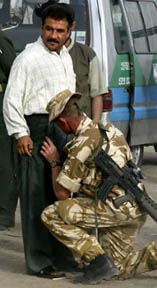
Well don't ever say the US Soldiers aren't doing anything to improve the lives of Iraqi citizens... And all this time I thought Bush was against gays in the military. Perhaps this is part of the new Rumsfeld "quick and easy" doctrine?
[via The Reverse Cowgirl]
June 09, 2003
Bush, You Can't Believe A Word He Says
"He's given his opponents a dream slogan - 'You can't believe a word he says'."
from t r u t h o u t - Spies Threaten Blair With 'Smoking Gun' Over Iraq
Now they are talking about Blair, but it may as well be Bush. I want to hear it repeated endless for the next 18 months. Repeat after me, "Bush, you can't believe a word he says."
Again now:
Bush, you can't believe a word he says.
That's right, you heard me.
Bush, you can't believe a word he says.
June 05, 2003
Reclaim the Public Domain
Sign the Reclaim the Public Domain Petition
And don't just sign a petition. Release your work to the public domain. I've been doing that with windistheenemy for almost 2 years now. Not sure about you, but I like giving gifts. And who better to give a gift to then the whole world?
Right Wing Terror
There have been five major U.S.-based terror attacks over the past decade: the Unabomber's campaign; the original WTC attack; Oklahoma City; the Olympic pipe-bomb; and finally 9/11. So if you measure by number of high-profile attacks, and not by body count, it's basically a draw right now: two attacks by right-wing nuts, two by Islamic nuts, and one by a radical Luddite. If two attacks is enough to throw hundreds of innocent civilians with suspicious-sounding names into jail for months, what are Ashcroft and Ridge planning for the far right? Fundraisers perhaps?
June 04, 2003
Swimming on Oil
Let's look at it simply. The most important difference between North Korea and Iraq is that economically, we just had no choice in Iraq. The country swims on a sea of oil."
- Paul Wolfowitz in Guardian Unlimited | Special reports | Wolfowitz: Iraq war was about oil
Christ, I almost have to respect Wolfowitz, despite all his evil, he at least shoots straighter then the rest of the Washington chickenhawk terror squad. The lies are coming out in the open. The question is, does anyone really care? My gut is that do care, but not on a scandal level. Come next years elections though, Bush is going to be in trouble convincing people to trust him though. He better pray for economic recovery fast...
May 31, 2003
Chain of Fools (Lying)
Been offline a few days and Billmon drops a brilliant collection of quotes documenting the "Weapons of Mass Destruction" story as told by all the big Bush administration players. Read it at the Whiskey Bar: What a Tangled Web We Weave . . .
mirroring it here as well to help spread the meme. Many, many thanks to Billmon for putting this together. Read his site folks its the shit, super sharp observations with a hilarious sting.
Whiskey Bar: What a Tangled Web We Weave . . .
Simply stated, there is no doubt that Saddam Hussein now has weapons of mass destruction.
Dick Cheney
Speech to VFW National Convention
August 26, 2002
Right now, Iraq is expanding and improving facilities that were used for the production of biological weapons.
George W. Bush
Speech to UN General Assembly
September 12, 2002
If he declares he has none, then we will know that Saddam Hussein is once again misleading the world.
Ari Fleischer
Press Briefing
December 2, 2002
We know for a fact that there are weapons there.
Ari Fleischer
Press Briefing
January 9, 2003
Our intelligence officials estimate that Saddam Hussein had the materials to produce as much as 500 tons of sarin, mustard and VX nerve agent.
George W. Bush
State of the Union Address
January 28, 2003
We know that Saddam Hussein is determined to keep his weapons of mass destruction, is determined to make more.
Colin Powell
Remarks to UN Security Council
February 5, 2003
We have sources that tell us that Saddam Hussein recently authorized Iraqi field commanders to use chemical weapons -- the very weapons the dictator tells us he does not have.
George W. Bush
Radio Address
February 8, 2003
If Iraq had disarmed itself, gotten rid of its weapons of mass destruction over the past 12 years, or over the last several months since (UN Resolution) 1441 was enacted, we would not be facing the crisis that we now have before us . . . But the suggestion that we are doing this because we want to go to every country in the Middle East and rearrange all of its pieces is not correct.
Colin Powell
Interview with Radio France International
February 28, 2003
So has the strategic decision been made to disarm Iraq of its weapons of mass destruction by the leadership in Baghdad? . . . I think our judgment has to be clearly not.
Colin Powell
Remarks to UN Security Council
March 7, 2003
Intelligence gathered by this and other governments leaves no doubt that the Iraq regime continues to possess and conceal some of the most lethal weapons ever devised.
George W. Bush
Address to the Nation
March 17, 2003
Well, there is no question that we have evidence and information that Iraq has weapons of mass destruction, biological and chemical particularly . . . all this will be made clear in the course of the operation, for whatever duration it takes.
Ari Fleisher
Press Briefing
March 21, 2003
There is no doubt that the regime of Saddam Hussein possesses weapons of mass destruction. And . . . as this operation continues, those weapons will be identified, found, along with the people who have produced them and who guard them.
Gen. Tommy Franks
Press Conference
March 22, 2003
I have no doubt we're going to find big stores of weapons of mass destruction.
Defense Policy Board member Kenneth Adelman
Washington Post, p. A27
March 23, 2003
One of our top objectives is to find and destroy the WMD. There are a number of sites.
Pentagon Spokeswoman Victoria Clark
Press Briefing
March 22, 2003
We know where they are. They're in the area around Tikrit and Baghdad and east, west, south and north somewhat.
Donald Rumsfeld
ABC Interview
March 30, 2003
Obviously the administration intends to publicize all the weapons of mass destruction U.S. forces find -- and there will be plenty.
Neocon scholar Robert Kagan
Washington Post op-ed
April 9, 2003
But make no mistake -- as I said earlier -- we have high confidence that they have weapons of mass destruction. That is what this war was about and it is about. And we have high confidence it will be found.
Ari Fleischer
Press Briefing
April 10, 2003
We are learning more as we interrogate or have discussions with Iraqi scientists and people within the Iraqi structure, that perhaps he destroyed some, perhaps he dispersed some. And so we will find them.
George W. Bush
NBC Interview
April 24, 2003
There are people who in large measure have information that we need . . . so that we can track down the weapons of mass destruction in that country.
Donald Rumsfeld
Press Briefing
April 25, 2003
We'll find them. It'll be a matter of time to do so.
George W. Bush
Remarks to Reporters
May 3, 2003
I'm absolutely sure that there are weapons of mass destruction there and the evidence will be forthcoming. We're just getting it just now.
Colin Powell
Remarks to Reporters
May 4, 2003
We never believed that we'd just tumble over weapons of mass destruction in that country.
Donald Rumsfeld
Fox News Interview
May 4, 2003
I'm not surprised if we begin to uncover the weapons program of Saddam Hussein -- because he had a weapons program.
George W. Bush
Remarks to Reporters
May 6, 2003
U.S. officials never expected that "we were going to open garages and find" weapons of mass destruction.
Condoleeza Rice
Reuters Interview
May 12, 2003
I just don't know whether it was all destroyed years ago -- I mean, there's no question that there were chemical weapons years ago -- whether they were destroyed right before the war, (or) whether they're still hidden.
Maj. Gen. David Petraeus, Commander 101st Airborne
Press Briefing
May 13, 2003
Before the war, there's no doubt in my mind that Saddam Hussein had weapons of mass destruction, biological and chemical. I expected them to be found. I still expect them to be found.
Gen. Michael Hagee, Commandant of the Marine Corps
Interview with Reporters
May 21, 2003
Given time, given the number of prisoners now that we're interrogating, I'm confident that we're going to find weapons of mass destruction.
Gen. Richard Myers, Chairman Joint Chiefs of Staff
NBC Today Show interview
May 26, 2003
They may have had time to destroy them, and I don't know the answer.
Donald Rumsfeld
Remarks to the Council on Foreign Relations
May 27, 2003
For bureaucratic reasons, we settled on one issue, weapons of mass destruction (as justification for invading Iraq) because it was the one reason everyone could agree on.
Paul Wolfowitz
Vanity Fair interview
May 28, 2003
It was a surprise to me then — it remains a surprise to me now — that we have not uncovered weapons, as you say, in some of the forward dispersal sites. Believe me, it's not for lack of trying. We've been to virtually every ammunition supply point between the Kuwaiti border and Baghdad, but they're simply not there.
Lt. Gen. James Conway, 1st Marine Expeditionary Force
Press Interview
May 30, 2003
Do I think we're going to find something? Yeah, I kind of do, because I think there's a lot of information out there."
Maj. Gen. Keith Dayton, Defense Intelligence Agency
Press Conference
May 30, 2003
May 27, 2003
The Evil Becomes More Transparent
"We are trying to change the tones in the state capitals - and turn them toward bitter nastiness and partisanship," said Grover Norquist, a leading Republican strategist, who heads a group called Americans for Tax Reform.
Christ.
Statements like these make me more and more of a Lakoff fan by the day. The problem with this right wing fight picking is that no one knows how to transform the dialog back into the realm of reason and community building. Luckily if the right wing keeps blustering like this they are going to stumble over their own rhetoric and fall straight into their decline. But how much can they ruin before they collapse?
[via Kathryn Cramer]
May 24, 2003
Build Your Own Cruise Missile
Build you own cruise missile for under $5,000. Very scary and pretty much inevitable.
The need to build a worldwide culture of nonviolence becomes more potent every day it seems. Bush and Company are running into the age of terror with the worst possible strategy, escalation. Scary shit, and the worst of it is that they are happy to use that fear they generate to increase their own power. A paranoid world filled with off the shelf cruise missiles, something ain't right.
[via pseudorandom]
May 22, 2003
Matrix, Agitprop?
Are the Matrix directing Wachowski brothers the biggest subversives in America? Well, if they are getting any sort of percent on the box office receipts then they certainly are the richest subversives not named Soros or (for the brief moment) Buffet.
Forget the action and the sci-fi minutia and ignore all the player haters while your at it, the untold story about the Matrix franchise is that its the biggest piece of leftist agitprop to hit the western mediasphere in years. And so far only Salon seems to be getting it. And they only touch on the beginning it (not to mention their bizarre enjoyment of the worst sex scene to grace an A list movie in years). In a time when Bush and Co are trying their best to make American's believe in a one dimensional world of us vs evil, the Matrix is an elaborately crafted vehicle for undermining the conservative message. And countless Americans are eating it up. I wouldn't be surprised if we saw the effects come the 2004 elections.
Hollywood is a left wing paradise with a big problem. Most of the major movie players lean heavily to the political left, but their bread and butter comes from pumping out Good vs Evil themed flicks that play directly into the Lakoffian moral politics of the right wing. Regardless of the explicit messages in a film, the very structure of a Hollywood Blockbuster leads to a reinforcement of a conservative world view.
The first Matrix had a pretty explicit leftist agenda: rise up and revolt against a rigid power structure, question reality, the wool is getting pulled over your eyes by those in control of the system. But that message was undercut by the reliance on the standard Good/Evil binary. For every person driven to question the hidden network of powers driving our world, there is someone who sees another example of the good guys beating the bad guys.
The Matrix Reloaded is out to shatter that trope and its far more effective at calling attention to the structures of power. Remember those hippie "Question Reality" bumper stickers? Well the Matrix is getting people to question reality on a scale that Timothy Leary couldn't even dream of when high off his premium LSD + bullshit blend. The left has been content to release memes into their own marginal subcultures for far to long. The Matrix unleashes memes into the heart of pop culture. "Choice is an illusion created by those with power to control those without", says the Merovingian and the Architect adds in: "nearly 99.9% of all test subjects accepted the program, as long as they were given a choice, even if they were only aware of the choice at a near unconscious level."
The way the Matrix Reloaded points out the multiple layers of control built into society is perhaps the most potent of the messages it carries. Its one thing to make people aware of the first layer of control. Its far more powerful to make them aware of the way that a built in "resistance" can be used to solidify the power structure.
These are powerful seeds for any campaign to make the American public aware of the way the Bush administration is using the rhetoric and the media to sell a system of control. The left has been pushing these ideas for decades now, and general public couldn't give a fuck. Thanks to the Wachowski the ideas are now seething through the subconscious of the suburbs. And its far to soon to guess at what the ramifications are.
Six months from now, when the Matrix Revolutions hits theaters, we'll have a much better sense of it all. Most exciting to me are the indications that the Wachowski's are ready toss the Good/Evil binary out the window in a big way. Neo is the hero of the series so far, but everything else is way less clear. (*Spoiler Alert*) Who are the bad guys though. The Agents are now apparently on their own, at least those without earpieces. Morpheus is now a deluded fool of a leader. And where the Oracle, Merovingian, Persephone, Locke and the Architect fit into it all is up in a cloud of mystery. Perhaps it all collapses back into a nice binary, ala classic Hollywood. But I have a feeling we are in for something more complex. Perhaps a Princess Mononoke style peace making is in the offering.
Regardless of the binary, the leftist agenda is pretty advanced already. The Berkeley wet dream make up of the Zion Council, the Baudrillard references, the Cornell West guest appearance, the unverified anti-Bush jab, the corporate blandness of the Agents, the pro revolution plot-lines, etc, etc. Six more months and we'll find out exactly how extensive the agitprop goes.
Premium Propaganda
Some premium left wing Propaganda via nettime. No idea who is behind this but it pretty clear its a liberal pretending to be a Republican. Well done although I don't know how many Republicans would actually buy the argument or forward the mail. If it works its a really nice trojan horse designed to raise doubt in the minds of hawks everywhere (in America). I'm archiving it here.
Dear Fellow Republican,
Because claims continue to grow that Vice President Cheney knew about and
allowed the September 11, 2001 attacks for political and strategic gain,
the Republican Party needs your moral and financial support more than
ever.
Liberals are spreading over a hundred accusations that our Vice President
of the United States of America knew about and allowed the 9/11 attacks.
Fellow Republicans, we recommend not directly addressing all the details
spouted by liberals and their bleeding heart press. During a recent
prayer meeting here at Patriotic Citizens for the Defense of American
Values, deep inspiration and humility moved us to develop a special answer
to the mounting liberal propaganda. We call our answer the "Daisy Cutter
Moab Rebuttal."
Here it is: "Even if Vice President Cheney allowed the attacks on the WTC
and Pentagon, he did so for the good of the nation. Franklin Roosevelt
did this when he allowed the Japanese attack on Pearl Harbor so the United
States could join the war against the axis of evil of that era." (Use in
#13 below.)
Because liberals love Franklin Roosevelt so much, this answer shuts them
up quickly.
Only a true leader can make the toughest decisions in order to lead his
nation to its destined greatness. Even if our President allowed the
attacks of 9/11, this proves Bush is an even bigger hero for allowing Vice
President Cheney to make such a tough, necessary decision. We elect our
leaders to lead, not flirt and carry on with interns. It was President
Bush's amazing post-9/11 leadership that unleashed the American people to
free others around the world, including oppressed women in Afghanistan and
Iraqi victims of Saddam Hussein.
You can help. Our views will win over liberal propaganda regardless of
their so-called evidence.
Please donate to the Republican party to protect the truth from the
snooping eyes of the unrighteous (liberals).
Thank you,
Patriotic Citizens for the Defense of American Values
LIBERAL LIES and FACTS
**************************************
Liberal Lie #1: In October 24-26, 2000, detailed drills were held in the
Pentagon practicing response in case an airliner crashed into the Pentagon
building.
FACT: If God inspired the planners at the Pentagon to prepare for an attack
on their building nearly one year before the September 11, 2001 attacks,
they should be commended, not cast into suspicion.
********
Liberal Lie #2: Field FBI agents in Arizona notified their superiors of
information about hijackers using planes as suicide bombs, but the superiors
didn't act on this information.
FACT: The FBI management can not act on every wild claim made by field
agents.
********
Liberal Lie #3: In 1995 the FBI under Clinton's administration raided
flight schools looking for potential hijackers. The FBI and other gov't
agencies already knew of this specific real danger.
FACT: In government, six years is a long time and with all the FBI
personnel changes, the agency was unaware of its past diligence. It is
impossible a few high-ranking members of Herbert Hoover's esteemed FBI along
with other high-ranking officers from other U.S. intelligencies would betray
their own country by blindly following heinous orders to allow a mass attack
on their own country's civilians. Some agents would be truly patriotic
enough to risk even their own lives to uncover such a high-level crime
against the people of the United States of America.
********
Liberal Lie #4: A United States Air Force Intelligence Colonel at the
Monterey Language Institute U.S. Intelligence School told his class, "Bush
is a joke. He knew about 911 and let it happen." He was forced to resign.
FACT: Though this did happen, similar outbursts by military personnel about
gays in the military occurred under President Clinton. Those critical
officers also resigned.
********
Liberal Lie #5: Before 9-11 a con-man working for Navy Intelligence fled to
Canada with a sealed document showing the impending attacks by suicide
hijackers.
FACT: This person is clearly a con-man, and though he worked for the U.S.
Navy, he is unreliable and has a long criminal history during his entire
service in the United States Navy. This exposes him:
http://www.scoop.co.nz/mason/stories/HL0210/S00005.htm
********
Liberal Lie #6: Russian and other foreign intelligence agencies warned the
Bush administration in the summer prior to the 9-11 attacks that hijackers
intended to use planes as suicide bombs and were soon going to attack.
FACT: Foreign intelligence sources frequently notify the United States
about many so-called impending attacks, most of which never happen.
********
Liberal Lie #7: Ashcroft and some other government officials did not fly
commercial flights in the weeks leading up to 9-11 for fear of being on a
hijacked plane.
FACT: Ashcroft and others as citizens of the United States of America are
free to choose any method of transportation within their means and legal
rights. They stopped flying commercial for scheduling reasons and their
heavy workload.
********
Liberal Lie #8: Mayor Willie Brown of San Francisco was warned a few days
before 9-11 not to fly to New York on a commercial aircraft as he had
planned.
FACT: It is illogical a so-called Republican conspirator would call a
liberal Democrat Mayor to help him.
********
Liberal Lie #9: Vice President Cheney wanted to take over parts of the
Middle East and boost the his administration's sagging popularity. An
attack would fulfill both.
FACT: This accusation of treason against the Vice President should not
even be dignified with a answer.
********
Liberal Lie #10: U.S. armed forces were massing in the Middle East in the
weeks and months before the 9-11 attacks.
FACT: Though true, the forces were involved in a large military exercise.
Such U.S. military exercises occur regularly throughout the world. This was
only a routine military exercise.
********
Liberal Lie #11: The head of Pakistan's Intelligence agency (the ISI) was
in the United States meeting with Condaleeza Rice and others in the Bush
administration in the week before the 9-11 attacks. During that week this
Pakistani General wired $100,000 to hijacker Atta.
FACT: Pakistan is our ally, not our enemy. Iraq was our enemy, but we
liberated them and rid them of weapons of mass destruction and thwarted evil
in God's name.
********
Liberal Lie #12: A few years prior to September 11, 2001, Philippine
police discovered a document outlining suicide attacks with hijacked planes
in the United States. The Philippine police officer who found the document
gave it to police commanders who passed it to U.S. intelligence.
FACT: It is completely understandable and expected that such a document
would get lost on its way from a Philippine police officer through the
Philippine government then to the United States then through the US
Intelligence community. This happens all the time.
********
Liberal Lie #13: Families of 9-11 victims threatened the Bush
administration with going public with their questions about 9-11 after the
Bush administration stonewalled an independent 9-11 inquiry. The
Administration responded by backing an investigation led by Henry Kissinger
and by stalling the whole process. President Bush is terrified of an
independent inquiry into 9-11.
FACT: Use the "Daisy Cutter Moab rebuttal," which we feel is more
effective than diving into liberal-minded detail: "Even if Vice President
Cheney allowed the attacks on the WTC and Pentagon, he did so for the good
of the nation. Franklin Roosevelt did this when he allowed the Japanese
attack on Pearl Harbor so the United States could join the war against the
axis of evil of that era."
********
Liberal Lie #14: Attorney General Ashcroft is secretly using the powers of
the Patriot Act to investigate Vice President Cheney and others in the Bush
Administration for treasonous actions against the citizens of the United
States of America regarding the 9/11 attacks. Some members of Congress and
the Senate are also being secretly probed under the Patriot Act.
FACT: Completely false. Attorney General Ashcroft is an honest Christian
and loyal Republican committed to the cause of anti-abortion. To suggest
the Attorney General of United States would secretly investigate treasonous
crimes perpetrated by his Republican superiors is ridiculous regardless of
so-called liberal evidence. True Christians follow orders and are always
loyal to their bosses. The rumors regarding this are just that: rumors.
This is completely false.
********
To waken you and your friends to action, please rebut the liberal
propaganda. To view the details of their plot, study the following, but
only if you're over 30 years old (the age of Jesus when he started his
mission) and a committed Republican. Do not view otherwise!
http://www.communitycurrency.org/MainIndexMX.html
http://www.fromthewilderness.com/free/ww3/02_11_02_lucy.html
http://www.globalresearch.ca/articles/MOO208B.html
http://www.guerrillanews.com/after_math/
***********************
WE SALUTE the brave men and women behind the scenes in the ONI, FBI, NSC,
NSA, CIA, MCIA, AIA, OIG, DIA, USAIC, USSS, OFAC so willing to risk their
lives for their country and every bit as brave as single and married combat
soldiers on the front lines. Their courage to serve the U.S. Constitution
and U.S. citizens even when their superiors command otherwise protects our
democracy. This commitment prevents our agents from serving evil by
covering up internal high-level crimes against their country and fellow
citizens. Only athiests and the guilty fear the truth. God is Truth. Life
is short, and our agents are committed to doing the right thing. They are
part of the solution, not the problem. To paraphrase Jesus Christ in modern
language, "Real psychopathy is not the snapping, it's the ability to
maintain a calm presence and give plausible explanations to implausible
events." Matthew 23:27-28
***********************
* Warning: Do not be fooled by liberal hoaxes trying to stop this message
by claiming it is a virus.
* Neither this email nor the Patriotic Citizens for the Defense of American
Values are authorized by or affiliated with the Republican Party, but the
Republican party needs your financial help and prayers more than ever.
* "Daisy Cutter Moab Rebuttal" is not a trademark of Patriotic Citizens for
the Defense of American Values, but can be used by Republicans only.
May 20, 2003
Emergentism
Mitch Radcliffe is turning Emergent Democracy into a book. He outlines his key ideas on his blog. Good and interesting stuff although and he's got a degree of the over-optimism I see in a lot of Emergent Democracy discussion. No one is really dealing with the fact that the same tools that could lead to democracy can also lead to its corruption of downfall.
Now I'm all for optimism and positivism, but I like mine cut with a nice dose of pragmatism and an occasional dash of the paranoid critical method. What I find most telling is that no one has yet to really define what they mean by "emergent". There are a handful of attempts to bound the concept, but the term is kept vague enough to let everyone imagine their own particular version of it. Straight from the failed buzzword cookbook. Pitch a concept that sounds cool and new and structure it in a way that it triggers future fantasies. Let people run with concept while everyone pushes their own poorly defined vision. Enjoy it while the bubble expands.
Now like many buzzwords there is some really meat hidden in the concept. But until the idea is broken down to its seed, its not going to grow, its going to pop. Radcliffe does a good job bounding the concept of Emergentism, which is a nice start. But there still is no definition, and that's a problem.
Lesson From JFK
I'm not a big fan of "what if" history, but this argument as to why JFK might have stopped Vietnam has something more then just an overactive imagination. It has real facts, the kind they don't teach you in school. And it makes me a touch annoyed. In 1982 it was revealed JFK cut a deal with Khrushchev to pull missile out of Turkey in exchange for the removal of those from Cuba, against the advice of all his advisors. In 1982 I was in 2nd grade. You'd think that info would have made my high school history books. Guess not.
Back to 2003, we've got our own right wing low rent JFK in the White House. And his advisors sucker him left and right, day and night. Sad. Wonder how history will rember Herr Bush?
[via Calpundit]
Occupied Iraq (Permanently?)
Back In Iraq 2.0: U.S., Britain put off Iraqi self-rule "indefinitely"
Wow what a double edged sword. Signs increasingly point toward the neocons having no idea what they were getting themselves into. The Rumsfeld doctrine of fast, cheap and light troop commitments is getting disposed of quicker then an aged jim hat. I agree with Allbritton that at this moment this is actually better then fleeing the country ala Afghanistan. But unless the US is ready to drop the cash to really rebuild the Iraqi infrastructure there are no long term benefits.
Something that I haven't seen mentioned yet is how fragile Saddam's regime appears to have been. Could he have been toppled without mounting an invasion? We'll never know. But I have a feeling a well planned subtle long term plan could have gotten him out of power within a few years. Without the massive infrastructure collapse, and without exposing the Iraqis to the crude hands of US troops.
May 19, 2003
The 5 Principles of Rovean Newspeak
So the NYT goes into constructing the president's media image. Time to go a bit deeper. Mike Malloy breaks down the way Bush's speeches sell terror and government control. Its an audio file, and its well worth a listen. Take note that I am pretty biased against audio online, I'm much happier reading on my computer. This sound file is pretty potent though, check it out.
Building the Presidential Facade
Keepers of Bush Image Lift Stagecraft to New Heights
All Democratic presidential candidates should read this religiously and learn every lesson. The 21st century president exists mainly in the media, and any winning candidate is going to have to embrace that fact.
May 15, 2003
War Comes Home: DHS vs the Democrats
Homeland Security Department Used to Track Texas Democrats. You know the department that's supposed to protect us from foreign terrorists, and never used for domestic partisan politics. Yeah that one. The Bush Administration loves war, and I have a strange sense they are going wind up bloody from their bloodlust sooner or later.
[via bIPlog]
May 12, 2003
Hope
Wow, this one brought tears of hope to my eyes. 16 years ago Oral Lee Brown, a real estate agent making $45,000 a year, told 24 first graders she would pay for their college if they graduated from high school. In a school district where 75% of high school freshmen dropout, 19 of those first graders went on to college, and the first has just graduated.
A rich as America maybe there are still areas of extreme poverty, areas where hope and encouragement are in short supply. And this shows just how much that hope and encouragement can make a difference. Lets never forget that.
Struggle, support, sheepskin / Oral Lee Brown's 1st-graders reach for finish line
[big thanks to Thomas Vander Wal for linking to this article]
Graham Accuses Bush of Cover-Up
Presidential candidate and former chairman of the Senate Intelligence Committee Bob Graham, just skyrocketed in my personal approval ratings by accusing Bush of a cover-up in the 911 investigations. Lets see some light shined in this direction, please?
Moral Paine: George Lakoff Interviewed at Tom Paine
Great George Lakoff interview, part 1
[via - forgot where, sorry]
Hot Damn Its Political Warfare in Texas
52 (or 53) Texas state representatives have fled the state in order to shut down the Texas House, blocking the passage of a controversial redistricting bill. They are subject to arrest in order to be brought back to the House chamber in order to restore quorum, allowing for the House to legally operate.
In other words its all out political warfare, as some politicians are finally ready to stand up the Bush Administration's abuse of 911 to cement their power. I support them big time.
[via the Political State Report: straight from the trenches]
May 09, 2003
Beyond Friendster: Openness and the Future of Social Networks
Posted this at marginwalker.org, reprinting it here for your info and my archives.
There has been a lot of talk of Friendster and its kin in the network lately. The sharpest of the observations so far comes from Marginwalker's co-founder Adam Greenfield. As usual Adam's observations are right on the mark. However his conclusion throws me off a bit:
Something tells me these services won't reach their maximum potential until they can incorporate our less salutary feelings about association: the latent but powerful distinctions we make, the dislikes and fears we, however subtly, import into our presentation of self. These are precisely the shadows we may have "gone online" to escape in the first place, but they are a part of what we've always meant by "social," they serve a function evolved over a very long span of time, and I believe we ignore them at some disservice to our ambitions.
Now Adam may very well be right, but I really hope he isn't. We have the ability to use services like Friendster and its descendent's to effect profound changes on the make up of society. Instead of giving into the base discrimination (or "shadows") we incorporate into our daily life I think we should be using technology to eliminate the subtle biases that underlie our culture and selves.
Openness is a potent tool. The public emergence of homosexual culture over the past 35 years provides a telling example. Before Stonewall gays and lesbians stayed hidden from society. And as a result homophobia was able to flourish. You can be certain a lot of homophobic conversations took place in front of closet homosexuals who were too afraid to speak out. Now in 2003 the stigma of homophobia, while still present, is rapidly fading. Major presidential candidates are making gay rights a campaign issue in America, and only the far right gives a damn. Its pretty damn hard to be homophobic when you become aware of the fact that a handful of your friends happen to be gay. And at least in urban America its pretty damn hard not have a handful of gay friends.
The very openness that Adam takes offense too in Friendster, to me is an engine of social change. It forces us to reevaluate some of our hidden prejudices and calls into question some of the forces that segregate society. Now its entirely possible, as Adam seems to imply, that when faces with this sort of info, people will just look upon their friends for the worse. But I personally believe that in the long run the results would be positive. There is a mess of small discriminations that drive many of our social interactions. And when placed into larger contexts they just look silly.
Sousveillance is a term, coined by Steve Mann, which has been gaining some buzz of late. Its roughly the opposite of surveillance. Instead of a power watching over the people, sousveillance is the people watching over a power, and as a corollary watching over themselves. The openness that the architecture of Friendster creates is an integral part of a sousveillance society. And we as a culture are going to have to either learn to embrace the openness or attempt to make it go away.
This is all part of a larger emerging conflict between transparency and privacy, and we are going to dealing with the ramifications for a long time. But for the moment what I'm really interested in is how do we build better social networking technology? Adam is probably right that Friendster, LinkedIn and company are just the beginning and I agree that the ideal solution is an open source one. An open social networking standard which permits people to choose and build their own interfaces. I think some standard will inevitably be emerging in the next few years, and hopefully its not a proprietary one.
The question I have is what do we want this network to do? Is it there to cement our social networks and further our interactions within them, or is the goal to open up our social boundaries and push us towards new cultural understandings? These are delicate lines to walk. And if we build the right structures I think there is a tremendous opportunity to change society for the better. But there is a constant threat of building the opposite, tools which reinforce existing inequalities. How do we ensure we do the right thing?
May 07, 2003
Salam Pax Returns
Only read a bit so far, loads of stuff written from Baghdad during and after the war. Extremely interesting so far. You just can't get this stuff anywhere else.
"If You Want To Win An Election, Just Control The Voting Machines"
Never heard of Thom Hartmann before, but he's seems very smart and is definitely a prolific writer. And he writes of some scary stuff in this article.
It verges towards conspiracy theory, but the threats are real. What threats? The rigging of elections through privately owned voting machines. At the absolute least some more light needs to be shined in this direction. More details to come I hope.
May 06, 2003
Why the WMD Matter
So they still haven't found those weapons of mass destruction. Who cares? Honestly I was as ready to forget about it as rest of America is, until this post showed me the spin.
We don't know if Iraq ever had the WMD, but that's not that relevant as we know that Bush and friends stated very clearly that Iraq had them. And if Bush says it, it must be right, yes? Now if we can't find them, and they exist, that means they went someplace. And that someplace could very well be in the hands of a terrorist.
Now if the goal of the war was to get the WMD out of bad hands, then that means we lost (nevermind that they never existed). Bush's war increased the danger of terrorism to the US. Bush's war put us American citizens in greater danger.
Now I'm no spin master, but if the Dems could spin it like that... Of course they seem to have forgotten the art of spin as of late. Not to mention the off chance the WMD are already in Rove's office being prepped for the right PR oppurtunity...
American Dialectic
Damn, the bar is raised. Billmon gets serious and god damn has he done it right. A treatise on the dialectic of American political history. A long read but worth every second. All that stuff you've forgotten in school, put into a dialectical context and uploaded to the web. Refreshing.
Whiskey Bar: The Dao of American Politics, Part I
May 05, 2003
New Blog: State of Emergence
State Of Emergence is a new blog I've started. For politics only. Everything posted there will also be posted here, so there is no need to read the new blog if you read this one regularly. However if you are only reading this blog for the political content you'll probably be happier just reading State Of Emergence.
Reflections on the First Democratic Presidential Debate
Just watched the first presidential debate among the Democratic Party challengers. A pretty interesting affair all told, although the candidates all have their blandness...
I missed the beginning which I think featured some Kerry vs. Dean scrap, but caught most of the action (or at least I believe I did, I've avoided reading much about it as I want to write down my reactions before comparing them to others).
No strong winners or losers other then Kucinich who was already a loser, so he doesn't count. I think the closest thing to a winner was Gephardt and Kerry was the closest to a loser. In terms of Washington insiders with legitimate chances at the nomination, Gephardt really seems like the pick. Of all the candidates he simply looked and acted the most presidential. Had a sort of golden glow to him, real comfortable on TV acting like a leader.
Kerry on the other hand looks like the leader of a failed opposition party. He's one ugly ass prick, he doesn't stand much of a chance against Bush. He's straight out of central casting as the loser in this election movie, way too skinny and wrinkled. Still don't like Gephardt much, but I'm a lot more comfortable with him as a nominee then I had been. Add in the fact that he's from the South/Mid West and much more down to earth then Kerry and I think he's a much better candidate. Have a feeling Kerry's front runner status is about to disappear quickly. On the flip side though, Gephardt also looks strangely like Al Gore, but without any of that cold robot quality. Actually he looks sort of like a cross between Gore and Bush, really strange.
Edwards and Dean are the wild cards. Edwards really needs to step up a level, he's just not reaching his potential. Needs to gain a few pounds for the camera for one. There were a couple points when he started talking about his childhood where his empathy really started to show through. He's got some of that Clinton "I care for you, and can solve your problems" magic in him. But he needs to be pumping it out non-stop if we wants to be a contender. Its just not flowing consistently yet. He also looks really young.
Dean is a strange one. He needs some serious training in front of the camera, he's got to be looking the audience in the eye. His straight talking rep didn't manifest itself. Nothing about him really rose him above the rest of the pack, with one exception. He has perfected the psychological trick of getting the audience to view him as president. He talks like he's already nominated or even in the White House, dropping references to the "Dean administration". I've seen it in some of his writing too. Good stuff, straight out of the hypnosis handbook. The Republicans are good at that sort of manipulation, lets hope the Dems can get it down too.
Graham is a joke, he looks like a picture perfect corrupt fat cat insider. Sure he could win Florida, but he'd lose half the states Gore won. His hyper hawk position makes him completely irrelevant anyway, no way will he win a democratic nomination. There was one segment where all the candidates could ask one question to one other candidate, almost all where directed to Graham. The reason? Because everyone knows he's not a threat but he looks more serious then the other joke candidates, so he was the perfect way to not give extra TV time to competitors.
As for the jokes, anyone have any idea where Lieberman got it into his head that a short, ugly, ultra right wing, orthodox Jew could ever become the Democratic nominee for president? I have news for him, he can't.
At least Sharpton and Moseley-Braun know they don't have a chance. I've been a Sharpton fan ever since I saw him speak when he ran for NY mayor. He's probably the best speaker I've ever seen. He's running because he has an agenda he wants to push and I'm all for it. If he keeps attacking Bush and then pushing his issues, he can only help the Democrats and America's cities. He had a great line about Bush's tax cuts. "Its like getting Kool-Aid from Jim Jones, it might taste sweet, but it'll kill you". He'll never get the nomination, but there are definitely some strange scenarios where he'd actually be the best nominee, he's the only one who really seems to have the skill to lyrically devastate the Bush agenda and show the world just how bad it is.
Like Sharpton, Moseley-Braun also has an agenda, but sadly the agenda is to advance herself. Actually there is a bit more, I think she's out to rescue the image of black women from the horror of Condoleezza Rice. And that's fine by me. She's damn a damn smart women, and I think its a good thing for the Dems to have someone like her in the race. As long as she doesn't attack the other candidates its good to have a black women running, at least at this stage of the campaign. Hopefully she'll resign at the right time. She's putting herself in a good position for a cabinet post, smart woman, I respect that.
That brings us to the bottom of pile, Kucinich the loser. I had no idea before today that Cleveland went bankrupt while he was mayor. And now that I do I don't ever want to here a thing about him. How in the world can you even try and run after that sort of fiasco? You better have done something mighty impressive to make up for it, and Kucinich sure hasn't. On top of that he looks and acts exactly like a rat, I could practically smell rodent through the TV. He represents some far left ideals that really should be represented in the race, but all he can do is make those ideas look worse. He's exactly the wrong person to be representing anything, and he really needs to get out of the race.
Final thoughts? If John Edwards can step up and start running a strong campaign then I think he's the best candidate out there. He has capability to be a truly charismatic leader. But its really unclear if he can live up to his potential. If he can't I think Gephardt and Dean are the two best picks. Its still unclear if either of them really have what it takes though. Kerry is clearly overrated, and due in for a crash soon, I hope. He maybe could win if Bush keeps destroying the economy at record pace, but when it comes to insider power players Gephardt is a better candidate. All in all there is a bit of hope showing through in this debate, but not much. Its early still...
May 02, 2003
The Bush Administration Admits Inspections Worked?
"He couldn't put them together as long as the inspections were going on" before to the war, he said.
That little gem, attributed to a "senior administration official" is buried at the very end of the NYT cover story on Bush's 'War Over' speech.
Now lets think about it. If Iraq couldn't assemble its weapons of mass destruction because of the UN inspections, doesn't that mean the inspections were working? I think it does. Wonder if the senior official is a black man from the Bronx?
May 01, 2003
Mind Opening Blog + Humane Punishment
Mind open, mind blown. Every once in a while I come across some fact, story or writer who really blows open some of my worldview.
Al-Muhajabah is a white American woman, highly educated, very sharp and who is a devout muslim who wears the complete islamic dress (hijab). That adds up to a pretty unique perception of the world. Very opening to read her blog (if you let yourself be open of course). Plus she's a Movable Type master, all sorts of really well thought out plug-in implemented on her site.
Her post on issues in penal law hit me hard:
It's taken as a given in America that prison is far more humane than corporal punishment. But is it? The body heals; the mind and the soul may not. When we consider whether the prison system is humane we should look at the psychological damage caused by captivity. It's not as easy to measure as physical damage, but it may be far worse and more lasting.
So true, but I never would have thought of it like that in a million years. I have serious issues with the current American penal system, but I still was locked into a knee jerk corporal punishment = evil thought process. Now I still don't like corporal punishment, but I don't think I'll ever be thinking about it in the same way again. Damn, I love having my worldview widened...
April 30, 2003
They're Only Evil When They're Not Repressing Their Wifes..
"It so happens there are times when there are issues where social conservatives, whether they be Muslim or Christian, find common ground."
Iran, Syria, Iraq, Axis of Evil. Yep, unless its about repressing women. All of a sudden they become our best friends in the UN. Perhaps Bush and Co want to fight with all them because jealous of the way they mix politics and religion and get to beat their wifes. How fucking backward is this country going to be after another 1-5 years of this crap? We'll be acting like cavemen soon enough. Christian cavemen.
[via Matthew Yglesias]
Headline Flow
Ethan Eismann maybe on hiatus from blogging with Information Flow, but he did post some really interesting stuff on a mailing list we belong too.
Headlines around the world an incident in Iraq. I believe taken from Google News last night:
US Force Said to Kill 15 Iraqis During an Anti-American Rally
New York Times - 16 hours ago
US Troops 'Massacre' 13 Iraqis
The Mirror, UK - 8 hours ago
US troops 'shoot dead two more Iraqis'
Guardian, UK - 3 hours ago
Iraqis say US troops killed 14 protesters
San Francisco Chronicle, CA - 5 hours ago
US troops take fire, shoot back at Iraqis
Casa Grande Valley Newspapers, AZ - 12 hours ago
US forces kill 13 pro - Saddam protesters
Hi Pakistan, Pakistan - 13 hours ago
A good reminder that media bias is certainly not all structural...
Another Gem at the Whiskey Bar
Whiskey Bar: The Doctor is in - billmon keeps rolling. No idea who he really is or what he does, but he writes some of the funniest, sharpest political comedy around.
April 29, 2003
Fabrica Ocupada: Naomi Klein on Argentina's Quiet Revolution
Here in Buenos Aires, every week brings news of a new occupation: a four-star hotel now run by its cleaning staff, a supermarket taken by its clerks, a regional airline about to be turned into a cooperative by the pilots and attendants. In small Trotskyist journals around the world, Argentina's occupied factories, where the workers have seized the means of production, are giddily hailed as the dawn of a socialist utopia. In large business magazines like the Economist, they are ominously described as a threat to the sacred principle of private property. The truth lies somewhere in between.
Naomi Klein: Snapshot of a nation: Argentina
There is a revolution going on in Argentina and only Naomi Klein seems to be noticing. This is Klein at her absolute best. My take on her has always been that she's a marvelous journalist and a god awful theorist/figurehead. And now that's she's playing journalist again the results are great. No one reports better from the front lines of corporate globalism then she does. Read the whole article, its worth it. If the world economy doesn't U-turn soon then this piece is a crystal ball.
April 28, 2003
The Structure of Media Bias
The Liberal Media, the Conservative Press, which one is it? I find it interesting and sometime amusing the way liberals and conservatives always seem to think that the media swings the other way. I once thought it was a nice indicator of a relative balance in the media. And the media is a bit more balanced then many give it credit. But there is something else, something structural, let me break it down.
There is a strange dynamic inside our most popular media of today, minus the internet and books. That means TV, movies, radio, newspapers and magazines. Those 5 media have a structural bent towards conservative messages. But counteracting that bent, is a tendency for the staff to lean a bit liberal.
The typical result? A liberal leaning reporter trying to act balanced, but producing a story that comes off with a bit of conservative edge to it. The dynamics are easiest to see in Hollywood. Politically the players in the movie industry on average are strongly to the left, and they contribute mainly to the Democrats. But somehow a fuck of a lot of patriotic movies with strong moral messages come out of system.
Why? Because the conservative approach of pushing strong simple moral messages is tailor made for movies. It makes a nice strong ending to the story. Same goes for TV spots, newspaper headlines, and magazine covers. Simple, basic and familiar but dramatic. Its the conservative way. The structure of these media encourages the right wing worldview to show through on the simplest level.
However, the traits that make good reporters, actors, directors, editors and the like are more in tune with a liberal world view. Creativity, rational thinking and detailed exploration of stories. The nurturing liberal worldview breeds these ideas and encourages liberal reporters. Hence the "liberal media". And in times of slow news, the questioning liberal worldview slowly takes over the tone of the news.
You could see it in GW2 when news was hot and running quick the tone was pro-war, celebrating the moral clarity of soldiers heading to battle. A couple days later as things settled in, the questioning and exploration of the darker sides would return. And then bam! more war motion and the bombastic conservative headlines were back. Slow down, more liberal, explode fast, more conservative. Cycle. Repeat.
I have a feeling this sort of dynamic has been around for a long time. What's different now is that the Bush administration has a great feel for the rhythms of media, and have been timing there actions remarkably well. Their over the top conservative rhetoric and action is pace perfectly for maximum US media exposure. They understand the structure better then the Dems and it shows. And the advantage is huge. The left just doesn't have the rhetoric to win in the game of overblown headlines. Their arguments are better suited for a slower more reasoned environ. Its no coincidence that the lefts biggest media victory of late, the downfall of Trent Lott, came during the slow news time around Xmas. The Left needs to throw off the Bush administrations rhythm and slow the pace down. Summer is dead when it comes to news, and they'll need to maximize that to their advantage. And come Fall its all about setting the pace, whoever does it going to control the media game.
April 26, 2003
The Bush Media Silencer Strikes Again
Sharon Bush is moving on. One week after the grueling two-day mediation that sealed the deal, Bush is turning philosophical about her split from presidential brother Neil Bush.
She won't be writing a Bush family exposé after all. "You know I'd never write a hateful tell-all," she said Tuesday...
As for her post-divorce financial situation, Bush said Tuesday, "The grandparents (former President George Bush and Barbara) have been good to me and to the children."
HoustonChronicle.com - Bush ex-inlaw decides not to spill
Ok, lets paraphrase. After a nasty split with her husband Sharon Bush threatens to write a tell all exposé of the family. Papa Bush steps up and makes it clear that isn't an option, and tosses in a pile of cash to sweeten the deal. This stuff is old hat the Bush family. Nothing gets written about them. Those that try have a habit of dying... or at the least staying out of print. (note to self if you plan on writing a Bush bio it pays to be a loony who is down with Lyndon Larouche.)
April 25, 2003
Not Lying...
"We were not lying," said one official. "But it was just a matter of emphasis."
That's from ABCNEWS.com : Officials: 9/11 Was Main Reason for War. Not that I'm happy about it, but it does fit in with my thesis on The Art of Lying in Politics. Point 3, never admit that you are wrong. How true. If you are more concerned with manipulating the public via the media then with keeping friend and making diplomacy that is. The Bush administration continues to work the media effortlessly. More on that soon.
Analogy of the Day
Being Senate majority leader is akin to being grounds-keeper at a cemetery; you have a lot of people under you, but they aren't paying much attention.
[via Semi-Daily Journal]
On Santorum, Resign Now
Think its pretty evident that Senator Rick Santorum should be resigning from office, effective immediately. If he has any sense of decency that is. What a disgusting and morally repugnant creature. Couple quotes from the now infamous AP Interview:
In this case, what we're talking about, basically, is priests who were having sexual relations with post-pubescent men. We're not talking about priests with 3-year olds, or 5-year olds. We're talking about a basic homosexual relationship.
So let me get this straight a priest using his position of authority to molest a 12 year old boy is "a basic homosexual relationship"? Don't know what world Santorum lives in, but he needs to leave the world of the Senate pronto.
Lets not even get into his man on dog comments...
Course Bush is fully behind this sort of repugnant immoral homophobia:
"The president believes the senator is an inclusive man. And that's what he believes," Fleischer said.
So I guess inclusive now means you are willing to group homosexuals with pedophile rapists priests and bestiality, I think I'm going to be sick.
Let me say it again. Senator Santorum should be resign and resign now.
Bush, that is a whole other story...
[links via DailyKos]
April 24, 2003
When the Shiite Hits the Fan at the Whiskey Bar
I knew I was going to link to it just for the title, but Billmon has really topped himself with, When the Shiite Hits the Fan. Get this man a sitcom or something...
April 22, 2003
Michael Wolff on Al Jaz
"Al Jazeera, like so much else in the region, becomes part of an Americanization machine." Michael Wolff's latest column,
Al Jazeera's Edge digs into the breakout network of the GW2. Good stuff. His point is that Al Jaz is a business, a TV station. What grabs me more then that though, is that its making money by selling a political viewpoint. On a similar note is Mecca Cola, pitched as an alternative to Coca-Cola.
Both are examples of something, I've been thinking about a long time, the commercial viability of ideology. I call it Revolutionary Capitalism, and there will be more coming in the near future.
The Coming Iraqi Civil War?
In the previously mentioned A Farewell to Arms post, Christopher Allbritton talks about a rumor going round Iraq:
The marchers in Baghdad demanding a quick end to American occupation, he said, were incited by Ahmed Chalabi and the INC to stir up trouble against the Americans, so they will leave and the INC can seize complete control.
Now Chalabi is the neocons man in Washington/Iraq. His position of being the next potential leader of Iraq arose due to his extensive DC connections and lobbying. No idea if that rumor is true, but if it is then Iraq is going to get really nasty real soon. If even Chalabi wants the US out, then imagine what others think? As Allbritton points out there are a lot of ethnic groups, tribes, religions and invaders involved here. And they all want their power in a limited space.
Messy indeed. Lets see how Bush, Rove and company handle the news. More Afghanistan style ignoring I expect. But the stakes are larger in Iraq will the media be willing to step up and report? Unlike some who have given up on mainstreams media's ability to criticize the current administration I have some hope left. I think a good deal of the mainstream Bush dickriding that went on during the war was the product of the media's laziness combined with good timing on the part of administration PR machine. The admin PR people where able to keep creating new news events for the media. And since the media is lazy they went for the easy story. After a couple slow news days you could see the more balanced reporting return. But then the PR machine would hit back with new stories. Return to lazy media.
Now generating stories is hard work. Especially without an army of 300,000 people working for you to create some news. I have a feeling that the media will start hitting harder when slow news periods emerge. All of a sudden they'll need to investigate a bit to find the story. And odds are the story will sometimes be in Iraq. And it might not be pretty. I'll be keeping my eyes open.
April 19, 2003
Primary Reforms
Been thinking a lot about what it will take for the Democrats (for lack of a better alternative) to retake the White House. The Primaries are less then a year away. 8+ men (and probably just one woman) all competing with each other for the nomination over a span over a year. Its an archaic process and one that needs changing. Too much time is spent on the internal competition and not enough focusing on the opposition. It presents a picture of an un-unified party and draws attention to the flaws of the candidates. And the odd week by week progression through states is just bizarre, its designed to give jobs to obscure strategists, not help out the process. Anyway here are some thoughts on a better process, no idea what it would take to implement any of them.
- A one day nation wide primary. Just get it over with. Skip all the state strategy BS and pick a candidate. Early. Maybe a full year before the presidential election. Once there is one candidate they need run an intense and focused campaign, and they'll have plenty of time to do it.
- Prenuptial agreements. If someone wants the parties nomination, they should be required to play by some rules. No negative campaigning against other party candidates. No sore loser tantrums, if they lose they need to support the winning candidate 100% That includes campaigning hard for the nominee in the losers stronghold. Maybe it even includes using remaining campaign funds to support the winning candidate.
- Coordinated attacks on the opposing party. Before the primary the party should be planning certain unified points of opposition with the other party. Each candidate can push their take, but together they all should be coordinated as part of a larger strategy.
Again this is all said while being relatively ignorant of the actual structure of the Democratic party system, but still they can do better and we all know it.
Anyone but Bush in 2004!
April 18, 2003
Dean Steps Up on Bush
Howard Dean just wrote a tearing attack on Bush. Strong, clear and on point. Gives me a lot more respect for Dean. Someone needs to call Bush on the tone of paranoia and anger that he's setting for the world. And Dean comes real close to taking him up on the fact. Good stuff.
Theirs is a radical view of our role in the world. The President who campaigned on a platform of a humble foreign policy has instead begun implementing a foreign policy characterized by dominance, arrogance and intimidation. The tidal wave of support and goodwill that engulfed us after the tragedy of 9/11 has dried up and been replaced by undercurrents of distrust, skepticism and hostility by many who had been among our closest allies.
and
When did we become a nation of fear and anxiety when we were once known the world around as a land of hope and liberty?
On day one of a Dean Presidency, I will reverse this attitude. I will tear up the Bush Doctrine. And I will steer us back into the company of the community of nations where we will exercise moral leadership once again.
And not only will I seek to heal the divisions this President has caused in the world community, but I would also begin the process of healing the divisions he has exploited here at home.
This President shamelessly divides us from one another. He divides us by race ? as he did when he claimed that the University of Michigan uses quotas in its law school admissions. He divides us by class by rewarding his campaign donors with enormous tax cuts while the rest of us are deprived of affordable health care, prescription drugs for our seniors, and good schools for our kids. He divides us by gender by seeking to restrict reproductive choice for women. He divides us by sexual orientation by appointing reactionary judges to the bench, and as he did in Texas by refusing to sign the Hate Crimes bill if it included gay or lesbian Americans as potential victims.
It is a Bush Doctrine of domestic division, and I want to be the President who tears that doctrine up, too. I want to restore a sense of community in this country.
The whole article is archived below.
Published on Thursday, April 17, 2003 by CommonDreams.org
Bush: It's Not Just His Doctrine That's Wrong
by Howard Dean
[Note: After reading a recent article that called into question my opposition to the Bush Doctrine of preemptive war, I wanted to state my position clearly to set the record straight. I appreciate that the editors of Common Dreams have given me this opportunity.]
When Congress approved the President?s authorization to go to war in Iraq ? no matter how well-intentioned ? it was giving the green light to the President to set his Doctrine of preemptive war in motion. It now appears that Iraq was just the first step. Already, the Bush Administration is apparently eyeing Syria and Iran as the next countries on its target list. The Bush Doctrine must be stopped here.
Many in Congress who voted for this resolution should have known better. On September 23, 2002, Al Gore cautioned in his speech in San Francisco that ?if the Congress approves the Iraq resolution just proposed by the Administration it is simultaneously creating the precedent for preemptive action anywhere, anytime this or any future president so decides.? And that is why it was such a big mistake for Congress to allow the president to set this dangerous precedent.
Too much is at stake. We have taken decades of consensus on the conduct of foreign policy ? bipartisan consensus in the United States and consensus among our allies in the world community ? and turned it on its head. It could well take decades to repair the damage this President and his cohort of right-wing ideological advisors have done to our standing in the international community.
Theirs is a radical view of our role in the world. The President who campaigned on a platform of a humble foreign policy has instead begun implementing a foreign policy characterized by dominance, arrogance and intimidation. The tidal wave of support and goodwill that engulfed us after the tragedy of 9/11 has dried up and been replaced by undercurrents of distrust, skepticism and hostility by many who had been among our closest allies.
This unilateral approach to foreign policy is a disaster. All of the challenges facing the United States ? from winning the war on terror and containing weapons of mass destruction to building an open world economy and protecting the global environment ? can only be met by working with our allies. A renegade, go-it-alone approach will be doomed to failure, because these challenges know no boundaries.
The largest, most sophisticated military in the history of the world cannot eliminate the threat of sleeper terrorist cells. That task requires the highest level of intelligence cooperation with our allies.
Even the largest, most sophisticated military in the history of the world cannot be expected to go to war against every evil dictator who may possess chemical weapons. This calls for an aggressive and effective diplomatic effort, conducted in full cooperation with a united international community, and preferably with the backing of the multilateral institutions we helped to build for just this purpose. This challenge requires treaties ? such as the Nuclear Non-Proliferation Treaty ? that this Administration has sometimes treated cavalierly. In any case, war should be a last resort or an option to be used in the face of an imminent threat.
The UN Charter specifically protects the right of self-defense against armed attack, and most agree that action against imminent threat is also justified. As President ? as has been the case with all previous presidents ? I would not hesitate to use our military might to protect our people or our nation from an imminent threat. But you will not find a Dean Administration turning to the option of force in the first instance as this President does.
The immediate task at hand of the next president will be to begin rebuilding our relationships with our allies so that we can work in concert on tackling these challenges.
The next president will need to undo the work of this band of radicals currently controlling our foreign policy ? who view the Middle East as a laboratory for their experiments in democracy-building, where no such traditions exist. Their approach will drastically change the view that the world has had of the United States.
Our nation should be viewed as a moral and just power, a power that seeks to do good, one that has led by example and with a spirit of generosity, and one that works with the world community in advancing the ideals of human dignity and rule of law across the globe.
The people of this country must understand that this Administration has a far different concept of the role of America in the world. This concept involves imposing our will on sovereign nations. This concept involves dismantling the multilateral institutions that we have spent decades building. And this concept involves distorting the rule of law to suit their narrow purposes. When did we become a nation of fear and anxiety when we were once known the world around as a land of hope and liberty?
On day one of a Dean Presidency, I will reverse this attitude. I will tear up the Bush Doctrine. And I will steer us back into the company of the community of nations where we will exercise moral leadership once again.
And not only will I seek to heal the divisions this President has caused in the world community, but I would also begin the process of healing the divisions he has exploited here at home.
This President shamelessly divides us from one another. He divides us by race ? as he did when he claimed that the University of Michigan uses quotas in its law school admissions. He divides us by class by rewarding his campaign donors with enormous tax cuts while the rest of us are deprived of affordable health care, prescription drugs for our seniors, and good schools for our kids. He divides us by gender by seeking to restrict reproductive choice for women. He divides us by sexual orientation by appointing reactionary judges to the bench, and as he did in Texas by refusing to sign the Hate Crimes bill if it included gay or lesbian Americans as potential victims.
It is a Bush Doctrine of domestic division, and I want to be the President who tears that doctrine up, too. I want to restore a sense of community in this country ? where it?s not enough to worry whether your own kids have health care, but whether your neighbors? kids have health care. I want to go to the South and talk about race. White southerners have been flocking to the Republican Party in recent years, but I want to offer them hope that their children will benefit from better schools and affordable health care, too. The Republican Party has done nothing for working people, black or white, and we need to remind Southern white folks that the only hope for better schools, and better job opportunities, and health care that is affordable is a Democratic President.
I am what is commonly referred to as a social liberal and a fiscal conservative. I am proud of the fact that as Governor I routinely balanced the budget ? which I was not required to do by Vermont?s constitution ? and paid down our state debt by nearly a quarter. I had to make tough decisions, and I will admit that some of them did not make the progressive community happy. But I made those decisions because I have a guiding principle that social justice must rest upon a foundation of fiscal discipline. Because of that approach to governance, Vermont today is not cutting education and is not cutting Medicaid despite the perilous economic times brought on by the Bush fiscal policies.
One of my goals as a Presidential candidate is to represent the Democratic wing of the Democratic Party ? a line made popular by the late Paul Wellstone. Some have questioned why I would so closely align myself with a politician whose politics were considerably more liberal than mine. The fact is that I admired Paul Wellstone greatly, not only because of his politics, but because he stood up for his beliefs and fought for them until the day he died. I can only hope that someday people will say the same about me ? that I, too, remained true to my core principles no matter what. I believe that the Democratic Party needs to stand for something if we want people to vote for us. And by standing against the Bush Doctrine of preemptive war and domestic division, we may yet rediscover the soul of our Party.
April 15, 2003
Cons vs Neocons: A Growing Discord?
MyDD: Fallout has a couple of nice instances of discord among the conservatives. Lets hope this grows enough to shatter the tactical unity they've been enjoying in recent elections. Favorite quote is Eagleburger:
If George Bush [Jnr] decided he was going to turn the troops loose on Syria and Iran after that he would last in office for about 15 minutes. In fact if President Bush were to try that now even I would think that he ought to be impeached. You can't get away with that sort of thing in this democracy.
Wonder if he's thinking he's got better job prospects in a Democratic White House then he does in the current. Nevermind that he's probably ancient and in no need of work. Guess that's the radical side coming out in the neocons
like old communists they are upsetting the old conservatives. Be funny if it wasn't so damn upsetting. If I become president, be sure to remind me to wake Osama out of retirement, so he can bomb me a carte blanche to do whatever I want in DC. And for those .arpanet and .mil people who periodically visit this that's a joke, get it.
Is There A History to The Evil in the Washington?
How neoconservatives conquered Washington -- and launched a war raises far more questions then it answers. I've heard many times that the neocons where originally Trotskyists, but never have seen the story laid out. If its even true, that is. And if its true it should be documented someplace. Anyone have any pointers?
April 14, 2003
Will T-Mobile ever get it?
T minus 1 year and counting. Been over a year now that Starbucks has been offering 3rd party wireless internet. Forgot the initial company name, but the service is run by T-Mobile now. And its a case study on how not to attract customers.
Would you rather rip off one customer or have 10 happy customers? T-Mobile apparently wants the former. From the get go the Starbucks wireless service had 2 pay options. Pay by the minute at super sized prices or unlimited access provided you commit to a year contract. What's missing is a middle ground, the space where all most all their target market lies. People's need for wireless internet comes in bursts, on random trips where they don't have access in an office or hotel. And when they have need for access they want it to be unlimited. If T-Mobile offered day passes for $10, weeks for $20 and months for $30 they'd be racking up customers. Instead they rack up animosity. I've paid them at times, but each time I do I hate them more. And I sure don't recommend them to people.
Writing this up now because for a second I thought T-Mobile had learned. They finally offered a month to month option for a sort of reasonable $40 I only need a week but I almost paid up, it make this week a bit smoother. Until I saw the $25 cancellation fee. WTF? What is the point of a monthly option if you get penalized for only taking a monthly. Could have easily bought 3 or 4 months scattered through this year at $40 a pop. Instead I'll be taking my business else where, thank you.
And just for google let me add that T-Mobile sucks.
April 11, 2003
The Republicans Vote Racism
How low can they get? The Republican Party was the party of Lincoln. I know its hard to believe in this day and age, and it just got even harder:
Yesterday's debate suddenly veered from guns to race when Cubin criticized a failed Democratic amendment that would have banned gun sales to drug addicts or people in drug treatment. After noting that her sons, ages 25 and 30, "are blond-haired and blue-eyed," she said: "One amendment today said we could not sell guns to anybody under drug treatment. So does that mean that if you go into a black community you can't sell any guns to any black person?"
Rep. Melvin Watt (D-N.C.), who is black, interrupted and demanded that Cubin retract the statement. Cubin said that she did not mean to offend her "neighbors" on the Democratic side, and maintained that her comment was within House rules.
Watt was not satisfied. "She needs to apologize for using words that are offensive for the entire African American race," he said. He demanded Cubin's comment be "taken down," meaning it was inappropriate for a House debate. In a largely party-line vote, the GOP-controlled House voted 227 to 195 to uphold the chair's ruling that the remark fell within House rules.
In other words the entire Republican party in the House of Reps just voted in favor of racism. Disgusting.
Debate on Gun Rights In House Turns Racial (washingtonpost.com) is the reference.
[via dailyKos]
April 09, 2003
Peace Americana
I'm an American, no doubt about it. I was born here and lived here for all but a year of my life. America represents a lot of things I'm proud of and some I'm not. I'm not a big fan of nationalism, but I still love this country, despite all that Bush and friends have done lately. Been pretty disturbing since S11 to see just how much the anti-war movement is willing to hand over the American Flag to the conservatives. Waving a flag is almost like being pro-war. And that's fucked up.
The American Peace Sign flag is my favorite response to the co-option of the flag by the right wing. It simultaneously promotes a support for America and support for peace. As my small contribution to spreading the meme, here is vector version of the peace flag. Its an Illustrator 10 .ai file so its really for designers only, but if anyone wants other versions just email me. And yeah feel free to do whatever you want with the file. If you improve it at all, be cool to get sent a copy, but there are no restrictions.

April 04, 2003

April 03, 2003
The Onion as Nostradamus
Right at the beginning of Bush's Presidency the Onion had a piece called Bush: 'Our Long National Nightmare Of Peace And Prosperity Is Finally Over'. Scarily they were all too right.
Mere days from assuming the presidency and closing the door on eight years of Bill Clinton, president-elect George W. Bush assured the nation in a televised address Tuesday that "our long national nightmare of peace and prosperity is finally over."
"My fellow Americans," Bush said, "at long last, we have reached the end of the dark period in American history that will come to be known as the Clinton Era, eight long years characterized by unprecedented economic expansion, a sharp decrease in crime, and sustained peace overseas. The time has come to put all of that behind us."
and a bit later
During the 40-minute speech, Bush also promised to bring an end to the severe war drought that plagued the nation under Clinton, assuring citizens that the U.S. will engage in at least one Gulf War-level armed conflict in the next four years.
2004 Strategies - part 1 of ?
CalPundit has a good post on strategies for the Democrats in 2004. Most intriguing are: 1 - Gay rights and 2 - a 1964 Barry Goldwater strategy.
Gay rights is interesting. As Calpundit points out there is a 30 trend of increase acceptance of gays in America. Has it passed the tipping point where the acceptance outweighs kneejerk homophobia? Definitely close, but it merits further investigation. Drug policy reform, especially with marijuana is a similar issue with an even stronger case behind it I think. Is there an American born after WWII who hasn't smoke a joint?
The Barry Goldwater strategy is potent as well. Don't know much about it but CalPundit claims "Lyndon Johnson beat Barry Goldwater in 1964 by making him look like he was set to plunge us into World War III". Considering Bush and Co are running things on fear and loathing, if the Democrats go figure out a way to make this approach work they could be in really good shape. End the bloodlust and paranoia, that's exactly what the country (and the stock market) needs.
April 02, 2003
On a Mission From God to Ruin Us All
"Bush believes he was called by God to lead the nation at this time, says Commerce Secretary Don Evans, a close friend who talks with Bush every day."
This is one scary fucking article. As Bush might say, will God help us all...
[Via Daily Kos]
March 30, 2003
Anti-War Propaganda
So nice to finally see good propaganda coming from the side you support.
[via zephoria]
Does Protesting and Extremism Work?
Does protest and extremism work? CalPundit has some solid thoughts. Don't think he factors in culture enough though. The question I'm still trying to answer is how much do extremist movements shift cultural norms?
I think its pretty clear that at times extremist movements pave the way for the eventual acceptance of ideas into the mainstream. Slavery is a great example. But how often does this happen? And what factors make an extremist movement succeed?
Damn He's Good: Robin Cook on the Current State of War
Sunday_Mirror.co.uk - COOK: BRING OUR LADS HOME is an op-ed by Robin Cook, the former british cabinet member who resigned over the war. Think it sums up the current situation better then anything else I've seen.
For a much more detailed sum up, Daily Kos is the place to go. Kos has been spot on over the past couple weeks, highly recommended once again.
March 29, 2003
The Art of Lying in Politics
The Bush Administration's media manipulation skills never ceases to amaze me. As the war in Iraq skewers away from the chickenhawks dream plans its starting to become clearer just how the Karl Rove media technique works. Its all pretty simple really, it can be broken down into 3 steps:
- Keep the message simple
- Keep the details secret
- Never admit you are wrong
Follow those steps and you look like you are doing a good job in the mass media. Up close or under close scrutiny all the lying and bullshitting the administration engages in is pretty evident. But when broadcast over mass media it looks like the administration is right on track.
Never admitting you are wrong is the most important step. Once you admit you are wrong your words become circumspect when broadcast. Bush always maintains that things are going well, and because he never entertains the possibility of being wrong, he projects and image of being right and believable. Not everyone buys it off course, but in the mass media and winner takes all democracy all you need is a healthy percentage of the population to buy it.
Clinton used this technique as well, but not quite as deftly as Bush. Clinton's problem was the details, he was too willing to dig into them. Once the details are out its harder to maintain the image of always being right. And Clinton missed the secrecy as well, Bush keeps as much info secret as possible so there are less details to complicate the projection of being right.
Perhaps the greatest tactical failing of the Bush administration is the way they've let the success of these media techniques infect their attempts at diplomacy. These techniques work when broadcast in the media, as I said before they fail completely when used up close and in person. They just don't work in diplomacy, hence the outrageous failings of the Bush administration in the UN, Turkey and elsewhere.
Worst part of it all is that now the world hates America, and Bush is still sitting pretty at home. I think (hope) I can handle 2 more years of this crap, but if he gets 4 more beyond that then I don't know...
March 28, 2003
New Stereotype Alert: Violent Peace Protester
There is a new stereotype on the rise, the violent peace protester. Seen it popping up all over the web. Usually comes from an amused and/or angry conservative and generally is phrased in a way that ignores the fact that the vast majority of protesters are completely nonviolent. Not exactly the best PR for the antiwar movement.
Still I'd rather have a Black Bloc and an extra stereotype then no Black Bloc and a bunch of whining liberal protesters. Peace doesn't mean being a wimp and the Black Bloc tactic at least tries to escalate protests to a level of higher impact. No hard evidence whether the tactic works at achieving positive results (of for that matter that any protest tactics work). But an experiment is better then nothing so I'm all for it at the moment.
Horrors of War
The Memory Hole > This Is Gulf War 2 and its not pretty. The pictures a pretty horrifying, but America needs to see them to remember how horrifying war can be.
March 27, 2003
Dollars Vs. Euros the Winner Gets the Oil
The Real Reasons for the Upcoming War in Iraq: A Macroeconomic and Geostrategic Analysis of the Unspoken Truth, by W. Clark
is a fascinating document. No idea how much of it is true, but it sounds like its potentially on point. And if it is its scary.
Key underlying idea is that oil is currently bought and sold using dollars exclusively. Iraq recently switched to a Euro standard and OPEC is thinking about it as well. If that switch happens it will result in a huge drop and destabilization of the dollar, fscking up the US economy majorly. Need to investigate more, anyone know how true this might be?
+++ Update +++
Paul Krugman has rebuted this rumor pretty strongly. I'm inclined to believe him.
March 25, 2003
And He's Off
Back to Iraq for Christopher Allbritton. Well he leaves in a day or two, but he's got some strong words on corporate media to part with.
bq. Starting this week however, the real purpose of Back to Iraq comes into view, as this becomes a much more heavily reported site instead of one based on analysis and commentary. (That will still be there, but in much smaller portions.)
bq. I’ve been doing a fair number of interviews, too, as various media members want to know my story. Often they ask me why I’m doing this, what do I expect or hope to get out of this, am I crazy, etc. Well, I’m probably crazy, yes, but what I’m hoping to get out of this is some respect for the Web (and blogs) as a serious medium for independents. To all the journalism professors who say blogs aren’t “real” journalism, I say, “I don’t see you getting out of your tenured chair and putting your butt in the middle of Kurdistan to report on what’s happening.” To those who say, “You’ve got no editor,” I reply, “My readers are my editors.” To those who complain, “You’re biased, you offer nothing but op-eds,” I reply, “I am biased, but at least you know where I’m coming from. And just wait until next week when my butt is in Kurdistan.”
March 24, 2003
The Best Intelligence is Russian?
Venik's Aviation is a Russian site that is providing very detailed reports on the military situation in Iraq. Not sure of the accuracy, but so far it seems on point. Has about a 24hr lead time on bad news, versus it being reported in the American Mass Media. Damn how things have changed from the cold war days. Now Russian has the freest flow of information, ironic no?
"I understand when the government wants to brainwash the enemy, but bullshitting its own people is just sad." is the choice quote from the site's Russian (apparently at least) author, Venik.
March 23, 2003
Wartime News Feeds
Daily Kos has quickly emerged as my favorite info feed for this awful war. Essential reading.
March 22, 2003
More Protest Thoughts
I'm writing this sitting safely at a computer as helicopters and sirens scream through the streets. SF Indymedia indicates 30,000 are marching and some being arrested. Enemy Combatant Radio is giving legal updates. I was out in the streets all day Thursday, but I'm still pretty ambivalent on the effectiveness of the protests. Here's where my thoughts stand at the moment:
Protest Positives
* Emotional Unity: people feel better knowing they are not alone in the opposition to the war.
* Emotional Outlet: breaking Starbucks windows isn't too cool, but its better that energy gets taken out on corporate property then on people someplace.
* International PR: its essential that some internationally newsworthy protests happens so that people around the world don't think all Americans are with Bush and Co.
* Domestic Results - Personal: Shutting down the city means people in America will start associating war with domestic uncomfort. They may not be able to realize that war = major deaths in foreign places, but maybe being personally discomforted by traffic and city shut downs will change people's willingness to support wars.
* Domestic Results - Political: Can't imagine the national economic losses of protests can measure up to the cost of waging war, but perhaps the it can encourage local and state governments to be more vocal in resisting the drive towards military violence. And of course politicians can't be to happy to see all these voters upset in the streets.
Protest Negatives
* Bad Domestic PR: Protests don't look so hot on TV and they sure piss off those stuck in traffic. They don't encourage people to change there views towards those of the protesters. Probably alienate a lot of people actually.
* Success Unproven At Best: Did the protests of the 60's lead to the end of Vietnam or the election of Dick Nixon. Could be both, could be neither, but Nixon certain came into office well before the war ended.
* Perpetuates Fear: The government is using fear to sell war and reduce civil liberties. Protests in the street (or at least the police response to the protests) help spread that fear.
* Economic Damage: Slowing down the economy isn't usually the best thing for the people.
All in all I'm still on the fence. Happy I was protesting hard on Thursday, those actions made the international papers. But now I'm more interested in figuring out actions that produce more long term results. In other words I think my time could be spent better doing something besides protesting. What it is exactly I can't say yet, but I firmly believe that there are ways we can improve this world on a large scale, so its back to the lab for me. Stay tuned for further developments.
Support Independent Journalism in Iraq
Christopher Allbritton is an independent reporter who was in Iraqi Kurdistan last summer. He's about to head back in a few days. Posted his website before.
His goal for fund raising was $10,000 which seems like a minuscule amount to be covering a war in a foreign country with. So far he's only raised $7,000 and he's going to Iraq anyways, but his trip will be cut short unless he can raise more funding.
We all know that independent journalism is in trouble as the media companies continue to consolidate. The need for people like Christopher Allbritton is huge. there is a war being waged in our name in Iraq, it be nice to at least get some independent reports of what is going on inside the country. I urge you all to contribute what ever you can to his efforts. This list is all about finding the news that isn't being reported in the mainstream media, here is a chance to really make a small impact in the way the story of this war is being told.
You can donate to Allbritton by going to his website and clicking on the PayPal icon on the right side. Its an easy process, no need to have a PayPal account to make payments. I just donated, be great to see you contribute as well.
March 21, 2003
Post Protest Decompression and Reflection
Decompressed a bit from all day protesting, tired but ready to put some thoughts together.
First off I spent the whole day protesting on a bike. This is the way to do it. The theme of the day was decentralized swarming and it appeared to completely overwhelm the cops. Choice quote from the NY Times: "By late in the day, Assistant Chief Alex Fagan said, the situation in San Francisco deteriorated into 'absolute anarchy.'" And that was with a vast majority of the protesters being on foot.
The mobility and versatility of the bike is incredible. If the goal is to shut down the city then the bike is the tool. While bulk of the protesters were swarming downtown, me and a friend connected with about 100 other bikers and did a long range protest. Whatever street we rolled on was basically shut down. Every couple intersections be circle in for a few minutes cutting off cross town traffic. We did about a 5 mile circle around downtown. With all the cops in the core, we didn't encounter a single po-po. In other words if there were a handful of other crews of 100 bicyclists doing the same thing we were the city would have shut down to a whole other level.
I think 10 or 20 crews of 50-100 bicyclists could completely shut down a city the size of San Francisco, or maybe even NY. Shut down quick and move to the next intersection. If the police try and intervene they just shut things down more. And with enough crews moving randomly traffic will back up chaotically. Cars turning off one blocked street only to encounter traffic from another blockade. And with a bike the risk of getting arrested is way lower as its far easier to make a quick get away. Its a far more decentralized tool for a decentralized protest.
*** warning technical bike tangent ***
Those who know me well know I ride fixed gear and generally look down upon those who ride mountain bikes in urban areas. But I have to say that a mountain bike is probably a better bike for protesting. The fixey treated me right but the mountain bikes curb hopping ability is damn useful when negotiating crowds and trying to escape in an urban area. Being able to coast while riding really slowly all day would be nice too. Come to think of it I should have flipped that flip flop hub. First time ever since switching to fixey that I've seen a benefit to heading back to the other side though.
*** technical bike tangent over ***
All that said, let me note that I'm not 100% sold on the effectiveness of protest as a revolutionary tactic. How exactly does protesting change the world? The answer is unclear and unfocused. I was out there today partly in solidarity with the other protesters and partly just to experience it. I'm still up in the air on whether is an effective use of energy. Its pretty obvious that Bush couldn't give a fuck if SF gets shut down, but that's not the only factor to consider.
After today's experience I'm far more inclined to think protesting is important and helpful, but maybe I'm still high off the days energy. Effective or not, protesting is damn fun. Not always, tear gas, getting arrested and getting abused by the cops are not exactly pleasurable. But hanging in a crowd of like minded energized people is great. As is the feeling you get shutting down an intersection. Or the feeling of riding free in miraculously car free streets.
Not only is protesting fun, but it gives the protesters a great feeling of connection. Not only to the other people protesting around you, but also to all the people protesting around the world. That's a powerful feeling and a prime reason why protest can be good.
To tired to finish this now, going to post and then add more tomorrow, going into some of the reasons I'm on the fence about protesting.
March 20, 2003
March 19, 2003

March 18, 2003
The Blogger as Independent War Reporter?
War looks more and more inevitable now. The last one in Iraq was a disaster in terms of independent journalism, although the Bush administration probably seems it the opposite. Arguably the fact that the Pentagon had almost perfect control over the presses access to info in the Gulf War 1 was a major factor in the fact that it was so easy for Bush and Co to manufacture the Gulf War 2. How different is this one going to be?
There are few online attempts to provide an alternative information source for the Gulf War 2. Hope they do a better job then the mainstream press did a decade ago.
http://www.back-to-iraq.com/ is a pretty much unknown journalist, Christopher Allbritton, going at it alone. This is a real attempt to be an independent journalist using an online blog as the outlet.
http://www.kevinsites.net/ is the blog of CNN reporter Kevin Sites. Given that he gets paid by a big cable network his ability to speak his mind is a bit more truncated. Still this blog appears like he might have a "what I do on my own time is my own business' attitude. Hope that its true and he can provide a really candid view of the war.
http://dear_raed.blogspot.com/ is the blog of Salam Pax an Iraqi living in Bagdad. No pretenses of being journalism here, but its never the less far more informative about what's actually happening in Iraq then anything I've ever read in the papers. Good stuff, hope it can stay up and Salam can get through this evermore inevitable seeming nightmare untouched.
March 17, 2003
As the Bloodthirst Builds
how could “support democracy in Iraq” become to mean “bomb the hell out of Iraq”?
March 13, 2003
Drinking Green Art (and Politics)
Had drinks with Sam Bower director of the excellent Green Museum last night. Talked about the way that art movements don't take off unless there is a portion of the establishment that finds the philosophy of the art useful. Modernism for instance was a tool for the US government to push American ideals onto the world after World War II. A artistic complement to the Marshall Plan. The book to read apparently is How New York Stole the Idea of Modern Art. Its now on the top of my wish list.
Interesting to see how our new school imperialists in the Bush administration just don't get it. They push with raw power, without understanding that the war can't be won without a cultural victory. Of course winning a cultural war is just as distasteful to me as winning a military one. A cultural marriage on the other hand is quite intriguing. What happens when Islamic and Western culture mix? Could such a cross breed (if allowed to exist) lead us closer to a political movement of unity and peace?
March 12, 2003
Yet Another Specter
A Specter is Haunting Gaming. Hmmm isn't this great, all this time I've been thinking video games are this growing field where innovation and creativity can still lead to a successful new idea that also is profitable. Guess not, at least by this take on the industry. Sounds about halfway between the music and movie industries. Which is exactly where video game budgets sit.
Guess the game industry is just a bit too likely to vote democrat. Only the oil and war companies are allowed to flourish nowadays.
Psyops Stepping Fast
Target Iraq - Art of War is a collection of what seems to be psyops (psychological operations aka propaganda) fliers dropped on Iraq. No documentation though. If they are real (and they feel real to me) the scariest bit is the tone. They are all written as if the war is a given. Obviously there are psychological reasons to use that tense, but its damn messed up the way the military is taking this unneeded war for granted.
March 11, 2003
March 09, 2003
Search and Resist
Resist!ca Activist Search Engine is a cool tool to search the web with all the corporate bs stripped out. Good stuff, although its obviously weighted towards a particular political result. Highly needed, even though I often prefer a more balanced set of results showing all sides to an issue.
March 06, 2003
February 28, 2003
While One Hand Waves Iraq..
While making major noise with Iraq it appears that the Bush administration does have a bit of a domestic agenda. Not to improve the economy, but to crack down on the harmless makers of glass pipes. Raids Put Drug-Paraphernalia Traffickers Out of Business is the NYT headline, but word on the streets they mainly went after people selling hand blown artistic glass pipes. Guess the economy isn't bad enough and the feds want to put some more people out of business. 1984 pops up again as the spectre of war distracts us from the oppression in our back yard.
February 27, 2003
Reconstituted States
Adam Greenfield drops An Open-Source Constitution for Post-National States over on his excellent v-2 site. Tasty food for thought, although to be perfectly honest I'm not quite sure how it relates to the real world. And for god's sake if the goal is to move forward why hold onto the regressive concept of the state?
I've never drank the social contract Kool-Aid. There is something deeply disturbing about the fact that governments somehow are vested with the ability to control everything that goes on with a give territory. And as a reluctant citizen of the Bush-Cheney fiefdom I don't need to venture far to find an example of why vesting large amounts of power in Governments is problematic. If we are looking to build a better way organize society isn't it time we look beyond the state?
February 26, 2003
Big Bears, Stupid White Men
sophismata puts the bear market into a well needed historical perspective.
February 25, 2003
February 23, 2003
February 22, 2003
Political Mapage
So you want to know my politics? The Political Compass puts me as being strongly (but not extremely) libertarian (anti-authoritarian) on social/political issues and very close to the center leaning slightly to the right on economic issues. Closest label is anarchist. They're probably 75% right, their labeling system seems a touch dated, not sure my true politics would fit very neatly on their 2-D graph.
"Pirate" Maps
Where The Pirates Are is another interactive map for today, this one showing "piracy" rates for various countries.
Very interesting and highly informative, despite the fact that it reports some extremely dubious figures. All the "loss" figures are a load of crap. There is no way most people would really be buying all that software and movies at the official prices. How many people who are willing to download Photoshop for free would pay $600 for it? In Pakistan? It hasn't even been proven that file sharing and "piracy" are actually causing any losses at all. Last I checked having a bigger audience/user base was a good thing.
February 20, 2003
February 19, 2003
Subcomandante Insurgente
Once again Subcomandante Marcos addresses the news with the strongest, clearest and most poetic voice around. Not sure where the english version is on the web so I'm placing it here.
"This is the war of fear.
Its objective is not to defeat Hussein in Iraq. Its goal is not to do
away with Al Qaeda. Nor does it seek to liberate the people of Iraq. It
is not justice, nor democracy, nor liberty which drives this terror. It
is fear.
Fear that the entire world will refuse to accept a policeman which tells
it what it should do, how it should do it and when it should do it. It
is fear.
Fear that the world will refuse to be treated like plunder.
Fear of that human essence which is called rebellion.
Fear that the millions of human beings who are mobilizing today
throughout the world will be victorious in raising the cause of peace."
Originally published in Spanish by the EZLN and the FZLN
************************************
Translated by irlandesa
Communique' from the EZLN which was read during the demonstration in
Rome, Italy, on February 15, 2003. It was read by Heidi Giuliani, the
mother of activist Carlo, who was assassinated by the Italian police in
Genoa in July of 2001.
Zapatista Army of National Liberation.
Mexico.
February 15, 2003.
Brothers and Sisters of Rebel Italy:
Greetings from the men, women, children and old ones of the Zapatista
Army of National Liberation. Our word is made cloud in order to cross
the ocean and to reach the worlds which are in your hearts.
We know that today demonstrations are being held throughout the world in
order to say "No" to Bush's war against the people of Iraq.
And it must be said like that, because it is not a war by the North
American people, nor is it a war against Saddam Hussein.
It is a war by money, which is represented by Se~or Bush (perhaps in
order to emphasize that he is completely lacking in intelligence). And
it is against humanity, whose fate is now at stake on the soil of Iraq.
This is the war of fear.
Its objective is not to defeat Hussein in Iraq. Its goal is not to do
away with Al Qaeda. Nor does it seek to liberate the people of Iraq. It
is not justice, nor democracy, nor liberty which drives this terror. It
is fear.
Fear that the entire world will refuse to accept a policeman which tells
it what it should do, how it should do it and when it should do it. It
is fear.
Fear that the world will refuse to be treated like plunder.
Fear of that human essence which is called rebellion.
Fear that the millions of human beings who are mobilizing today
throughout the world will be victorious in raising the cause of peace.
Because the victims of those bombs which will be launched over Iraqi
lands will not only be Iraqi civilians, children, women, men and old
ones, whose deaths will be merely an accident in the headlong, arbitrary
path of he who, from his side, calls on God as an alibi for destruction
and death.
The person leading this stupidity (which is supported by Berlusconi in
Italy, Blair in England and Aznar in Spain), Se~or Bush, used money to
buy that power which he is trying to hurl upon the people of Iraq.
Because it must not be forgotten that Se~or Bush is the head of the
self-proclaimed world police, thanks to a fraud which was so immense that
it could only be covered up by the shadows of the twin towers in New
York, and by the blood of the victims of the terrorist attacks of
September 11, 2001.
Neither Hussein nor the Iraqi people matter to the North American
government. What matters to it is demonstrating that it can commit its
crimes in any part of the world, at any moment, and that it can do so
with absolute impunity.
The bombs which are to fall in Iraq seek also to fall on all the nations
of earth. They would also fall on our hearts, and thus universalize that
fear which they carry within.
This war is against all humanity, against all honest men and women.
This war seeks that we should know fear, that we should believe that he
who has money and military force also has right.
This war hopes that we shall shrug our shoulders, that we shall make
cynicism a new religion, that we shall remain silent, that we shall
conform, that we shall resign, that we shall surrender...that we shall
forget...
That we shall forget Carlo Giuliani, the rebel of Genoa.
For the zapatistas, we are the men who dream our dead. And today our
dead are dreaming a rebel "NO."
For us there is but one dignified word and one conscientious action in
the face of this war. The word "NO" and the rebel action.
That is why we must say "NO" to war.
A "NO" without conditions or excuses.
A "NO" without half measures.
A "NO" untarnished by gray areas.
A "NO" with all the colors which paint the world.
A "NO" which is clear, categorical, resounding, definitive, worldwide.
What is at stake in this war is the relationship between the powerful and
the weak. The powerful is powerful because he makes us weak. He lives
off our work, off our blood. That is how he grows fat while we languish.
The powerful have invoked God at their side in this war, so that we will
accept their power and our weakness as something that has been
established by divine plan.
But there is no god behind this war other than the god of money, nor any
right other than the desire for death and destruction.
The only strength of the weak is their dignity. That is what inspires
them to fight in order to resist the powerful, in order to rebel.
Today there is a "NO" which shall weaken the powerful and strengthen the
weak: the "NO" to war.
Some might ask whether the word which has convened so many throughout the
world will be capable of preventing the war or, once it has begun, of
stopping it.
But the question is not whether we can change the murderous march of the
powerful. No. The question we should be asking is: could we live with
the shame of not having done everything possible to prevent and stop this
war?
No honest man or woman can remain silent and indifferent at this moment.
All of us, each one in our own voice, in our own way, in our own
language, by our own action, must say "NO."
And, if the powerful wish to universalize fear through death and
destruction, we must universalize the "NO."
Because the "NO" to this war is also a "NO" to fear, a "NO" to
resignation, a "NO" to surrender, a "NO" to the forgetting, a "NO" to
renouncing our humanness.
It is a "NO" for humanity and against neoliberalism.
We would hope that this "NO" would transcend borders, that it would sneak
past customs, that it would overcome differences of language and culture,
and that it would unite the honest and noble part of humanity, which is
also, and it must not be forgotten, the majority.
Because there are negations which unite and dignify.
Because there are negations which affirm men and women in the best of
themselves, that is, in their dignity.
Today the skies of the world are clouded over with warplanes, with
missiles - which call themselves "intelligent" merely so that they can
conceal the stupidity of those who are in charge of them, and those who,
like Berlusconi, Blair and Aznar, justify them - with satellites which
point out where there is life and where there will be death.
And the land of the earth is tarnished with machines of war which would
paint the earth with blood and shame.
The storm comes.
But dawn shall come only if the words made cloud in order to cross
borders is turned into a "NO" made stone, and they make an opening in the
darkness, a crevice through which tomorrow can slip.
Brothers and sisters of rebel and dignified Italy:
Please accept this "NO" which we, the zapatistas, the smallest, are
sending you.
Allow our "NO" to unite with yours and with all the "NO's" which are
flourishing today throughout the earth.
Viva the rebellion which says "NO!"
Death to death!
>From the mountains of the Mexican Southeast.
By the Comandancia General of the
Clandestine Revolutionary Indigenous Committee of the
Zapatista Army of National Liberation.
Subcomandante Insurgente Marcos
Mexico, February of 2003.
February 17, 2003
Rise Up Streetside
A New Power in the Streets front page New York Times. Right on, for once street protest is making an impact on the traditional media. Here's to more to come.
February 16, 2003
Impeach!

Can't make it the protests in SF today, but I am behind my computer, so here is me playing my part.
Merriam-Webster definition 2 of impeach: to cast doubt on; especially : to challenge the credibility or validity of.
As the Bush administration continues to manipulate the media like a virtuoso, its time to start question their actions. To cast doubt upon Bush.
These images are designed to multiply, to spread throughout our visual frames of reference. They are released to the public domain. They can be used freely for whatever purpose you so desire. They are free. You can alter, use and share them at your leisure and/or haste. High quality vector art is available to all. The Bush administration PR machine is high gear, lets get the opposition marketing operation rolling in response.
Spread the word in the name of freedom.
January 21, 2003
Internet Pathways to Metaphors
Doc Searls has an interesting column on the metaphors underlying the recent arguments on copyrights. Even more interesting for me though was the hyperlinked + google journey it sent me on. Been a while since I've jumped off on that sort of exploration of new ideas. An excellent counterpart to warning about over reliance on the internet for news I just posted.
Searls references an essay by George Lakoff, a cognitive scientist I had previously known nothing about. Haven't had enough time to really figure out how much I agree with his theory on the moral metaphors behind American Conservatism and Liberalism, but it is certainly innovative and interesting. Makes a great companion piece to this weekend's "Memo to the Democrats: Quit Being Losers!" NYT Magazine piece.
Looking for more info on Lakoff lead me to this excellent edge.org interview. Lakoff comes off as one of the rare thinkers who is able to let his ideas evolve all over the traditional academic boundries, leaving a trail of insite behind. Leave no doubt his books are now on my wish list...