
November 13, 2008
Outlier Tailored Performance

Outlier is my new venture. Probably find me writing a bit more there then here for a while. Outlier makes tailored performance clothing for cycling in the city. SItes filled with info so take a look. Smart shoppers probably want to head here or here to catch a discount...

October 23, 2008
The World For
Seth Carnes, my old friend and former partner in both One Infinity and 47 has a brand new project that allows the whole world to get in on this US presidential election. Check it out below and don't forget to vote.
February 08, 2008
The Spam King of Nigeria and Other Stories
Ordinarily I'd just post a like like this one on the side bar but :apophenia: a google horror story: what happens when you are disappeared is a crazy one. A couple years ago I did a scenario planning session that revolved around spammers hacking email accounts and impersonating people from your past. That's not exactly the story, but as "phishing" attacks get more and more sophisticated it's heading in that direction. And google's centralization of power sure is going to help in that process.
I've been terrified of google for a long while now for exactly these reasons. They just have too much power, too much information centralized in one location. (Or really centralized and multiplied across multiple locations) It doesn't really matter if google is good or evil, or both because that much info placed into one interface and virtual location ensures that bad shit is going to happen. You know like your entire digital identity being hijacked, used abused and then sold off as scrap to the highest bidders. Add in google's god awful customer service (and a company with engineers at the helm is almost always ensured bad customer service) and the you've got an awfully frightening entity.
February 04, 2008
Notes on Yahoo Microsoft
Couple quick notes on the Microsoft- Yahoo deal:
- Yahoo and Microsoft are two of perhaps only four companies, the other two being Google and Amazon (via it's Alexa purchase) that have massive databases of information spidered from the web. Given how much effort now goes into gaming these same spiders that historical database just might be extremely valuable. The spidering infrastructure they have is probably even more valuable, except Microsoft already has much of that built via their MSN search already. How much value is there in keeping this out of other's hands?
- Microsoft going into debt for the first time? Signs of a financial empire finally crumbling? There cultural clout of course has been plummeting, but they still have a near monopoly on business desktops so who knows.
- Apple + Yahoo rumors = very interesting.
- The US tech world is always so US centric. Where do the foreign search engines stand in all this? Are there other datamining powerhouses that are below the radar but with a whole lot at stake in Yahoo's fate?
January 25, 2008

July 05, 2007
Notes on the iPhone

- I wasn't planning on buying this thing, really. But after a trio of raves from some of my favorite interface commentators, I quickly realized I pretty much had no choice. There is no question the game has changed with this device.
- There was a period of time where the iPhone sat in the cradle, iTunes with the AT&T sign up screen loaded and the Treo on speakerphone hold with Sprint. For a half hour or so I sat there essentially debating which corporate force I should commit my soul (or at least my personal data) too.
- Of those three corporate monstrosities Apple is by far the scariest to me as it functions as a dictatorship. Whatever control Sprint or AT&T have over me is at least modulated by their natural bureaucratic inefficiencies.
- The fact that Apple went with what is apparently the weakest/worst cellular company shouldn't be surprising as they are also naturally the company most likely to give in to Apple's demands.
- The fact that I am once again an AT&T customer has not really set in yet. Once it does I'm sure it will be depressing.
- Palm/Treo is just too sad of an entity to be counted as either a corporate monstrosity or a threat. If they had expanded upon the Treo 300 in any sort of semi reasonable rate of progress over the past 4 years they'd have a device at least as exciting and useful as the iPhone. Who knows what the story is over there, but it's got to be too pitiful for me to want to hear it.
- There are about 18 million things that my Treo 700p does better than the iPhone, yet I have no intentions of ever going back. The Treo is just too damn heavy compared to the iPhone. Not in weight really, but in thickness, in processor slowness, in interface sludge and a stubborn resistance to evolution.
- The iPhone is really a computer. It's explosive success in part comes from being the first mobile device designed as such and actually succeeding. Most phones are designed like overgrown pocket calculators. The Palm and Treo owe there success to working well with the limitations of late 90's chips and making a great intermediate device. The iPhone is the real thing.
- The iPhone fits in my pocket so well it convinced me to eliminate half the items in my pockets.
- The iPhone is too symmetrical, there are no great tactile clues on how to orient the phone when you take it out of your pocket. It is just as intuitive to hold it upside down as it is right side up.
- The multitouch interface is incredibly intuitive, you feel like an expert user from practically the first touch.
- An incredible effort has gone into making this thing feel smooth and seamless.
- All the organic sliding looks and feels great and also owes an incredible debt to the much maligned interface designs of Flash websites.
- The iPhone interface designers could learn a fuck load from the early Palm's insistence on eliminating as many unnecessary clicks as possible. There is a subtle tendency to hide poorly thought out interface ideas under animation effects. It's not to bad yet but I can easily see it becoming an issue in the future.
- There is some serious inconsistency in the interfaces. Notes gets a big WTF for one, did someone's grandkid code that one? Weather gets a whole icon on the home and then leads to an essentially flat app, no detail. The little one that annoys me is the edit button on the sms & email apps, it's in a different place on what are otherwise nearly identical interfaces. The lack of search in contacts is mystifying as there are contact search functions in other parts of the phone, it's a bit odd.
- What retard decided there was no need for any sort of multi-selection? Deleting email one at a time is a serious chore and copy and paste just doesn't exist. This better be a temporary glitch not some one button mouse obsessive disaster.
- As much as it pains me to say it, the flexibility of the multitouch interface seems to trump the tactile feedback of hard buttons. If anything there might actually be one hard button too many on the iPhone.
- Tactile buttons aren't going anywhere though, they just need to be built for specific uses and separated from the general device. The iPod aspect of the "phone" is in parts exceptional, but doing something as simple as skipping to the next song can be a laborious chore.
- Adding physical buttons back onto the iPhone is pretty much the kiss of death, the computer in your pocket effect only works as long this device stays as slim and seamless enough to be able to forget you are carrying it.
(update - I quickly realized I'm wrong on this, a standard phone like five way button where the home button is now would be great. A button or two on the left & right of that would really help too.)
- Externalizing the physical buttons into an external device (an iPod remote for instance) seems like the best solution, but it's still a compromise, the proliferation of devices does not end with the iPhone. It may be the most convergent of all mobile devices yet, but convergence is starting to look like a phenomena that occurs in tandem with, rather than in opposition to the seemingly exponential growth of devices.
- Is anyone working on a tactile touch screen? A screen capable of producing some sort on non audio-visual feedback? The future is begging for it.
- The iPhone needs 3G badly, the difference between using it on WiFi and on AT&Ts network is radical.
- The lack of 3G sucks for us early adaptors, but it might be great for WiFi. I'm almost certainly reopening my personal connection up to the public, after knee jerk adding a password to it. I wonder if Apple will start shipping Airport stations that default to open?
- Using the iPhone gives you a totally different understanding of WiFi, a real understanding of what a WiFi mesh might be, as opposed to an isolated set of access points that you laptop into the internet from.
- If this phone shipped with 3G wireless data, WiFi would be pretty much a mute point.
- The difference between using a WiFi mesh network and 3G network provided by a cellular company is intensely political. Yet the only difference the end user might will generally notice will probably be in their cell phone bill. And it's unclear whether that difference will be an increase or decrease.
- Playing with the iPhone really does feel like you are playing with the future. Yet function wise the only real difference is in the interface. Other than perhaps the very nice visual voicemail, there are no applications on the iPhone that aren't already bundled together in most of the smart phones that have been on the market for a while already. Is this device just a slick slight of media trick, or has Apple (and/or Steve Jobs) really singlehandedly pushed us into the next generation?
June 08, 2007
Sometimes the internet has too many words already
So we've pretty much been on sabbatical for a half year at least, and likely will remain so for an indefinite amount of time...
March 11, 2007
All Free
Freebase is exactly the sort of thing that you only take seriously once you know Danny Hillis is behind it. Hillis is a bit of an underground hero in a world where many of his nerd peers skyrocket to fame in the business press, if not in popular culture as a whole. A nerd's nerd, his best known company went belly up in the 80's, his current one flies well under the radar and the NYT article linked above introduces him by mentioning his time as a Disney Imagineer, although it's never been clear he did anything notable there. But that first company was years ahead of it's time, his slim book Pattern on the Stone is easily the definitive text on how computers actually work and his Long Now Foundation one of the more audacious and mindboggling non-profits around (and one in which I'm technically a "charter member".) So yeah, when Danny Hillis launches a venture, you know the nerds at least are listening.
Freebase is the latest in a long series of essentially failed attempts to transform information into meaning. Or more specifically to transform computer readable information into computer readable meaning. Many have walked that path before, and in the end there is only one real success story, but that success story was Google with their Page Rank algorithm that made them a success. And like Google, Hillis is starting this venture with the best of intentions, and like Google Hillis is already starting say things that should make you very afraid.
The rhetoric of Freebase is all about freedom, openness and sharing. Everything about it says this is for you, this is for free this for the good of the world. Yet with a simple turn of a phrase or perhaps a slip of the tongue, Hillis lets on that he doesn't just want to share a lot of information, he wants it all. “We’re trying to create the world’s database, with all of the world’s information,” are his words and they probably sound familiar to anyone who has read a bit about Google over the past couple years. Despite loudly saying "don't be evil" Google is known to talk about the goal of "organizing all the world's information."* A phrase perhaps better suited for a cartoon supervillian than a large corporation.
The all might sound innocuous enough at first, until you place it into the context of Google's own actions. Perhaps you have a Gmail account, or at least send emails to someone who does. All the worlds info includes everything on those emails, do you want Google organizing all that information? The Gmail terms of service originally indicated that emails you delete might not actually be deleted off their servers, does that make "all the world's information" sound a little different then before? Some information is meant to disappear, sometimes for the better, sometimes for the worse. Google it seems is not willing to make that distinction, although ironically they more than any other entity have the power to make things disappear. Instead of a situation were information is either available or not, we are creeping towards a world where information is either available through the front of Google, or it's only available the back, to those who can move through the backdoors of their databases.
Now I'm a huge fan of Hillis' work, and on a certain level Freebase is designed precisely to mitigate some of Google's emerging database monopoly, yet it's pushing forward with the exact same hubris that has made Google's "don't be evil" mantra such a sick joke upon the world. The rhetoric of freedom and openness may sound as universal as "all the worlds information", but it speaks to humans, while the information gathering is done by Turing machines. Hillis and the Freebase team are probably genuine in their interest in doing something for the world, but in the end they can only represent the interests of those that share their tech forward beliefs. Nestled safely in Silicon Valley it's probably easy to think the whole world shares those sentiments, but nothing could be further from the truth. The result it seems is a strange incubator where the supernerds slowly morph into supervillians, bent upon conquering the world (of information.)
*Google seems to have backed off this as public stance of late, but it still pops up on their site in places like their corporate philosophy page.
February 14, 2007
Political Targets
Reading Googlection 2008 makes it look like the Republicans are way ahead on using search engine advertising to push their candidacies for the US president. It's not super surprising knowing that Karl Rove comes from a direct marketing background and the GOP has historically been better at micro-targeting voters. It is ironic though that for all the Democrats diversity rhetoric, they still market themselves to the masses, while the Republicans push a monoculture world view and then push their candidates to diverse niches...
January 03, 2007
A Question for 2007: When is inequality a good thing?
The internet was supposed to be the great equalizer, the tool that would let anyone become a publisher, a news source, a movie director or the creator of even new medias. Shockingly enough in large part it succeeded and the predictions came true. Anyone on the right side of certain economics and techno-literate thresholds can indeed go online and distribute their works for little or no cost. We live in a world of publishers now and it's great in many ways, for one it enables this blog to exist. Yet something also went horribly awry in the process. We got everything the internet promised, everything except the equality.
In a world of millions of news sources we still focus our attention on a select few. There has been a bit of a reshuffling at the top for sure, new information powerhouses have stepped up and dominated, while some of the old media players have stumbled while others danced nimbly into newly global audiences. But information continues to follow a power law curve, which roughly means we focus 80% of our energies upon what emits from just 20% of the providers, and the top 1% command half of our total attention. Wealth too follows this distribution, with the super rich dominating absurd amounts of the world's cash flow, and the payouts to the top dogs at the likes of Google, MySpace and YouTube only reinforce this inequity.
Equality is a concept wrought with it's own inequities. We pay incredible lip service to it as a concept, but rarely implement it well in reality. There are only a few people willing to defend say the extreme difference in earnings between top Wall Street executives and the entire quarter of New York City's population that lives below the poverty level while also living in one of the world's most expensive cities. But there are few still who are actually willing to do something about it.
One of the ironies of inequality is that it's almost always looked at a bad thing, when in fact it often is exactly the opposite. Take your blood for example. You may have left small drops from cuts and scratches around your childhood haunts. You've probably given a few samples that now sit in testing labs or medical disposal sites. You might have donated a few pints that now sit in blood banks or circulate in some form through another persons body. But the vast majority of your blood stays within your body and you wouldn't want it any other way, would you? Your blood evenly distributed across the globe wouldn't do anyone much good, would it? That globe of course is an inequality in itself, stars, planets and atmospheres are ultimately the result of a radically unequal distribution of elementary particles.
Equality of course can also be stunningly boring. We wouldn't want all flowers to be equal in shape and coloring, nor do we enjoy it when every building looks the same. But none of that takes away from the fact that the inequalities of power, wealth and culture we tend to focus on have awful and far reaching consequences. Consequences we don't often actually address. There is a danger in shifting more attention towards the overlooked space of positive inequalities, a risk of de-emphasising the existing problems even further than they are now. But with that risk comes the potential to find solutions. Perhaps, but just perhaps, the fact that so little is actually done to address the radical inequalities in America and beyond stems from that discord between the idea of inequality being bad and prevalence of subtle examples of where it isn't. More than that though is the prospect that somewhere within the examples of positive inequality lies an answer, or at least a start of answer to how we can transform the negative inequalities around us into a better state of being.
So it's 2007 now, maybe ask yourself, when is inequality a good thing?
December 31, 2006
The Long Tale of 2006
2006 is racing to a close and you may well be aware that Time Magazine has named "you" person of the year. If you work for a financial firm on Wall Street, in the City of London or on whatever expensive piece of real estate you've landed you probably could have figured that out by looking at your record breaking bonus check. Of course if you worked in New York's financial industry you were already making over $8,000 a week before that bonus even kicked in.
Across the East River from Wall Street there are parts of Brooklyn where the average household income per year is less than that average wall streeter is making each week. If you lived in one of those household you might be a bit more surprised about being named person of the year, no? Of course this radical inequality in income distribution isn't exactly news to anyone, it's been around ages and statically mapped out by the Italian economist Vilfedo Pareto about a century ago. If you graph that distribution out what you get is something called a power law curve. In 2006 though the trendy terminology was "the long tail", a phrase for just one part of the power law curve, the part where those of us making less than $8,000 a week happen to reside.
The long tail is in large part a phrase created and popularized by Wired Magazine's Chris Anderson in a book and blog of the same name. While I doubt Anderson intended it as such, the long tail is one of the more misleading pieces of rhetoric around. What Anderson wants to focus on is the stuff that drives Time magazine's "you", the increasing world of user generated content, movies, sound files, Flash animations, blog posts and all the other amusing detritus of unknown quality filling out the internet. And there is no denying that this stuff is exploding, sometimes in quite interesting ways. But what makes the long tail so disingenuous is that what happens in the long tail has almost no ramifications on what happens in the head. The language of the long tail often takes on the rhetoric of democracy or even revolution, but the fact is that nothing about the influx of user generated content necessarily impacts the inequalities encoded into the power law curve. If anything the long tail presupposes inequality, and Anderson is in essence saying "pay no mind to the inequalities at the top of the internet, look at all the exciting stuff over here in the tail".
Of course it's become increasingly apparent that the internet is wrought by, if not outright characterized by inequality. Web traffic is even more concentrated to the largest web sites.* Of course a couple of those top 10 sites are actually places like YouTube and MySpace where large amounts of user generated content drives traffic and then deposits money in hands not of the creators, but instead in the coffers of the large corporate landlords. Nicholas Carr aptly compares this setup to sharecropping. One can see foreshadowing of this effect in Chris Anderson's writing, for all his hyping of the long tail he sees far more concerned with creating the structures and situations in which long tails can occur than he is concerned with what things might actually be like inside those long tails. The owners of the MySpaces and Flickrs and the producers of video editing softwares are getting rich by enabling an unprecedented amount of people to make and distribute their own 'content'. And way off at the edge of these systems are a few alpha users who also may be getting rich, or at least famous to their peers by making some of that content. They aren't in the long tail though, they are in privileged head. Those in the tail might have a little fun, but they get neither the audience nor financial rewards that demarcate success in this 21st century culture.
No matter how you spin the long tail, and without a doubt there are aspects of it that are interesting and perhaps even admirable, you can't detach the long tail from the power law curve that it is part of. And as long as we are talking about a power law curve, we are talking about radical inequality. Unfortunately that's something that's predated 2006 for quite some time and doesn't look to be leaving with the new year either...
- If you follow that link though, you might notice the story has a rather misleading headline "The Shrinking Long Tail - Top 10 Web Domains Increasing in Reach". That the top ten domains are increasing in reach is a fact, at least if the statistics in that article are correct, but that fact has no correlation the long tail shrinking or rising in any manner. It's perhaps easier to think about it in terms of income. When the rich get richer, does that mean there are less poor people or more? That's just not a question that can be answered without more information. The top websites are getting richer for sure, both in terms of money and in terms of attention paid to them, but there may well be millions of new tiny sites stretching the tail out further and further.
December 13, 2006
The Second Trap
Clay Shirky on the Second Life overhype. I'm pretty partial to what he terms as "virtual reality is conceptually simple" argument. A large part of that hype I think comes not just from the simplicity, but by how easily it is for traditional marketing people to map their "real world" tactics to Second Life. To develop a web marketing campaign requires understanding of just how the web actually works. Second Life however is close enough to the real world that is very easy to just map traditional marketing tactics over. It's basically a big old baited trap for marketing people who are looking to get involved in the web, but don't quite get how it works...
Perhaps more than anything the mistake is in thinking that the value of internet is about what shows up on the computer screen. In fact the value of internet is in how it functions as massive relational database, and whatever shows up on the screen at any give time is thinest of thins skins to a couple datapoints.
What ultimately is funniest to me about Second Life though, is how closely it mirrors the cyberspace that William Gibson painted in Neuromancer when he coined that term. I was raised on that vision of the future the same way an earlier generation was promised jet packs and video phones. And when that vision actually became a technological reality, all I can do is shrug and turn back to the real future unfolding in completely unexpected directions.
November 11, 2006
Irreversibly Google
The story of Google is in many ways the archetypal engineer's dream. They invented a better way search the web, set up in a garage-like space and rose to the top. But engineer's also value results that can be reproduced, and part of what makes Google so scary is that it can not be reproduced. As hard as Yahoo and Microsoft are trying, with obscene amounts of financial, engineering and computing resources at their disposal they can't generate search results as good as Google's. The search world is already oligarchical, but as google rapidly turns into a verb, it is well on it's way to become a monopolized space.
Page Rank you see is an irreversible and an irreproducible process. Page Rank is the name for the key aspect of Google's search algorithm, the engineering breakthrough that make Google so much better than all those now dead or battered search engines of the 1990's. And it's also the thing that makes it so damn hard, if not impossible to make a search engine as good as Google's. You can reverse engineer Page Rank of course and you can be damn sure both Yahoo and Microsoft have invested plenty of time to that effort. The problem though is that Page Rank just would not work if you ran it today, and that's why Yahoo and Microsoft just can't provide the same quality of results as Google.
At it's core it's a problem of the data set. Page Rank's big break through was that it realized that links between webpages could be used as a way to judge the quality of a piece of content. If a page was linked to by multiple sites odds are it was a better page than one with no incoming links. Furthermore if the links came from other high quality pages the odds would be even higher. I wrote that all in the past tense though, because Page Rank is a victim of it's own success. The internet is now filled with massive amounts of pages generated with the explicit goal of hacking Google, of pushing sites up higher in it's search results. The internet as a dataset is now dirty, if not filthy.
This is a problem for Google of course, but it's not nearly the same problem it is for them as it is for it's competitors. Google needs to deal with the many sites trying to hack it's results, but it has a major tool to fight them, the data generated by Page Rank before search engine optimization became a profitable and fulfilling career. It means Google weighs slightly towards older sites, ones established in the era of clean Page Rank, but it also means that anyone trying to reproduce Page Rank by spidering the internet today, just can not get results nearly as good as Google's. So until someone devises a brand new algorithm, it's going to be Google's internet and the rest of us are just searching for our own small little piece of it...
October 10, 2006
Economics/Attention
It's the year 2006, how do you get away with publishing a book without ever googling your title? I have no idea but Richard Lanham's new book The Economics of Attention curiously has no references at all to Michael Goldhaber's The Attention Economy: The Natural Economy of the Net, hmmmm. Goldhaber's work was published online in a peer-reviewed journal nine years ago. It's core premise is practically identical to Lanham's. Google the title of Lanham's book and Goldhaber shows up as the third full result, behind only references to Lanham's book. I'm all of nine pages into that book so who knows how it stacks up, but it sure hasn't started out right, at least if your a nerd like me who reads the bibliography first...
September 10, 2006
Emergence 06: Closing Panel
Jeanette Blomberg is an anthropologist from IBM. So funny how easy it is to write a sentence like that now, as opposed to say 5 years ago...
Mark Jones is the service design lead at IDEO Chicago. He looks like Andy Dick.
Rick E. Robinson is smart, but I missed his particular credentials, beyond the Ph.D that shows up on his slides.
Jennie Winhall of RED.
Robinson:
"people live differently because of what a service allows them to do."
calls for a return to "longitudinal research" - focusing on continuity and change. big, expensive, expertise intensive.
Communispace has a 100% client renewal rate.
Noah takes a photo of himself everyday for 6 years.
Winhall:
"Service designers have no way of measuring costs of changes to design."
"Strong argument against over designing of services."
September 06, 2006
Social Hardware
Somewhere off on the periphery of my online home there is a whole conversation brewing about the merits of "social software". The spark for this round apparently is someone named Ryan Carson and his blog post on why he doesn't use social software. Now this is the sort of conversation I try and filter out and ignore. It was sort of pitiful from the start, a blog post is a piece of social software, so using it to proclaim you don't use social software is pretty much a nonstarter. Then there was Carson argument, which is essentially "I'm too busy, plus I'm married now", or in other words he's too lame and important to be interesting...
Now somehow Carson elicited a ton of response from some rather smart people, although Fred Stutzman's is probably the one most worth linking too. What was interesting to me though from these response was not what was said, although some was certainly insightful, but what was not. There was plenty said about social software but nothing at all about social hardware.
Now it's easy to say you don't have time for social software, although if you have time for email then clearly you are lying, as email is social software in it's purest form. More than that, do you have time go into conference rooms for meetings? Do you have time for drinks after work with colleagues and clients? Do you have time to attend conventions for work? Do you have time to meet friends for coffee, or go to a concert or ballgame or maybe head to a museum? Or if you are a married man like Carson, do you have time to go to a restaurant with your wife? A conference room, a convention center, a bar, a coffee shop, a stadium, an art gallery, these are all pieces of social hardware. Large objects constructed to allow you to interact with other people in a wide variety of styles. If you have time to be social you have time to use social software. Maybe you prefer other forms of socializing, but that is a choice you make. Everyone has time to be social, so to argue that social software is in trouble because it takes too much time is absurd.
A computer by itself, is a piece of antisocial hardware. It is all about a person alone in from of a glowing, captivating screen. But once that computer is connected to a network it has potential to become a social tool, but only if unlocked by software. This software can come in any flavor, look and feel capable of being generated by a Turing machine. And making new flavors and fads is pretty cheap, certainly a lot cheaper than creating a new bar, restaurant or convention center. Yet while what can go on the screen may be infinite, the social aspect of it all remains deeply tied to the hardware, making the machine social is simply the act of linking various nodes of a network together.
Social software is the art of managing links on a network over time. Instant messaging is a temporary and private link in real time. Email is temporary and private but time shifted. A blog post is also time shifted, but is public and if not permanent than at least has a much longer half life than a typical email. The classic social network apps like MySpace, Friendster and Facebook are different. Instead of turning links on and off when needed, they establish links once and then make them essentially permanent. What happens next is just a series of other social software styles overlaid onto this network. Most of the fuctionality of these sites is as blasé as it gets, replacements for email, blogs, photo albumns and bulletin boards, usually in a somewhat inferior form to the more deadicated versions of those apps. What makes them unique is merely that you can now use your social network itself as a modulating factor. It's a classic case of constraint unlocking potential. By constraining functionality to just a space determined by the semi-permanent links of a person's social network, these sites can channel other existing pieces of social software into a more vibrant, and from the looks of the use numbers, addictive form.
It's not quite a "nothing new under the sun" thing, there is a new twist to the new social softwares, but there is not that much new. To say that you don't have time for social software is essentially the same thing as saying you don't have time to be social at all. Maybe you prefer more of a hardware setting, to socialize at a country club or dive bar or at church or at ballfield. Maybe that leaves you too drained to keep up with your Facebook feeds. But it's not because you don't have time for social software, it's because you've made a simple choice to pursue a different social avenue. One that presents a different set of nuances and twists then what is available online. That's your choice and perhaps it's a great one. But social software is no more time consuming than any other social structure and it will continue to evolve in interesting directions. Now keeping up with those directions might indeed be tiring, but only if you are conscious of it. The people who actually are using these things without thinking about it are the ones truly pushing the form, to them their community lies in part in software, and from here on in, that is pretty much something to take for granted.
September 05, 2006
The Abstract Dynamics Bookstore
Occasionally I've thought it might be a good idea to build up a little Abstract Dynamics bookstore of sorts using Amazon's rather powerful API and referral setup. But given how little money I've ever made off my experiments with their setup and given how much time it would take it has never happened. Until now, when Amazon decided to make it ridiculously easy to set up. So easy that it was live before I even really got to mull over the appropriateness of it all. Basically it's a store dynamically generated by Amazon using 9 of my selections as a base, it's an experiment do with it what you will, while I figure out if there is a way to get way past that nine selection limit...
August 23, 2006
Another Time

Every once and a while you catch a moment that makes you precisely aware of the sort of things you take for granted. I cherish those moments, it's rare opportunity to actually be able to see yourself in a bit of perspective.
I had one today after placing an order for a small sample quantity of items from a large industrial company. Their New York rep sent an email saying they'd mail me an invoice, and being a sample I would need to prepay before shipment. Somehow that bewildered me, I knew I needed to prepay, but I was ready to swipe my debit card that instant, or at least send the numbers over. It just seemed so slow, so out of touch with the rhythms of my day to day. Especially since I pickup my mail maybe twice a month. I've been spending years trying to eliminate mail, now my whole project is on hold till the US Postal Service comes through? How slow, how primitive! And all that was before I realized the invoice wasn't even getting mailed from here in NY, on reread it seemed like it was getting mailed from Switzerland...
Of course the real primitive here is me. I've been living too much of my life on internet time, instant gratification time, always on, high speed download time... If I want to get into the business of physical goods I need to learn the rhythms and pacings that make them work. One step at a time was the mantra when I finally learned how to make physical computing projects work, and that is probably how I'll need to address the issues of manufacturing real goods, things with real weight, things that move on the backs of trucks and across oceans in twenty-foot equivalent units. Maybe it will be frustrating, maybe it will be a welcome pace, either way I'll need change my perception of time, my culture of time, just a little to make it work.
August 18, 2006
The Value of Metcalfe's Law
For whatever reason Metcalfe's Law has been all popping up everywhere I look over the past 24 hours.
The July issue of IEEE Spectrum has an article "Metcalfe's Law is Wrong" that is probably the crystal under which all this attention can be formed.
Metcalfe's law basically states that a value of a network grows exponentially with the number of nodes. A telephone network with only one phone is worthless. One with two is usefully only to the few people who can reach those two phones. But a phone network with a million phones has a massive value. The authors of the IEEE article don't dispute the existence of "network effects", the fact that as nodes increase networks rapidly increase in potential value. What they dispute is the exponential math that Metcalfe, the inventor of Ethernet and founder of 3Com, uses. The authors instead argue for logarithmic growth, or something close to it. They are probably right.
They also make an important point that "Metcalfe's law" is not a law at all, but merely a empirical observation that serves as a useful guide for analysis. What they completely miss is the wide open flaw in Metcalfe's Law, which can be summed up in one word, value.
What the fuck does it mean when you say the value of a network increases, with the number of nodes? Well it depends on what sort of value you are talking about. A network of phones in a world of deaf people has no value no matter how many nodes it has. What a network gains when it adds nodes is not value but potential value. That potential value only can turn into "real" value when valuable content flows through the network from node to node. You just can't sit down with Metcalfe's law, in either the original exponential or new logarithmic version, and use it to calculate the value of your network based on the number of nodes. All those nodes are worthless if they don't have anything to say to each other.
You can build a network, you can get a guideline of it's potential value, but to unlock it you first need to figure out just what value you are talking about. And then you need to get that value into the network in a way that is communicable and then and only then will the network actually begin to produce the values you want.
update: not 10 minutes after I posted this I stumbled on Metcalfe himself responding to the IEEE article in quite an interesting manner. And as usual Fred Stutzman has some interesting things to say as well.
August 15, 2006
The Innocence of Power Laws
I've been reading a short book - an essay, really - by John Kenneth Galbraith called The Economics of Innocent Fraud. It's his last work, written while he was in his nineties, not long before he died. In it, he explains how we, as a society, have come to use the term "market economy" in place of the term "capitalism." The new term is a kinder and gentler one, with its implication that economic power lies with consumers rather than with the owners of capital or with the managers who have taken over the work of the owners. It's a fine example, says Galbraith, of innocent fraud.
- Nicholas Carr Rough Type: The Great Unread
I've long argued that the "natural" shape of most markets is a powerlaw, and that any deviation from that shape is due to some bottleneck in distribution. Get rid of the bottleneck and you can tap the latent demand in the market, unlocking the potential of the Long Tail.
- Chris Anderson The Long Tail: A billion dollar question
Many have noted the irony that my book on niches appears to be a hit. It will enter the NYT Bestseller list this week at #13 (moving up to #10 next week) and is already #14 on the WSJ bestseller list (moving up to #11 next week). I can live with that irony!
- Chris Anderson The Long Tail: The Long Tail economy
Rosen's answer could not possibly have been more honest. The best way, by far, to get a link from an A List blogger is to provide a link to the A List blogger. As the blogophere has become more rigidly hierarchical, not by design but as a natural consequence of hyperlinking patterns, filtering algorithms, aggregation engines, and subscription and syndication technologies, not to mention human nature, it has turned into a grand system of patronage operated - with the best of intentions, mind you - by a tiny, self-perpetuating elite. A blog-peasant, one of the Great Unread, comes to the wall of the castle to offer a tribute to a royal, and the royal drops a couple of coins of attention into the peasant's little purse. The peasant is happy, and the royal's hold over his position in the castle is a little bit stronger.
- Nicholas Carr Rough Type: The Great Unread
Part of the reason the book is successful, I believe, is because as I was writing it the smart readers of this blog helped improve the ideas, catch my errors and suggest dozens of applications and dimensions of the Long Tail I never would have thought of myself. So today's recognition is also a recognition of the power of tapping collective intelligence. I couldn't have done it without you!
- Chris Anderson The Long Tail: A top ten bestseller!
August 03, 2006
Hot Hot Networks
As the current summer heatwave takes itssmall toll on the internet, it's pushed a couple hidden issues a little closer to the surface. One is just how fragile the internet is (and is not) and the other just how god damn hot and power hungry it is.
In Albert-László Barabási's Linked he demonstrates that the internet forms what he calls a scale-free network. One of the interesting characteristics of a scale free network is that it is virtually indestructible as a communications medium. No matter how many nodes you take out, big ones, small ones, whatever, you still, in his models at least, you can still communicate across the network. You can slow the network down incredibly by taking out key nodes, but you can not destroy it as a communications tool.
But that is the internet as this big thing, this mass that Barabási studied and then modeled via graph theory. That is not the same thing as what we can call your "personal internet". Your personal internet is your email, your blog, your online bookmarks, your MySpace page, and the like. The precise contents vary from person to person, maybe X relies on MyYahoo and Y on YayHooray. But regardless of the specifics your personal internet is a handful of sites and they are not nearly as resilient as some hypothetical scale free entity. Just taking out your email for a few hours can pretty much destroy your internet communications, while having your site, or main news-source out can leave you hanging half off the network. Or as someone on one of my mailing lists tossed out: "And of course if both Dreamhost and GMail go down at the same time, then that means it's time to go onto the roof and have a beer." Which of course is a great idea, but how many days do you want to stay on the roof, and how much beer do you have stocked up?
The second issue is in a way about Moore's Law, you know the one about computer speeds doubling every 18 months or two years. I've had a minor disagreement with Art Kleiner over the past couple years on just how seriously to take Moore's Law. Been highly skeptical of any attempt to prediction the future with the accuracy of a law, I don't think it can be taken for granted. In fact at least anecdotally it seems to be slowing down now. I just replace a four year old laptop, and I went from a single 1.9GHz chip to a dual 2GHz, which is barely double in four years. Part of this is a technological issue, and part is an issue of demand, speed just is not as important a selling point as it once was and hence there is less drive to push it at the speed of Moore's law. Art's point is that you need to factor in price, that Moore's law is better seen as a doubling of processing speed per dollar rather than a raw doubling, and it's a good point.
But what neither of us have factored in, is the cost of computing in terms of how much power it is consuming and how much heat it is generating. Faster chips run hotter and suck in more electricity. While chip designs are getting more efficient at least at times, the over all trend still seems be towards more power consumption and more hot hot hot servers and laptops. Unless this can get reigned in, Moore's law might just run smack into a brick wall of rising power costs. It might still be possible to double the cost of computing per dollar of microchip every couple years, but it might not be worth the added cost on your electric bill...
update: reader Gummi sends this link, a few choice quotes:
"Chips will be as hot as nuclear reactors by the end of the decade... and as hot as the surface of the sun by 2015, if they continue on their current design path, according to Pat Gelsinger, Intel's architecture chief."
"The nub of his presentation is this. Moore's law will remain true for the next ten years: but the thermal properties and power requirements of future chips conforming Moore's rule of thumb will be unsellable, unless design approaches are radically revised.
""'No one,' as Gelsinger puts it,'wants to carry a nuclear reactor in their laptop onto a plane'. "
July 31, 2006
Could Global Warming Kill the Internet?
The current summer heat wave has been blamed for taking out MySpace for 12 hours, and more anecdotally the internet does not seem to be weathering the weather to well. The few mailing lists I subscribe to are filling up with tales of server fires and emails failing or being delayed far more than usual. Tales that are mirrored pretty accurately in my own webhosting and email accounts.
The internet is a big network of servers, and servers are hot. They devour electricity, they run hot and they mainline air conditioning. When the global thermostat goes up, the servers start going down. It is all a bit of sci-fi now, but could it be that one of the big casualties of global warming might just end up being the internet?
update: Dreamhost (who I use) have posted a fascinating mea culpa about why they went down in the heat. The power demands of these hosting companies and datacenters is pretty insane...
Wireless Warfare in the Streets

The Wi-Fi in Your Handset - New York Times
It's a pretty innocuous headline and photo, but make no mistake this is an early salvo in what looks to be a heated battle over the control of the wireless infrastructure. The cell phone service providers are on one side, the equipment makers and software companies on the other. Governments? They are both omnipresent yet conspicuously absent from the core of the debate, they seem to only have a clue as to what is happening at certain key junctures (ie when municipal WiFi discussions get serious like in SF or Philadelphia).
At the core this is an issue of information, an issue of which corporations are controlling the gateways between you and the network(s) you need to access to connect to the world. To a large extent it seems the wires are already laid down, at least for the moment it seems there is plenty of fiber in the ground and the providers are reduced to the status of commodity sellers. Net neutrality might change that, but that is an issue for another day. It is the wireless protocols that are up for grabs. So far the cellular companies have a massive lead, they have the infrastructure both to provide and to profit built up, running and accepted by the public at large.
But with that advantage comes a huge arrogance, and perhaps a short-sightedness as well. The cell companies think they can call the shots and in the process they've pushed aside the handset makers and locked the software and information technology companies out almost completely. They also have with typical phone company airs completely failed to win the confidence of their users, do you know anyone who actually likes their cell phone company?
The cell phone companies are gambling on controlling the airwaves, on staying oligarchical. This threatens a whole other group, perhaps we can call them the network idealists, the coders and hackers, activists and enthusiasts that drive the networked underground of global information projects. I call them Benkler labor, after Yochai Benkler and his theory of networked productivity.
The anti-cellular company strategy combines a hodgepodge of consumer dissatisfaction, plain old desire for better prices, Benkler labor and in places old school government public works projects into the creation of a so far mythical, but theoretically very possible, wifi meshwork. If there are enough accessible wifi hotspots overlapping each other in a giant mesh of wireless connectivity, it becomes possible to route around the cellular providers. Instead of a handful of capital intensive cellphone towers, the plan is to provide connectivity via a swarm of wifi routers connected to people's broadband lines in their homes and offices. It sounds a little precarious to me, but if you were a mid to large sized company coming face to face with the fact that your livelihood is dangerously close to being controlled entirely by a handful of cellular companies any way out probably looks like a good gamble.
At the moment at least the wifi forces are all about open technology, they are at such a disadvantage compared to the already built up and profitable cellular networks that they need every advantage they can get, and open network infrastructure is a key one. Some of the players are idealistic about it, others I suspect not, but for the moment at least this is in a large part a battle of openness versus closed and controlled access to the networks, which is what the cellular companies have now and want to keep. If the cellular companies win this battle it is tantamount to handing over your personal information to your provider. It isn't pretty, but you probably have done it already. They know where you are, or at least where your phone is. They know how to reach you. They know who you talk to, and if they wanted to I'm sure they could figure out exactly what you said, although it would not exactly be legal in the US for them to do so. All they want to do is add the contents of all your emails, web browsing and file sharing. Yeah not too much.
The stakes are high, whoever controls the pipes in which your information flows essentially occupies a position where they have the potential to exert incredible control over you. Whether that potential is realizable though is a huge issue. The wifi activists offer a solution with unclear long term ramifications. They want to ramp up the wifi network to a point somewhat akin to where the wired internet lies today. One that is relatively open, somewhat balanced but with huge weakness just beginning to emerge, as American's are learning with the current net neutrality legislation churning in congress. In other words we are on the verge of a round of corporate warfare with potential to be as messy as that "real" warfare engulfing the middle east. So pick your carrier carefully, who knows where this leads...
July 21, 2006
GAM3R 7H30RY
GAM3R 7H30RY is McKenzie Wark's experimental online book, created with the Institute for the Future of the Book. I've always found Wark's writing both fascinating and infuriating and what little I've read of this work keeps up the pace. But what is far more interesting is just accurately the digital book format mirrors the same sort of fascinating/infuriating oscillation.
In the end the format both fails and succeeds in big ways. Like Bruno Latour's similar, yet less ambitious experiment Paris: Invisible City, the content is just incredibly ill suited to be read on a computer screen. Part of the problem is resolution, computer screens today tend to have resolutions around 100 pixels per inch. Reading comprehension off a screen apparently doesn't match that of printed matter until the resolution is about 200 pixels per inch. When you are reading the news, or some blogger, or the sports scores this does not matter much. But when you are trying to grok a complex academic text, forget it. I once read the entirety of Hardt and Negri's Empire on my "smartphone". I enjoyed it completely, yet I could not recall a single thing from the text.
The other side of the problem is posture, academic texts are also not meant to be read while sitting upright at a desk, and putting a hot laptop on your lap is not exactly the same as curling up with a good book, is it? But this again is ultimately a technical issue, and like with the screen resolution issue odds are it will be solved soon enough. Which brings us to the good stuff.
What's great about GAM3R 7H30RY is the incredible amount of commentary it is generating. It is pretty much the most dynamic feeling text out there. Lots of call and response going on and it makes it all feel very alive, like a breathe of fresh air in a stagnent library. Not only does it capture the vibrant energy that occurs in good blog powered exchanges, but thanks to it's ajax interface it actually pushes past into something even better.
The real question I have, and it's one I seem to ask all the time, is how much of this scales? How much of this is repeatable and how much is just a function of time, place and circumstance. There certainly might be some first mover advantage here, the novelty generates interest, which generates more feedback than the next experiment will get. Then there is the matter of the books structure. Wark is a highly stylized writer, and he loves playing with form. In this case the form is an almost ritualized structure of rather discrete paragraphs. Chunks of text that do not need a huge amount of context to be understood.
I suspect this structure is extremely helpful in fascillitating feedback. The pauses between paragraphs are so big and so deliberate, it makes it very easy to pause to type out a comment. You actually need to actively click to get the next paragraph, so it's pretty much a choice of two actions, react or continue on. The big question here is whether that amounts to something more like a parlor trick, or a writing tactic that can be replicated with relative ease. Or maybe it's a red herring, but then again maybe every academic book in some future will be written in these little chucks, explicitly to provoke feedback.
In the end though, I'm still waiting for the printed version to read this thing...
July 08, 2006
Low Level Corporate Warfare, Wireless Style
Things are starting to get interesting in the world of wireless infrastructure, in a low level corporate warfare sort of way. Perhaps nothing sums up the stakes than this little bit from Wired, on why Nokia has slipped off their index of 40 most "wired" companies:
"What’s an innovator to do? Carriers, not handset makers, now dictate the cell phone feature set."
Well, what will they do? Last week they dropped a clue by announcing they will provide free wifi in New York parks. That's small time compared to what FON wants to do, which is build a world wide free wifi mesh network. Funnily enough it looks as if there is a Nokia-FON connection already existing. Nokia apparently even has a charming name for it all "Anarchic Wireless Networks". More to come I suspect...
July 02, 2006
Net Neutrality
Net Neutrality is not exactly the easiest issue to understand (just ask Senator Ted Stevens.) I have what must be an above average grasp of the issues involved, and for the longest time I couldn't quite explain it simply. But the easiest way to break it down is that the cable and phone companies want to turn the internet into cable TV. Premium internet, pay per channel basis. Want to send pictures to your friends and family, head over to the equivalent of public access, the fast connections are reserved for the big players. That's not really the bad part though, the bad part is that congress is RCH away from legislating this corporate vision into reality. Way more info over at Save the Internet
June 04, 2006
Economies of Design and Other Adventures in Nomad Economics
Ok, time to go a bit more public. That image that should be showing above is the front cover of the public draft of my first book Economies of Design and Other Adventures in Nomad Economics which you can buy by following this link. You can also download the pdf for free. It's a public draft which means its far from done, filled with typos, and due to the magic of print on demand it should be updated frequently. It's also the first(ish) draft of my first book, which means I've learned a tremendous amount just in pulling it together. If things work out the second draft will be a complete rewrite and a far better organized one at that. But the raw ideas are out on paper and I'd love to get as much feedback as possible, so please read, enjoy and comment!
The book also has a site, and like the book it's so far been semi-public. No longer. Feel free to point your browsers to nomadeconomics.org just what will happen there is slightly indeterminate, but hopefully informative and entertaining.
April 13, 2006
The YouTube Presidency
In 2004 the American political system began to come to grips with the internet era. They got the ecommerce bit down real quick. Howard Dean lead the way and everyone copied him before he could even finish shrieking. 2004 also marked the point where online media, blogs in particular began to make themselves noticed, although their overall impact on the results of that election is probably rather minimal. Here in 2006 blogs are pretty much taken for granted, although just what the impact of that will be is uncertain. And what's about to get noticed I think is YouTube.
Unless YouTube has taken it down, embedded below should be a clip poetically titled "President Bush pants like a dog". Not exactly what the White House media team wants you to watch is it? But like it or not this looks like the new style, the new format for video, and what sells on YouTube isn't exactly what sells on the 6 O'Clock news. I doubt it will have much impact on these upcoming elections, other than perhaps an outlier or two of sorts, but what happens in 2008? Instead of a president who looks good on TV are we going to have a president with the best MySpace profile and the ability to make the funniest YouTube clips?
Jokes aside, politicians are going to have to come to grips with the new way people watch TV/video. And that's not an easy task as TV appears to be in a bifurcation of sorts. On one hand people want to come home to longer and far more complex shows to play in their Tivos, and on the other hand they want the funniest and dumbest clips to watch on their desks at work. Is the YouTube president the one who avoids making the biggest mistakes, or the one who can constantly generate positive viral clips to feed the streams?
Perhaps the answer is to skip participating and just become the host. I thought up most of this post sitting is Steven Johnson's class where someone quite aptly compared YouTube to America's Funniest Home Videos, which I might add is much better than my own "like TV only worse". And if being the host is the way out and YouTube is really America's Funniest well then there is the answer to 2008, Bob Saget for president!
April 03, 2006
How Wide Can a Website Be?
The New York Times has redesigned it's website. It looks like the cross between a blog and the International Herald Tribune and that's good. Mainly cause the IHT has had one of the best designed sites on the web for years, but hey it's nice to see "MSM" acknowledging just who runs the internet news game too. More importantly navigation is a breeze, find things is no problem. Well you can't find the write up of today's Met's game in the sports section only on the front page, but I'll assume that's a glitch.
There is one real problem with it though, although I'm not sure it's their's or mine. The freaking thing is too wide, 975 pixels apparently. Web designers have been trying to grab all these extra pixels for years now, and with the Times it looks like management caved in to them in order to "take advantage of the larger monitors now used by the vast majority of our readers" and that's a mistake. Now I'm not some user bitching cause I have an antiquated machine with a tiny monitor, I'm actually a total resolution whore, I want as many pixels as possible, crammed as closely as possible. So much so that last I looked my 14" 1600×1200 pixel laptop was actually higher than anything then on the market, so much for progress...
So I have one of these larger monitors they are talking about, but I can't see all the content on the Times site, it's getting cut off on the right. Why? Well just because I have a large monitor, doesn't mean I want to give it all over to the New York Times. There are other things on my screen and I like them there. Designer's have always had a hard time grasping this, so it's always taken the clients to reality check their arrogance. But if there is any class that can best designers in arrogance hands down it's a TImes staff member, and now we have a deadly combo.
Except it looks like the joke might just be on them, cause just what is getting cut off in my browser window? Nothing I care about, no, what's getting cut off is all the ads! Maybe this wide site thing isn't so bad after all...
March 31, 2006
OurSpace?
Loads happening in MySpace land this week. Well there are loads happening every week there, what's interesting this week is actually what's happening at that intense spot where MySpace, politics and media meet.
The good first. What's been happening in California where MySpace is being used to organize massive student protests is I think quite remarkable. We are talking about an incredible political emergence of a highly marginalized group, and it's being lead by high schoolers. That is empowerment, that's the internet dream of the network routing around obstruction. I'm a little concerned with what the half life of the movement might be, but I'm 3000 miles away so all I can really do is watch it all unfold.
But then as the Space giveth the Space taketh away. And in this case it shut down "200,000 'objectionable' profiles". Those inner quotes by the way are from the Financial Times, just what objectionable contains clearly is an open question of sorts. Now in this spamified age a web site shutting down some accounts is hardly a new thing. But few if any sites have accounts that their users invests so much in as MySpace. If danah boyd is right that MySpace is now an important place for teenagers to formulate and discover their identities, and do believe she is right, well then we now have to face the fact that those identities are now owned by News Corp and News Corp has the ability to delete teenagers identities as they see fit.
Now having your MySpace profile deleted is hardly the end of the world. The intensely network nature of MySpace does mean that it's exponentially harder to rebuild a developed profile than say starting a new WoW character, but in the end it probably only takes a weekend to reconstruct an extensive MySpace profile. However if you've ever been a teenager, and I really hope most of my readers have been, well you might remember that not every teenager had the best perspective on what the end of the world might be. Just how much of a threat is having your MySpace page deleted? It's a pretty tricky question to answer and from that Financial Times piece it's something MySpace management has thought a lot about.
“MySpace is more potent and powerful than even we knew,” Mr Chernin [president and chief operating officer of News Corp] says. “And it is becoming a more integrated part of people’s lives.” However, as efforts grow to attract more advertisers to the site, News Corp is facing two challenges. Young users have to keep wanting to use the site, rather than switch to a “cooler” alternative.
Also, advertisers have to feel confident their reputation will not be tainted by “inappropriate” content.
I'd have to add into there that News Corp answers not only to it's advertisers and users but to it's own political agenda as well. Unless it flames out into a mass exodus odds are some sort of dynamic psuedo-equillibrium is going to form between those forces. And just how that psuedo-equillibrium is constituted is going to have a huge impact on what happens in MySpace. Is it a wide open commons for kids to express themselves however they see fit. Or is it a regulatory environment, one where they can express themselves only within a particular set of boundaries set my New Corp execs? And since the later seems almost a given now, perhaps it better to ask just how regulated will it be? Is it just deleting spam, or is it deleting messages that go against News Corps favorite politicians? Deleting trolls or deleting pro-ana profiles?
Man I sort of hate to bring Deleuze into this, particularly my least favorite essay of his, but really I can't think of any better way to end this than a link to "Society of Control"....
March 26, 2006
The Internets of Things
People are making tiny computers and sticking them in everything, this much is pretty clear. So is the fact these things are starting to talk to each other. Just what to call these everythings though is a whole other story, but from the rather sub-academic linguistic mess comes one compelling figure of phrase, the internet of things. And well this is the internet and this is a blog, so let me just do my duty and add my own iteration to the word slop and suggest we need to get a bit more Dubya Bush on that phrase and start talking instead about the the internets of things.
The world may have laughed painfully when George Bush started talking about the internets, but the very fact that we can talk about the internet in the singular is a rather remarkable historical fact. A fact of protocol. Whether or not that the wireless objects increasingly percolating around us will all talk the same language, speak the same protocol, is in geek terminology a non-trivial problem. That is to say it is a resolutely political issue, and one with ramifications that could well effect us all.
Who writes the protocol(s) for the internet(s) of things. I first asked that question over in the comments on Adam Greenfield's v-2.org. An quite accurate and rather dismissive response came in from internet of things coiner Bruce Sterling: "Geeks are writing the protocol. Geeks are the class of people who write protocols." Which is sort of like saying "monks are the people who write books" back in 1300. Completely accurate and completely irrelevant to the issues of the future. We quite likely are a generation and change away from a world where being able to write code is as second grade as being able read and write. Now of course writing protocol is a rather special class of programing, the same way say writing novels or legal statues is a specialized class of writing. But that just begs the question, are the protocol(s) of the internet(s) or things getting written by the lawyers or novelists? And if it's both and more as it may well be well you can kiss that internet singular goodbye.
The unity of the internet comes two protocols embedded in the five letters of TCP/IP. We'll save you the details and histories and just say that that birthing process occurred in a rarefied embryonic stage of networked cultured. So rarefied that a surprising percentage of the main players went to the same California high school. More importantly perhaps though, it was only through luck and a naive disinterest that institutions like AT&T, Xerox and the US Department of Defense never sunk their claws into the processes going on in their nether regions. You can bet that the NSAs, Sonys, Microsofts, Nokias and Deutsche Telekoms of the now are not going to let similar opportunities to mar the protocols of tomorrow slip past unmolested.
Yes the geeks are writing the protocol today, but which geeks? The Chinese government geeks? the Redmond option whore geeks? Russian mafia geeks? American dwarf linux geeks? Sony DRM geeks? favela internet cafe geeks? If its an internet of things than only one can really win. If multiplication prevails we have not an internet, but internets of things. And the difference between the two is quite literally of Tower of Babel proportions. Are these things in this together or do they take sides in the networks around us?
March 21, 2006
TheirSpace
Friendster lost steam. Is MySpace just a fad? is danah boyd's latest essay on the big social network sites, and her continued defense of MySpace against rising media driven fears. I'm pretty much in agreement with her on the level she has framed her argument, as the freedom of users to create their space versus the attempts of managers and concern parents to control it. Yet something big is missing from that story, something about MySpace being created by an internet marketing company know for spam, adware and spywear. Something about it being bought for a rather large sum by news corporation known for pursuing power first and profits second.
Through out her writing danah constantly invokes a bottom up defense of youth culture. Essentially that the kids are alright they just need space and privacy to develop their own identities. It's an argument I'm totally sympathetic to, but it becomes completely problematic when one realizes that something like MySpace just isn't a traditional bottom-up youth culture situation at all. Rather it's something more like an engine, a structure to contain the bottom up energy and transform it into something else entirely.
Now that probably comes off as rather critical, yet it actually purposefully devoid of value judgments. If all MySpace is doing is giving kids a place to be themselves on line and transforming that into ad revenue its a rather benign operation in my book. But is selling ads the only reason for MySpace as a company? Is it the only reason News Corp was willing to pay many hundreds of millions for the service? Without inside knowledge it's difficult to answer, but it is an undeniable fact that the MySpace database is filled with a massive, perhaps unprecedented, amount of demographic data.
MySpace knows their users basic info, name, email, age, etc. Then it also knows their friends, their friends data, their favorite bands, the way they speak, who they like, who they don't. Heck it can probably run a simple algorithm and figure out your favorite words (assuming you use MySpace). A more complex algorithm and it can probably imitate they way you talk.
Not only does MySpace have an absurd amount of personal data on people, the sort of stuff traditional demographics companies have been collecting for decades. But it also has something perhaps far more valuable, a wealth of data on the relationships between all those people. And just what emerges from those relationships remains to be seen. We can speculate a little though.
Imagine a new friend request, good looking person, same style, likes the same books and movies you do, never met them but sure you say yes. Something maybe a touch off, a touch cold, robotic maybe. But they are in your network, in the conversation churn. But slowly they push in odd ways, push certain products, certain activities, push for more info. The future of marketing just might read the same zines as you, buy the same punk 7" as you, watch the same YouTube as you. Perhaps they might even know just what you'll buy better than you.
That's just a scenario, imagine another one. One where it's not about the personal touch, but instead the bigger picture. Youth culture has always relied on reality moving faster on the ground than it does in the board rooms. The ability for kids to find and build their own worlds outside of the ones filled with parents teachers and cops. But what happens if MySpace can see trends faster in their data than kids can actually see them on the ground?
Just a scenario, but remember it might be my space and your space, but it's their data in the end...
March 14, 2006
Power 2.0
Most tellingly, the company [News Corp] spent $400m on MySpace.com, the social networking phenomenon that has proved hugely popular with 35m regular users on both sides of the Atlantic. Mr Murdoch has undergone a Damascene conversion, admitting he hugely underestimated the power of the web. He said last night: "It is a creative, destructive technology that is still in its infancy, yet breaking and remaking everything in its path. We are all on a journey, not just the privileged few, and technology will take us to a destination that is defined by the limits of our creativity, our confidence and our courage."
- Guardian Unlimited | Internet means end for media barons, says Murdoch
So, as Squash points out, Rupert Murdock is now chugging hard at the Web 2.0 Kool Aid. In fact he's even managing to sound even more like a dot.com flashback victim than even the hardiest of the 2.0 players. Yet nothing at all illustrates shocking inequalities of the "long tail" than that $400 million that Murdock dropped on MySpace. In the old model a media company had thousands of paid employees, journalists, anchors, video editors, printers, delivery guys, all there just to get the content made and to the audience. Now the same company, has millions of "users" doing the creation and distribution work for free. Is that empowering the little guy, or is that empowering Mr. Murdock and co's bank accounts?
March 08, 2006
Total Information Incorporation
Australia's The Monthly has one of the best summations of what could be called the reactionary case against Google, in the form of Gideon Haigh's Information Idol: How Google is Making Us Stupid (application/pdf Object via intermaweb).
How does one respond to this sort of thing? In all honesty I just stumble, the target is dead on, but the logic is so wrong. It always pains me to read something that so effectively points out just damn conservative so many on the left still are. Google's rapid rise towards total information incorporation is certainly one of the biggest challenges of the now, but is the way forward to run back to libraries? I certainly can't say I have much of an answer, but maybe one could start by thinking about what a public Google might be? Till then I'm just going to marvel at the irony of how this article that defends libraries so hard managed to use as it's one image a library that illustrates Bentham/Foucault's panopticon as well as any prison I've ever seen...

February 02, 2006
The Long Tail
Chris Anderson has finished his book on the long tail. I wonder if he wants his sales figures to lie somewhere in the middle of that tail or if he'd prefer something closer to a bestseller in the powerful head?
One curious thing about this long tail metaphor/diagram is that there is a tail and head, but where is the body exactly? Anderson "solves" this problem in his first post by calling the head the body, and helps himself out visually by using a curve that appears not to be an actual power law, but instead a distortion of one..
So in some ways Anderson has reached the end of this long tail, although I suspect the blog will continue on. But at this juncture I'm left wondering if Anderson's project is less about celebrating the long tail as a whole and more about exploiting the growing tail of distribution in order to find oneself in the powerful head of income.
All that said I still think Anderson sometimes is digging in interesting stuff and the blog to book model that he's help pioneer is quite intriguing...
January 27, 2006
The Future of Effective Phishing
It happens every six months or so, I get an email, a piece of spam, or more accurately a phishing email. Well actually I get those everyday, usually purporting to be from eBay or Paypal (which of course are one the same as a corporate entity). What I get every six months is a phishing email that makes me stop and think, that I almost click on. The latest was a nearly flawless reproduction of an eBay request for more info on a bid item. If my last active auction was something a bit less than six months ago, I may well have clicked. Instead I started to wonder, how good will these things get?
The first phishing email I ever saw was pitiful, it claimed to be from Citibank, but was written in a language more akin to h4×0r with all the poetics stripped out. Of course the phishers quickly learned that Citibank uses a particular form highly proofread english adapted rather quickly. It was maybe six months later that I became aware that phishing might actually work. I logged into my Citibank account and noticed a message warning customers about phishing scams. What was striking about it was not the warning, but the casual tone that Citibank included the word "phishing" in its highly proofread english. The word was getting tossed around as if they assumed their customers knew what it meant, yet at the time I barely recognized it and I would hazard to guess I'm far more internet culture literate than a vast majority Citibank customers. Clearly phishing was something the bankers were talking about and talking about a lot. Right around this time they also changed their interaccount transfer feature, sealing up a particularly phishing friendly way to move money out of their system and it seems directing the phishers on towards eBay and beyond.
What happens when phishing meets social networks? The past four or five years or so have lead an entire generation, one that includes me, to leave a vast data trail across the internet. Information about who is friends with who, information on what you are interested in, what books you've read, even information on how you write and how you converse in text. Lets leave aside everything that the merchants and search engines have collected, cause that's a whole other story. Just the information that's public or semipublic is more than enough to weave a nasty phishing tale. For instance I just told the world where I bank, and this site is riddled with facts that occasionally come up in conversations with aquaintences. Facts that I find slightly startling they know, despite knowingly having published them myself.
If you get an email from a friend, in their writing style, containing accurate info about yourself, is that an email you can trust? I no longer trust any email claiming to come from any institution that has its fingers in my money somehow. I click on the legitimate ones with extreme caution, checking the links, viewing the source, often I don't click at all, I go to their front pages and log in manually. What happens when email is no longer trusted at all? Is effective phishing what it will take to finally have a popular secure email (call it smail or semail) format take off? Or can the phish be driven to extinction?
November 26, 2005
There is no here here
When Google calculates its search results it gives considerable weight to the phrases used to link to a given page. If millions of people decided to hyperlink the phrase "retard" to this site, it'd probably show up first in a search for this word. While the process is occasionally hackable, most famously in case of "failure" which returns George Bush as its first result, for the most part it works well. Unless that is, you are interested in "here".
Here falls apart online because it actually means there, as in "anywhere but here". If a shopkeeper says "you can find it here" it means "stay", or if you are talking over a network "come". If a webpage says "you can can find it here" it means go, follow the link, bye. Here is the generic hyperlink, a word that can be used to send you anywhere on the internet. But most hyperlinks have meaning, and people tend to use those meanings as the link text. Here represents those links that people don't feel the need to vest with a meaning, but perhaps want to vest with some force, they want you to "go here" (or really go there) rather than be interested in what the link actually means.
Googling here of course returns an ordered list. A list of the most popular web plugins it turns out. Adobe Acrobat comes in first. Is it because they are the most popular, or because pdf files are distributed throughout sites, where as something like Flash (number 3) only stops you at the gates, you get one chance to download flash per site, all or nothing at all. Real Player takes second, a testimony to their fierce propagation of incompetent software. They are popular because media companies are afraid of what is possible here on the internet. If here and there mean the same thing, where does the media company intercede to make their profit? Apple comes in forth with their QuickTime software, they actually understand that here and there are indeed the same place, its called your computer and if you want to make a profit the best way is by controlling the hardware. It is only at fifth place, with MapQuest, that here becomes meaningful, an actual result. Netscape and Internet Explorer, come in sixth and seventh respectively. Netscape I suspect gets more links because it has more need to get there; IE is already here, installed with the operating system. Like Apple, Microsofts power lies at the root, the ability to be both here and there online.
Google, like the internet itself draws its power from being neither here, nor there, but inbetween everywhere at once, immanent. There is no here there, only results, only meanings.
November 24, 2005
Metataggers: Digital Graffiti / Empire / Archives
There are certain digital thresholds of history, points in which the type and amount of data available via computers and their networks changes radically. The point in which magazine and news articles are available via Lexus/Nexus for example, or the points in which archive.org started archiving the internet and DejaNews (now part of Google) started archiving the usenet.
It's not quite as clear a line, but I have a feeling one day the point in which everything started to get blogged will mark another such transition. Case to point I started digging around for the web evidence of a show I did back all of 3 years ago, september 2002. Neither archive.org nor google revealed the precise material I wanted, the gallery's original web page for the show. Instead I found a short post on evhead.com, the blog of Evan Williams founder of Blogger. I guess that's worth some geek cred... In anycase if something soon won't exist unless its been blogged, I best document this thing...
Metaggers: Digital Graffiti was the name, featuring the art of Shep Fairey, Paul Miller and 47 which at the time was me, [sic] and Ethan Eismann. Among the pieces I had in it was "Empire" which you can view "after the fold" for this entry.

Empire:
October 29, 2005
ITP Podcasts
Not going to keep posting about new podcasts, just go to http://itp.abstractdynamics.org/podcasts/ and dig. Quality varies, listen at your own risk. I'll try and get a better xml feed of it going soon...
October 18, 2005
Six Pack
for a variety of reasons I'm not really adding to the xml feeds I have over on the right side of the front page here, but these are the six feeds not over there that technology permitting I wish were over there.. Please enjoy.
This Blog Sits at the Intersection of Anthropology and Economics
October 08, 2005
Bubble 2.0
Yow, this has to be one of the dumbest things I've ever seen written, O'Reilly (the tech publisher and conference company) on their Web 2.0 conference: "The only problem with this is, if everyone agrees it's a bubble, then it isn't a bubble."
They went as far as putting "then it isn't a bubble" in bold AND italic. I won't step that low. They also made it the title of the piece. Apparently they think its some great bit of insight. Like if everyone agrees that the ship is sinking then of course it can't sink.. yeah. To top that off, even if somehow their statement where true, the post itself is coded to make it worthless. If the writer doesn't think it's a bubble well then everyone can't agree its a bubble can they?
Personally though, I think this Web 2.0 business is the opposite of a bubble, more like delusions of grander. These core webheads want their bubble days back so bad, they want to feel that important again, be back in that media spotlight again, be bathed in the money of suckers again. And at a conference like Web 2.0 they can close the doors (via a $3,000 entrance fee), lock out the outsiders and engage in the sort of collective ass licking, striation and wall building that any maturing industry perpetually engages in. Its good for the insiders, but for the rest of us...
September 22, 2005
ITP Podcast Beta, Clay Shirky Thinking About Networks
Playing around with recording some of the classes here at ITP for public posting. This the trial run, from Clay Shirky's Thinking About Networks class, week 3. Audio and a few images. Its a pretty geeky experience listening, try it out. Will work on getting all the proper podcasty protocols running real soon... Until then, the goods are here.
September 16, 2005
Open Tag, Close Tag
I'm not sure if its missing entirely, or if I just missed it, but the whole
tagging/folksonomy discussion seems to be lacking any significant exploration of the difference between various types of tags. One difference in particular strikes me as important, the difference in who can author and edit the tags given to any particular item. Whether the tags are open, as in open to the public to create and edit, or closed, for private creation only. This in not a dichotomy, there is plenty of gradation and also approaches that lie somewhat off this spectrum of open to closed. But it is a decent guideline for what is happening.
The best example of closed tags is Technorati, which allows web page authors to add tags to their pages but no one else. How these tags differ from the "metatags" of old school html is beyond me, and its clear from that past that letting people define their own page is not exactly the most reliable way to produce meta data. Technorati compensates for this by using as much tag data as they can snag from outside sources, del.icio.us, furl, flickr, etc... Still searching their index reminds me of the spam filled searches that predate Google. The closed tag has a deep flaw inthat the people with the most incentive to use it extensively are often not the ones that people searching for information have the most interest in.
Flickr's tags are not open, but they are a big move in that direction. Flickr lets anyone inside your social network (as defined inside their system) add tags to your images. This is a simple interface change with potentially radical implications. Suddenly it is no longer necessary for all users in the system to tag in order to get a relatively even distribution of tagged data. Instead a dedicated core of "taggers" can tag up the data of all the lazy people like me who just don't care... Flickr's system works well in part because it is not fully open though, but rather bounded. By limiting the taggers to one's social circle they eliminate anonymity and reduce the potential for malicious tagging.
del.icio.us takes a different approach, one that is simultaneously open and closed. If you are using del.icio.us to search and mark your own account, the tags are essentially private. No one is allowed to go into your del.icio.us bookmarks and add tags to your collection. But because del.icio.us is a bookmarking site, and because each bookmark references a unique identify, a url, or more accurately a URI (universal resource indicator), del.icio.us is able collate the numerous private tags, and bundle them into public tags for any given URI. del.icio.us controls this infrastructure of course so this never should be confused with a true public service, but as companies/services go del.icio.us appears to be amongst the most transparent.
What gets market fetishizer's hearts all aflutter about tagging is embedded in the open tag, the possibility that a large group of people might be able to produce more useful metadata than a small set of librarians and catalogers. Whether this will happen is an open question, although at the moment del.icio.us sure seems to lead to better results then Technorati. What happens as tags scale in use is a big unknown though. Or even if they will scale, maybe most people still don't care about producing metadata? Certainly open tags open up the potential for a metadata elite of sorts to emerge. I might not care about tagging my crap, but maybe there are people out there that do, and maybe they'll be willing to take the time to tag my stuff. I've already seen it happen on Flickr, and I'd be willing to bet it will happen in any successful semi-open tag system. The freaks that want things categorized will go ahead and do it, while the rest of are happy with our personal ad hoc processes. Tagging might not eliminate the hardcore classifiers, but instead let them multiply by lowering the threshold for entry. You don't even need to go to library school to enter the classification battles now!
The other side of open tags worth looking at the though, is just how they work. What's really important here is not tagging itself, but algorithmic search. Tags are just an interface that makes it easy to generate metadata. With closed tags this essentially creates locally structured data, and a small set of hooks for algorithmic search. With open tags though the hooks for algorithmic search multiply. One tag saying "nomadic" is pretty meaningless to an algorithm, it needs a means of verification. But in an open tag system there might be 150 tags all saying "nomadic" and another 30 saying "nomadism". This is the sort of information that is extremely useful to an algorithmic search. Of course there will probably be another dozen tags saying "phentermine", or whatever else it is the spammers want to splatter, but one hopes the algorithms of tomorrow will stay a step ahead of the spam... What's important to realize though is that it is not the collection of open tags themselves that produce the relevant search result, but the algorithm that is using the tags (and most likely other information as well). Tags themselves are merely ticks in a database, its only through the execution of code, or through the navigation of a database structure that the information becomes useful and interesting.
September 15, 2005
Blogging
Back in grad school for a week and already a dead blog. It's a bit odd, the opposite would seem to be true, I'm studying technology, culture and society, I should be doubling up the blog output, no? But it turns out, for me at least, that blogging output is directly related to how long I have to sit in front of a computer without major interruption. Blogging dovetails flawlessly with days of computer work. Having classes, and moving my computer in and out of school completely disrupts the process. Half done entries die somewhere on my bike commute, rather then evolve in small increments in a working day. Ideas that evolve easily alongside freelance design work, get chopped in half by class time. Clearly I need a new pattern. Either that or give up on the blog for a bit...
September 06, 2005
Web 2.02 (bottom up)
Peter Merholz has a response up to my Web 2.0 piece. Peter is one of the sharpest commentators and observers of the internet around and par the course it well worth reading. And he brings up two points that need some clarification, so as Slick Rick would say, here we go:
First off Peter is entirely right that the early web was not a place where "anyone" could build. Not in the least. But I also was pretty careful not to make that claim, so I'm not sure where the "anyone" Peter puts in quotes comes from.
The distinction between and amateur and professional is like that between the ocean and land, very clear most of the time, but almost impossible to pin down at the border regions. And when you talk about amateur and professional skills rather than amateurs and professionals as in people, well then the distinction becomes almost impossible to sort out. But in the end I think it's pretty damn clear that it takes a lot more skills to be rolling your own up to general standards websites now then it did 10 years ago. You just can't learn how to make Ajax sites or database driven sites or write good CSS the way you used to be able to learn HTML or Flash 3. Precisely demarcating that difference is near impossible, but it's pretty clear that it exists. The somewhat arbitrary and perhaps a bit silly distinction I used, of a skill that a reasonably intelligent and motivated person could learn in a weekend was there precisely to make it clear that the amateur web was not one that "anyone" could get onto, but was one that took a very different sort of learning process then what exists today to become a creator.
Peter's second point is well taken and I'm afraid I'm a bit at fault. I never meant to imply in any way that Peter was intentionally arguing that companies should relinquish control over to his company. However whether he likes it or not I do believe that is part of what he in effect did end up arguing. I mean, the article appeared on the website of the company he founded, a company in the business of selling web consulting. And when he says companies should relinquish control he's not saying they should have a gang of monkey's generate their websites or hire 14 year old "script kiddies" to write their code or turn your whole ecommerce site into a wiki. Relinquishing control is not something that you can just do like its a Nike ad. Rather in order to do it, you need to make sure you do it right. And if you want to do it right, hiring Peter and Adaptive Path is probably one of the smartest things you could do. They are among the very best, I have a strange feeling they'll do a much better job figuring out how to relinquish control then you, or most other companies could do on their own.
There is a reason for this, "relinquishing control" is hard, really hard. And not just psychologically, there are an awful lot of ways you can do it wrong. There is a reason why Amazon lets you add comments to book pages, but not edit the author and title of the book or use the page a private bulletin board, and its not because they hate their customers. Flickr lets you upload photos, but not mp3s or java applets. Ebay lets you sell your items online but requires you register with them. None of these businesses would work if they just let customers do anything and everything. They aren't in the lose control business, they are in the business of facilitating the flow of information. Not just any information too, but specific information, quality specific information, information relevant to their particular focuses.
When Amazon opened up its pages to comments they radically increased the amount of information available about each book purchase. In the process they relinquished some control over to their customers, in a rather controlled manner of course. Flickr gives their users control over their own photos online, but the numerous interface innovations that in part drives their success stem from controlling exactly what type of files the users can post. By narrowing the channel of information down to a couple similar image file types, the Flickr team was able to open up a whole array of ways in which that particular type of information could flow.
It is important to understand that openness and control do not necessarily need to be in conflict, they are not paradoxical at all, but in fact often work together integrally. It is only in very localized circumstances, for instance in the specific decision whether to have an API to a system or not, that the two enter into a dialectical relationship. Most of the time the two coexist quite easily, often complementing each other, and sometime quite essential to each others operation. For instance the distributed network that is the entire internet, would be close to useless without the centralized DNS system, which dictates the address on the network of practically every publicly accessible object on the internet.
My favorite example is still Brian Eno's Music for Airports. On this record Eno set out to create a generative system for music, a way to create music without the rigid control proscribed by western (and most other) music tradition. But to give up control completely is to give up being music at all. Even John Cage, whose 4'33" opens the entire piece up to the audience to create, relies upon the piece being done in a controlled environment. Outside of the performance hall, absent a performer on stage to provide a focal point, the piece no longer is music, is no longer recognizable. Eno, went far beyond this, he carefully curated the sounds going into his record. He went through an elaborate and convoluted process to create longs loops of sound out of rhythmic sync with each other. He hijacked the entire studio space to make the mechanics possible. He gave up control over certain key elements of the piece, the time when any given sound would play, and opened up a vast potential space for variation in the piece, but in order to achieve that liberation, he needed to control most of the process.
From a creators point of view it might be helpful to think not of control, but of self-discipline. Mike Migusrki has a piece doing exactly that, and its quite insightful. As a creator, in order to achieve the freedom to create what you envision in your head you need to achieve a certain mastery of your discipline. Only once you have achieved a certain control over your tools are your free to create what you want. Translated into a networked environment this transforms into a slightly different discipline. Suddenly the tools are shared, in order for information to flow from site to site, system to system a shared discipline must be developed and maintained. This discipline then becomes both a potential means to achieve a freedom and a potential for control to be implemented.
I wrote most of the above last week, before Katrina and its aftereffects disrupted all thought patterns. Since then the Web 2.0 conversation has advanced a bit, most notably with danah boyd's "Why Web2.0 Matters: Preparing for Glocalization". Have a feeling there is plenty more to come too. But overall I have the feeling there isn't really much disagreement. Expansion yes, Web 2.0 is a pretty amorphous thing, but there is something there and everyone wants to finger it. But perhaps the real answer is that old stand by, "all of the above". Or perhaps not, I'm looking forward to what comes next...
September 02, 2005
Post Technorati?
Put me in on that anti Technorati bandwagon. Been a passive supporter since before it even began, but like others I'm hitting my tipping point. The one problem, the reason I never spoke out before, is that there is no good replacement, or at least I haven't found/used one yet. Blogpulse is the closest, but they just don't catch as many incoming links as Technorati can. If of course you can get Technorati to actually give you results.
My technique is to constantly reload their "sorry" page in the background. Tends to work on about the 30th try. All the while taxing their servers even more. I wrote this post because I started thinking about ways to automate my little fake DOS attack on their servers, just to catch the results. Which of course would do nothing but make them even less effective to everyone else. Bad move. So what works? I think I've followed ever link to alternatives I've seen over the last month, and been disappointed close to every time... There must be something better out there, yes?
August 27, 2005
Web 2.0
Are the internet hypelords getting a bit tired? There's this funny whiff of déjà vu that comes along with the latest and greatest buzzword: Web 2.0. Web 2.0? Wasn't that like 1995? Don't they remember that Business 2.0 magazine? Or remember how all the big companies have stopped using version numbers for software and instead hired professional marketers to make even blander and more confusing names? I hear "Web 2.0" and immediately smell yet another hit off the dotcom crackpipe...
But perhaps that's a little too harsh, while Web 2.0 might have emerged in a large part from tech publisher O'Reilly's PR, underneath it is a real feeling among some that there is something going on that makes the web of today different then the web of a few years ago. Blogs, open standards, long tails and the like. The most concise and clear definition I've found is Richard Manus', " the philosophy of Web 2.0 is to let go of control, share ideas and code, build on what others have built, free your data." Which of course doesn't sound that different then say the goes of the plain old unnumbered "web", back ten years ago. But the Web 2.0 are right, the web is different now, but the big differences aren't necessarily found in those prosaic "information wants to be free" ideals, which actually stand as one of the biggest constants in web evolution.
What really separates the "Web 2.0" from the "web" is the professionalism, the striation between the insiders and the users. When the web first started any motivated individual with an internet connection could join in the building. HTML took an hour or two to learn, and anyone could build. In the Web 2.0 they don't talk about anyone building sites, they talk about anyone publishing content. What's left unsaid is that when doing so they'll probably be using someone else's software. Blogger, TypePad, or if they are bit more technical maybe WordPress or Movable Type. It might be getting easier to publish, but its getting harder and harder to build the publishing tools. What's emerging is a power relationship, the insiders who build the technology and the outsiders who just use it.
The professionalization of the web has been a long and gradated process. The line between amateur and pro didn't exist at the dawn of the web, but over the course of the years, over the course of new technologies, a gap appeared and it continues to widen. There have been web professionals for a decade now, but where as the distinction between a pro and an amateur was once a rather smooth one, it is now a highly striated one. Early html took an afternoon to learn. Simple javascript, early versions of Flash, basic database usage, php, these are things that took a motivated but unexceptional individual a weekend to learn. All it took to transform into a pro was a weekend, a bit of drive and the ability to sell yourself to an employer. This is smooth separation.
Its 2005 now Ajax, the latest and greatest in web tech. If you want to build an Ajax site, you have two real options, be a professional or hire a professional. I'm sure there a few people out there who could teach themselves Ajax in a weekend, but they would have to be exceptional individuals. You can't just view source and reverse engineer Gmail or Reblog. You need to be a professional programmer who understands web standards, databases, CSS and dynamic html... These are apps built not just by pros, but often by teams of pros. The difference between a professional and amateur is no longer smooth, but striated.
The Web 2.0 is a professional web, a web run by insiders. In the larger space of the software industry as a whole these are still young brash upstarts pushing a somewhat radical agenda of openness and sharing. In contrast to the agenda's of old line software companies like Microsoft and Sun, AOL and Oracle, the Web 2.0 actually merits some of its hype. The world of RSS feeds, abundant APIs and open source code really is a major departure from the "own and control" approaches of an earlier generation of companies and something I'm personally in favor of. But just how open are these technologies really? And just how many people do they empower? Take a close look and Web 2.0 looks a bit more like a power grab and a bit less like a popular revolution.
Like the proponents of "free" markets, the pushers of Web 2.0 seem to have a quite an idealistic idea of just what "free" and "open" are, and how systems based around those concepts actually function. Peter Merholz is perhaps the sharpest and most thoughtful of Web 2.0 evangelists and his essay "How I Learned To Stop Worrying and Relinquish Control" just might be the best argument for the Web 2.0 philosophy around. But its also paints a radically misleading picture of what it means to "relinquish control". For relinquishing control doesn't just mean letting go, losing control, it actually means controlling just how you let go.
Netflicks is a great example. Merholz talks about how the company success revolved around giving up on late fees, unlike traditional video stores they did not control how long a customer could keep a video. A smart move for sure, but they didn't just relinquish control, but instead opted to control several other key factors. They gave up control on the length of the rental and instead opted to control how many videos a customer could have at any given time, and take control over the final decision as to what video a customer would get. Netflicks isn't giving up control, they are exchanging it, they built a highly controlled system in which enabled them to allow certain vectors, namely the length of video rentals, to fluctuate freely.
What Amazon.com's customer reviews, which Merholz prominently cites as an example of a company relinquishing control to its customers. And indeed if you write a review there is a good chance your words will show up in Amazon's page for the book. Amazon will cede control of that small section of the page to you. But just how much do they really give up? In submitting a review the reviewer grants "Amazon.com and its affiliates a nonexclusive, royalty-free, perpetual, irrevocable, and fully sub-licensable right to use, reproduce, modify, adapt, publish, translate, create derivative works from, distribute, and display such content throughout the world in any media." Even then Amazon requires you to follow their review guidelines and delays the publication for 5 to 7 business days, quite possibly so that they can review the review in some way. Once this is all done the review is then placed on a page that Amazon has complete control over the layout. The reviews go near the bottom, well "below the fold". So just how much control has Amazon given away? And just how much have they gained back in return?
At the technological core of the Web 2.0 ideology is another innovation that Amazon has been a early leader in, public APIs, or Application Programming Interfaces. APIs are tricky concepts to grasp, they are essentially ways in which on computer program can talk to another, or one part of a computer program can talk to another part. Until recently, until Web 2.0, talking about public APIs basically meant talking about computer operating systems. Most APIs where private, things that development teams used to build complex systems of interlocking programs, things like Amazon, Ebay and Google. Amazon and Ebay in particular have quite complex relationships with a certain subset of their customers who happen to run businesses that rely in part or entirely on using Amazon or Ebay services. Amazon has affiliates and zshops, while Ebay its power sellers and eBay stores. I haven't been able to track down a good history of public web APIs, but I suspect Amazon and Ebay released theirs mainly as a service to their power customers, as a way to help these customers make them even more money. Google on the other hand released its public API mainly as a geek toy, not as a revenue source. The sort of action that makes Web 2.0 devotees ecstatic. The public API is a way to share data, allow independent programmers to build their own applications using information collected and sorted by the likes of Google and Amazon, and allows users to access this data in any variety of ways not fully controlled by the data holder. The public face of the public API is that of openness and sharing, of relinquishing control. Look a bit behind that facade though, and once again, we find yet another system of control.
A public API is not what a companies internal developers are using to extend their systems. It doesn't give you full access to the data or full access to the functionality of the system. This is often a good thing, as an Amazon customer I'm quite happy that the Amazon public API does not include access to credit card data or purchasing habits. Despite all the Web 2.0 hype about open data I've never seen anyone argue for companies sharing this info. But the limits on what can be accessed via a public API go far beyond just protecting confidential user information. In fact the company creating the API has absolute control over what goes into it. They maybe giving up a degree of control, but they are controlling exactly what that degree is.
A company that allows you to access their databases and applications via an API is clearly more open than one with no API at all. But the API is also instrumental in establishing an asymmetrical power relationship between the API maker and the user. The user is free to use the API, but the creator has control over just what goes into the API. In addition the use of the API is almost always governed by a license restricting just how free a user can be with an API. Google's API for instance restricts the number of "automated queries" to 1000 a day. This essentially means that it can be used to prototype an application, but not to create any sort of commercial use beyond the smallest of scales. But just in case the license also clearly prohibits any commercial use at all. Is this a way to free the data or a way to implement another level of control over it?
Any user of a public API runs the risk of entering a rather catch-22 position. The more useful the API is, the more dependent the user becomes on the APIs creator. In the case of Ebay sellers or Amazon affiliates this is often a mutually beneficial relationship, but also inherently unbalanced. The API user holds a position somewhat akin to a minor league baseball team or McDonald's franchisee, they are given the tools to run a successful operation, but are always beholden to the decisions of the parent organization. You can make a lot of money in one of those businesses, but you can't change the formula of the "beef" and you always run the risk of having your best prospects snatched away from you.
There is another asymmetrical relationship at work in the public API system, an asymmetry of data. The public API rarely, if ever, gives full access to the data and the way an internal API can. Even the most open of public APIs will not give access to stored credit card numbers and passwords, at least not intentionally. Often though the gap between the two systems is far greater. Google's public API for instance allows you to do searches and dictionary lookups, but doesn't give access any of the data mining functions at work in Google's internal system. You can't use the API to find out what terms are searched for more, what sort of searches are originating from a particular address, or what one particular user (based on Google's infamous 30 year cookie) has searched for over the past year. That sort of datamining is reserved for Google employees and their associates. And not only is the API user denied access to much of this information, they also are gifting Google with even more data from which it can extract data. With every public API call the creator gives out information it already possesses, while gaining a new piece of information back, information on what people are interested in.
At the core of the API is a system of control, the API creator has a nearly limitless ability to regulate what can go in and out of their system. And it is precisely this system of control that allows the API to set certain vectors of information free. In Google's case the ability to obtain ranked search results, definitions and a few other factors. In Amazon's case its book data, images of the cover, author names, titles, prices, etc. Ebay's lets you build your own interface to sell via their marketplace. Flickr's lets you search photos. In no case does the public API give full access to the system. You can't find passwords, credit card info, users addresses, all of which is a good thing. Nor can you find much info on what other API users are doing, or what the people using the standard web interface to these systems are doing. Often the volume of your activity is restricted. Often access requires registration, meaning not only is the use of the API monitored, but its also possible to associate that activity to a particular individual. By design, and perhaps by necessity an API privileges the creator over the user.
Privilege is what the Web 2.0 is really about. What separates the Web 2.0 from that plain old "web" is the establishment and entrenchment of a hierarchy of power and control. This is not the same control that Microsoft, AOL and other closed system / walled garden companies tried unsuccessfully to push upon internet users. Power in the Web 2.0 comes not from controlling the whole system, but in controlling the connections in a larger network of systems. It is the power of those who create not open systems, but semi-open systems, the power of API writers, network builders and standards definers.
More then anything else the paradoxes of Web 2.0 "freedom" then the open standard. Open standards are freely published protocols that people voluntarily agree to comply with. Standards like html (for publishing web pages), css (for controlling the look and layout of webpages), rss (for subscribing to information feeds) and jpeg (for compressing and viewing photolike images). These standards are not nearly as open as their name might imply. Sometimes they are created and run by corporations (Adobe's pdf format), sometimes by nonprofits (the W3C which governs html standards), sometimes like with RSS there are public fights and competing versions. Implementing changes to an open standard at the very least requires considerable political skills, one can easily make their own version of a standard, but unless they can convince others to adopt their version, its not a standard at all. It is only by gaining users that a protocol gains potency, and to do so the standard itself must be politicized, and frequently institutionalized.*
The real hook to the freedoms promised by the Web 2.0 disciples is that it requires nearly religious application of open standards (when of course it doesn't involve using a "public" API). The open standard is the control that enables the relinquishing of control. Data is not meant to circulate freely, its meant to circulate freely via the methods proscribed via an open standard. In order to relinquish control over the data one first must establish firm control over how that data is formatted and presented. An action that increasingly requires the services of a professional, whose involvement of course adds another layer of control. This is the world of the Web 2.0, a world of extreme freedom along certain vectors, extreme freedom for certain types of information. It is also a world of hierarchies and regulations, a world in which a (new) power structure has begun to establish and stratify itself.
If we return to Peter Merholz's essay, this can be seen rather clearly. It's title indicates its about him giving up control, but of course its really an argument that others should give up control. But where should this control go? How should it be done? This is, in Merholz's words, "a scary prospect". In the end he's not just arguing that companies should relinquish control, rather he's arguing that they should relinquish control over to him, his company Adaptive Path, and others that share their philosophy. Reliquish control over to the professionals, those that know what they are doing, know how to control things on the internet.
None of this should in anyway be construed as a critique of the Web 2.0, rather it is a critique of those who push one-sided visions of what the Web 2.0 is. If pushed into an oversimplified judgment I would come out solidly in favor of public APIs, open standard and circulation of information along the passages these systems create. But these transformations do not come unmitigated, they do not come without hooks and catches. In many ways Web 2.0 is just another revolution. Like many revolutionaries the leaders of the Web 2.0 make broad promises of empowerment for their supporters. But history shows time and time again that dust clears and the dirty battles washed away, it is the leaders, the insiders, that are by far the most empowered. At its heart this is the Web 2.0, a power grab by the internet generation, the installation of a new power structure, a new hierarchy, a new system of control.
*for a much more detailed exposition on the standards process and the issues of protocol see Alex Galloway's .
July 28, 2005
Microcultures
In what might just a fit of self-parody Wired's latest issue uses the anniversary of the Netscape's IPO to launch a retrospective, 10 Years That Changed the World (perhaps better stated as 10 Years of Ecommerce?). The usual Wired hype and wide eyed optimism applies, but the fact is they have a right to gloat a bit. They got some things right. Technology is powerful, and while most of the Wired crowd seems to suffer from an inability to think critically about any of it, they were right about the impact. Make enough positive predictions and some are bound to come true.
The first time I really grasped the breadth and potential impact of the web was in 1994. I was in a computer lab, staring at Mosaic or Netscape, probably reading about obscure electronic music or printing directions to a full moon party in the high Mohave desert. The kid next to me, who I just barely recognized, sees the browser, a goes "so your into marching bands too?!" I turned to him a bit mystified and realized, that his internet was a whole different world then mine. We sat side by side, lived on the same campus, ate in the same cafeteria, but other then these few words basically lived in completely different worlds.
This is wasn't new to the internet of course, cities are filled will buildings of strangers whose lives intersect only in the elevators. Colleges filled with kids who share four years together and nothing else. But the internet took these striations and blew them the fuck apart while simultaneously weaving together new strands across the globe. Trains, telephones and mass media had been pushing and pulling at the geographical basis of culture for over a century, but the internet is what truly took it over the threshold and into a new phase state, a world of global microcultures. Unlike Wired I'll try to pass on judging it bad or good, more likely its both, but either way it sure has changed things...
July 26, 2005
Emergent Oligarchies
"These days, folks are building companies to sell them to Yahoo, Google, and MSFT. It's good to have three options ... more like five, really, with AOL and IAC. Picasa, Keyhole, Konfabulator, Bloglines...." -John Battelle
Been stressing this sort of movement for a while, and now its seems its accelerating. What's at stake is information itself, and increasingly its getting concentrated into the hands of a few companies. I'd add Amazon, Apple and Ebay to Battelle's list, and there are a few others as well. Most of the old media companies are players in this, AP, New York Times, etc, and there are a few young upstarts as well, SixApart, Technorati, Skype, Weblogsinc... All the leverage is in Battelle's first three though, , content generation and ownership is not where the real control over information lies. The real power lies in extracting meaning from the information itself, in search.
Google, Yahoo and Microsoft have the algorithms and databases necessary to turn strings of words into meaningful results. And they control what those results might be. This gives them power over words themselves. A subtle twist of algorithm can change results radically. Searches for Iraq can be tweaked to show only positive reports, or only negative. A search for Chardonnay might rank California producers over French. A search for John Roberts could weigh right wing blogs over left.
The examples so far are somewhat innocuous, an anti Scientologist site blocked in Google via lawsuit, Nazi memorabilia blocked in France. Right now the companies are trying to win trust, refine their algorithms and build databases. Watch their purchases and new products and you can see them suck in any information they can grab. Blogs, email, satellite maps. Yahoo's latest, Konfabulator makes desktop widgets that connect to the web. Like Google's desktop search tool it gives Yahoo a hook into the information on a users personal computer. These are companies devouring information, sucking it into their databases and digesting it for meaning.
The approach is radically different then the old line media companies, newspapers, tv and the like. The old line wanted quality, and sometimes even got it. Focused information, written, directed and edited by professionals. The new line wants quantity, as much as they can get, filtering is a job for the microchips. They lose some of the style an class of say the New York Times or Economist, but they gain it back in speed, mass and flexibility. The amount of discrete information they control dwarfs any old media, and the audience rivals the largest masses gathered by TV networks and blockbuster movies.
Battelle was one of the first people to fully realize that returning high in a Google search was far more important then a url. Every person online has their own little neighborhood. Websites whose url they can remember, rss feeds they subscribe to, sites they have bookmarked. This is a finite space, there is only so much information people can manage in this manner. Wander through your own online neighborhood and you can find roads to other places, paths towards more information. But its a slow process and in the scope of human daily existence and functionally finite space.
The search engines are the real information superhighways, or perhaps jet engines. In order to get to information outside of your information neighborhood you need to use a search engine. Which means the search engines have a degree of control over where you can go online. Essentially they can function as border guards, screening and watching where people go. They control the flow of information outside of peoples personal information hoods. Right now they mainly let things flow freely although they are collecting an awful lot of more information in the process. In the future they have the power to be customs agents, border guards, and executioners of information. We have given them the power and now must trust they do the right thing...
July 24, 2005
Tagging/Meta Voyeurism
There are taggers and then there are tag voyeurs. There are those that make the tags and use them to navigate the tagged information and then there are those that are interested mainly in tags themselves as an end. The tag itself becomes the relevant information, rather then the original tagged data. This takes us to the realm of the professional voyeur, the sociologists and market researchers, anthropologists and pundits, psychologists and intelligence officers.
In my previous post on tagging I focused on the taggers and the tag users. This post is about the tag watchers. They too are tag users, albeit in a slightly less seemly (but perhaps far more interesting) manner. And in this excellent post by Tom Coates its quite clear that tagging is becoming useful to these voyeurs. Rather then using tags to add meaning to existing information, the tags themselves become the information, information ideally suited for discreetly watching and analyzing at a distance.
Tagging is great for the voyeurs because it lowers the threshold for the generation of discrete information. Discrete information is different from just plain information in how neatly bounded and transportable it is. The information in say an apple tree is not discrete at all. There is a massive amount of data, on how to make more apples, on the state of the soil, on the winds in the area, the length of the winters, etc. But its exceedingly difficult to unlock this info and share it. In contrast a word on a web page is quite discrete, it can be copied, added to a database, compared to other words, its letters counted and quantified, its uses watched and tracked by machines.
Words are tricky though because when strung together as sentences and paragraphs they get less and less discrete, their potential meanings multiply and become ambiguous. Tagging (and metadata in general) is wonderful for fans of discrete information because they collapse large chunks of text back into far more discrete units. Its much simpler to track the "ajax" tag then to wade though a million posts on javascript and xml trying to find a trend. That doesn't necessarily make the tag tracking more accurate of course, but it sure saves time and effort.
Ajax is a telling example, its the hottest and most exciting thing in web development at the moment, but its also a very clear marker of the stratification of the internet. Making an Ajax powered site is a professional only job. Sure an amateur or two will make one or two, but compared to wide open playing field of html or even Flash, there is no contest. Its been a long time coming, and Ajax is only the latest of many steps, but to have a legitimate web presence now almost always requires some sort of professional help. You can use Blogger, Flickr and their ilk on the low end, or you can have a professional build you something, but successful hand built by amateur sites are getting pretty rare.
Tag voyeurism points to a much scarier potential striation of the internet, a striation between those that can watch the information and those that create it without knowing. This has existed for a long time in one area, those that run the servers can see far more then those that just use them. Google is similar, it provides information to its users, but it extracts far more then it gives out. If tags really take off its just another striation, another divide in which one side gains more than the other, another asymmetrical exchange of information.
Tagging
Tagging is not particularly new, in internet time at least. This is tagging as a digital process we are talking about, not the far more exciting (from a participants viewpoint) process of graffiti tagging. The hype has been building for over a year, and I've been holding back comment mainly because I was never sure what to make of it. It works ok at say organizing your own information, ala del.icio.us, one of the main inventors/innovators of tagging, but would still work once spammers got into it? In other words, can tagging scale?
Now a year after tagging got hype enough to have a hideous jargon term attached to it, the future potential of tagging is finally starting to clarify. Remember keywords? Those magic things you where supposed to embed into webpages to make your site show up in search engines. That's what tags are, rebranded keywords. Remember how bad the search engines that relied on keywords, the search engines before Google that is, remember how bad they were? If you remember then you can why I'm a bit skeptical about tags.
An experiment, go to one of the main tag hype locations, Technorati or del.icio.us and do a search via tags.
The results are about as bad as a pre-Google search engine aren't they? Maybe that's why I can't remember a single tag article I've read talking about actually using the tags...
That's a bit harsh of course. Tags are a variant of keywords, but they are not identical. The main difference is in the interface. Flickr and del.icio.us in particular have produced interfaces that make tagging ridiculously simple. Which means they've made generating metadata an extremely simple act, something of a holy grail among information theorists hence the hype surrounding the concept. In contrast adding keywords to a website was an annoying process that required you modify the source code of a web page. The difference between a keyword and a tag is primarily a difference in the posting threshold, a shift in how much work it takes to create the metadata.
Keywords were a failure in a large part because the posting threshold fell at a particular point where it was worth it for spammers and search engine optimizers to do the work, but not most people creating legitimate and useful information. The big question for tagging becomes, has the posting threshold shifted enough that meaningful tags will significantly outweigh the spam tags?
If the threshold shift is large enough then yes, tagging can scale. But if it can't its use lies mainly at the individual and small network level. Its a nice interface for adding metadata to your own information ala del.icio.us and perhaps to your personal network, ala Flickr, but its larger use ala Technorati is still up in the air. Does tagging add signal, or does it add noise?
February 20, 2005
The Database Avant-Garde
Talk about flattering, Steven Johnson responds to my review of Interface Culture, taking minor issue with my characterization that there hasn't been a real emergence of an "interface avant-garde". And using his broad definition of the term "interface" he's clearly right.
If one is ooking at interface mainly from the perspective of information, as Johnson does, the broad definition is probably the best approach, if a bit confusing. If however we look at it from the perspective of the computer as a medium, I think a further articulation is warranted. Here we can use interface in its more traditional sense, as the inputs and outputs. In addition to interface we also have the database and the algorithm.
Now if we look on this level we can see that Johnson's examples of new interfaces for information (Google, Technorati, del.icio.us) actually are actually all actions on the database. The big exception is Google which has radically innovated on both the database and also on the algorithm. What we are seeing is not as much the formation of an interface avant-garde but more a database avant-garde. It all adds up to better access to information, improvements to Johnson's broad interface, but all done with out anything but minor improvements to the more traditional interface (which it should be noted is far larger then just the GUI). We may be interfacing better with our information, thanks mainly to our better databases, but the interfaces to our machines continue to limp along..
October 18, 2004
Selling the Desktop to Google
Google has launched a desktop search product and as often is the case John Battelle has the full info. And like nearly everything Google has done of late, this move scares the shit out of me. Why? Because Google is not in the search business, they are in the datamining business. The information on your hard drive is both personal and valuable, do you really want to give it to Google for free?
More soon..
April 21, 2004
Gmail and the "Emergent" Power of the Internet Oligarchy
Another one bites the dust. Say good bye to Tim O'Reilly as a thinker, and say hello to another defender of the status quo.
First lets step back, there is a big picture here, we need to see it first. Back a decade or so ago, the internet was exploding, it wasn't quite new, but it was new to most people. It represented a break from the norms of society, a new way of communication, a new form of organization. It represented a potential for change, change for the better.
Riding this wave of change were a set of thinkers, people who understood the changes at work, and could express them in ways that people could understand. They became the voice of potential, leaders of possibility. One of them was Tim O'Reilly, publisher of the best computer books around.
Cut back to now. Things have changed, the internet is big now. The internet is big business now. Big dollars, big power. The big revolution in economics was a bust, the big revolution in communication is now just another aspect of the day to day. And what once seemed like a wide open space of possibility is now increasingly the domain of an oligarchy. AOL, Google, Yahoo, Ebay, Amazon, Microsoft and few other large corporations control vast portions of the internet, a jostle with each other for even more control.
Flash back a decade ago again. The difference between corporation and user was miniscule then. Yahoo was a site made by users to help other users. A few years later Google rose up by making a search engine the way users wanted it, not the way the first wave internet corporations envisioned it. The people starting companies where the people using the space. When leaders like Tim O'Reilly spoke out, they represented the interests of both the users of the space, and the truly innovative companies starting out in it.
Slice back to today and its a different story. The internet has undergone a phase change. The difference between the companies and the users is no longer fluid, it is striated. Being a user with a good idea is no longer enough to start a company or get a job at Google. Companies no longer hire anyone who seems intelligent, you now must have the skill set to cross the threshold into employment with a big internet firm. The big companies, the oligarchs, are now in a position of power.
Tim O'Reilly runs his own little fiefdom as the best publisher of computer books around. He has wealth and power to defend, a reason to justify the status quo. And his recent essay on Google's new Gmail service makes this all too clear.
Gmail is an email service just launched by Google. Google is offering a "free" email service in exchange for the right to serve targeted text ads in each email message. A trade off that set off alarm bells with privacy activists everywhere. In order to serve targeted ads Google's computers need to scan everyone of the users' personal email messages. As danah boyd as puts it, it just feels icky.
In an essay titled The Fuss About Gmail and Privacy: Nine Reasons Why It's Bogus Tim O'Reilly attacks those troubled by Gmail, and does it in a way that shows where his priorities now lie.
While O'Reilly claims to have 9 reasons to rebute Gmails critics, he really only has three. Two are tactics beloved by those in power for centuries. The first is the "don't rock the boat, aka its always been this way". The second is "trust us, we are smarter then you". Both are equally noxious. The third tactic is newer, a product of the corporate market era, we'll call it the "no one is forcing you, you just won't have much choice".
"Don't rock the boat" says Tim O'Reilly, Gmail's filters are basically the same as AOL's or Hotmail's or Yahoo's. He's right too. There is a huge privacy issue with email. As in email is not really private. But people think it is. They don't want companies reading their mail, by machine or in person. And if they would rather not think of themselves as being datamined by some computer cluster. The truth is that the only thing standing between your email and the prying eyes of your email host's employee's is the host's privacy policy. You know that thing you've never read.
So yeah its true that what Gmail is doing is not really anymore intrusive then what other internet email companies are doing when they filter spam. Its just that Google, with their legendary lack of subtle social skills, has made an already existing problem far more visible and apparent to the end user. In a way we should be thankful for them for bring issues to forefront. Most internet users have no clue just how much information they are depositing into databases of Google, Amazon, Yahoo and the other big internet players. And somewhere down the line people are going to wake up in shock, with the realization of just how much these corporations know about them and their personal habits. Just because a problem has been ignored doesn't mean its not a problem...
Enter the second line of defense, "trust Google, they are smart". Never mind that the early reports indicate that their spam filters are crap. Google indeed was quite innovative when they revolutionized the world of search engines at the get go. They also where a couple of PhD students plus a handful of employees. Now they are a multibillion dollar business about to go public. Innovation comes a bit differently in environments like that. Google's second big innovation came in the area of ads. Notice a shift in priorities? They've gone from innovative ways to help users, to innovative ways to help advertisers. So when they innovate are they going to innovate in a way to make your email better for you? or for their business?
The final argument O'Reilly makes is perhaps the most insidious, the "no one is forcing you" defense. This one really merits a whole essay, as its lodged deep into the mythos of the "free" market. The fact is that no market is ever "free". And while no one forces you do ever buy a product, firms have tremendous power over the shape and form of the markets they operate in. Google is an internet powerhouse and by entering the email market it will shape that market. If Gmail succeeds it will transform the dynamics of online email in a big way. And they are pushing the market towards a space of targeted ads and deep datamining. Is this a good thing? Well we don't quite know yet, but I'm watching this space with the utmost of caution.
ARPANET Ghosts
ARPANET is the network that evolved into the internet. A piece of history I thought no longer existed except in documentation. Yet every once in a while I get hits from either .arpa or .arpanet IP addresses.
Anyone know who or what might be connected to these domains in this day and age???
April 15, 2004
Searching for a New Power
A9, Amazon's Search Portal Goes Live
And I have to say I'm a bit scared. Amazon, like Google (which is actually powering A9) and Yahoo, is hinting that its real business might just be datamining. The front end services these companies offer to the masses are all used to collect vast amounts of information. Information on what people are buying, what they are interested in, and how they connect to one and other. Information with real value. Mass value. Perhaps even more valuable then obstinate business of Amazon, Yahoo and Google...
Even ignoring the potential value encoded in the hordes of data collected by these companies, its easy to see how the've embarked on this information guzzling path. All it takes is a few executives intoxicated by the information highs delivered by these database's. Hell if I worked for one of these companies I'd be one. "Give us more info" they cry. What is the relationship between people who search for search for lyrics online and actually buy CDs? Which zip code searches for porn the most and do they buy more videos or less? Just how much information can we extract from these fools anyway?
If information is power then we have met our new kings and they're thrones are the cubicle farms of Silicon Valley. And their websites are bringing in fresh data like Spanish galleons carrying new world gold. So what do we as subjects obtain in return?
update: John Battelle has an interview with Udi Manber the developer of A9. He seems like a person genuinely out to make a better search engine, although he never talks about his bosses motives. And then he makes a blatantly misleading statement "Our privacy policy is very clear on this subject -- we will never share this data with third parties." This not true at all, the policy actually states that among other entities A9 reserves the right to share the data in "Business Relationships with Third Parties We Do Not Control". Is that clear? No and it pretty much contradicts the won't share bit either. I remain hesitant on the real goals of this service...
March 15, 2004
Blog Profiteering
SxSW continues to have me thinking about blogs and profit. Its inevitable of course, there is just to large of an audience for it not happen. But when and how are the big questions.
Well the when, it is now. DailyKos and Talking Points Memo seem to be pulling $6-12k a month. Which is real money that you can live off of. But its almost all ads for political races, will the money still be there post November?
So the political blog business model is half proven, but the sustainability is as shaky as Bush's poll numbers. And the rest of the blogsphere? Still trying everything to get those dollars. Something will work, what is it.
Jason Calacanis is clearly putting way more thought and effort into monetizing blogs then just about anyone else. In his talk today he broke down the Weblogsinc strategy (and Nick Denton) and I'd say he's pretty much on point.
The core of what Weblogsinc is trying to do is consolidate enough blogs so that its economical to pay a sales force. And thank god someone is thinking like that. I'm not convinced its essential to do hands on ad sales to make money of blogs, and the political blogs are proving it. But the very fact that there will be ad sales people for blogs is going to be essential for the expansion of the market. These are going to be people convincing advertisers blogs are a winning proposition, and they are going to be the people driving ad rates up. And hell, its going to be way nicer to have an ad salesperson then not.
So how do you get a salesperson. You could join Weblogsinc of course, although they haven't actually hired a salesperson... Alternatively though 50 or a 100 bloggers could just network together and hire their own. An act that perhaps is best done in reverse, a salesperson could just start a blog sales practice... Again the question I can's answer is when. When does an act like that pay off? Now? Next year? Never?
Perhaps a better approach is not to become a freelance blog salesperson, but a freelance sales editor. I know for one that I would love one. Someone to correct the typos and find where I left out those crucial words... As blogging evolves I imagine a couple people could make good livings like that. So if your an underemployeed editor who likes hanging out online all day, give me a shout will you?
March 14, 2004
Non-standard Domain Names
Anyone out there have an opinion on all the weird non standard "dots" you can get a domain in?
I've got a new project idea and the desired domain is of course taken. Well ".com", ".org" and ".net" are gone. Which puts me into the realm of ".info" and ".us". Can I get away with that in this day and age? I'm leaning towards ".cc" but I could just get another name...
March 13, 2004
Seeds of Blog Media Consolidation
What happens when blogs start making money? A lot of people still want to know if they will make money of course, but I have little doubts. If there is an audience then there will be ways to make money. And the big political blogs already are. And as the blog space matures all the big blogs will reap major profits for the owners in one way or another.
But what next? After peeping the SxSW panel on "Small Media to the Rescue" I tossed the thought around. Is this media as free and open as we like to think?
In the back of my head sat a couple facts. One is the story of early radio. The early days were filled with an indy media vibe, and anyone with access the the technology could broadcast. But regulation soon followed and the amateur radio stations where shot to the short wave dial. The main broadcasting channels became commercially focused and the consolodation rolls on to this day, bursting periodically along with the regulation.
Apparently a month back Joe Trippi made a speech were he talked about how early broadcast media was filled with ideals of a better democracy and then failed. I wasn't there, but from what he then continued on to hype the internet as a way toward a better the democracy, without ever addressing whether it could get waylaid. Waylaid the same way the early broadcast ideals got subverted.
Now obviously the sequences that lead to the regulation of radio aren't about to get repeated. But both technology and culture have plenty of capacity to surprise and twist in new directions. Just like political consultants after they lead failed campaigns.
So what happens when blogs start to make money? When blogs become commercial enterprises?
We can see the sprouts of one path, the clustering. Weblogsinc, the Daily Kos diaries, Calpundit getting hired by the Washington Monthly to run a blog. Blogs clustering around an attractor. The formation of shapes in a previously fluid space. So far these actions are benign, positive even. Calpundit gets paid, Kos diarists get an instant audience and easy publishing system and Weblogsinc provides both a tech back end and an ad sales team.
But as cliche's go, "the road to hell is paved with good intentions" is currently under-circulated. Blogs aren't going to hell, but they are going somewhere, and its probably not exactly where the boosters are intending. For all the aggression towards "big media" in the blog space, it appears like blogs themselves are beginning to cluster into their own little media networks. And what happens next? I'll only predict that its not predictable yet...
March 05, 2004
Abstract Hosting Sprouts Again
Some seeds take longer to sprout, but that doesn't make the fruit any less sweeter.
In other words time to point your attention towards a couple more sites we are hosting, now suitable for public enjoyment.
Vestacrest is the site of good friend Neil Seideman. He's promising "NY/San Francisco Migration, Crowd and Network Theory, The White Guy's Dozens" and more. I'm expecting equal parts insight an hilarity, so get your ass on over.
Crunkster's been flowering for a bit now, but I don't think I've ever formally linked it up. Its the online home of hip hop writer extraordinaire Joseph Patel aka Jazzbo, get reading or go get a late pass, step.
In case you are wondering, yes we are still open to hosting more sites, but ya best move quick cause the requirements are tightening. At the moment I'll hook you up if you: write about things I'm interested in (more design bloggers especially), have proven you are willing to write frequently, and plan on posting mainly text, my account can't hang with too much more bandwidth drain.
Speaking of which, now is a flawless time to donate toward my hosting bills. Click that link and it goes straight to my hosting company, I don't even get to smell the cash... You know you want to do it.
Finally, why all of you should be giving more money to Mr. JFK to help him defeat Mr. Bush. And if you donate via this link, Abstract Dynamics gets credit, which helps turn us into our very own special interest group! Which of serves no one but us, but if you are nice I'll make it serve you too ;)
March 01, 2004
The New Phone System
Clay Shirky is usually a sharply on point analyst, but he seems to have slightly missed the point in hisVoIP - Plan A vs Plan B piece. Shirky's concern is technology that allows you to place phone calls through your computer (VoIP or Voice over Internet Protocol), and the threat it places on the old phone system. "Plan A is 'Replace the phone system slowly and from within," Plan B is far more radical: 'Replace the phone system. Period.'" But what Shirky ignores is that Plan C is already long in effect, and successful. The dominant phone system has already been replaced, not by VoIP, but by mobile phones.
I've been using my cell phone as my sole phone number for close to 3 years now without a problem. More importantly, every single person of my generation or younger I know who has moved in the past couple years has made the same choice. The cellular phone has rendered the old phone company into a vestigial organ, albeit a large slowly dying one. In countries that never had great wired phone infrastructures in the first place the process is even more dramatic, large chunks of the globe are going straight to cell phones leaving the old phone monopolies in the dust.
Mobile phone versus landline? Its not really a choice. A landline might be slightly more reliable, maybe. And it maybe slightly cheaper during peak hours, maybe. But really, why bother when you already have a phone you carry with you everywhere, and turn on and off at whim? One with a phone number you've had for years and doesn't get any phone solicitations. A phone you can answer while sending IMs and seemlessly continue the conversation out the door and onward to your next destination. Would you rather give up your home phone or cell? The choice is pretty clear for most people. The most important service the local phone companies offer nowadays is access to the internet.
Now the old phone companies won't just disappear, like Western Union, where you can still send telegrams, they will evolve while continuing to offer old services to a shrinking pool of customers. VoIP is a legitimate business too, although I highly suspect it will never get anywhere near the size of either the old phone monopolies or the new mobile phone oligarchies.
And there we have the new problems. While most places in the world no longer are stuck with one phone provider, few (if any) have more then a half dozen mobile providers. A decade and change ago VoIP might have represented an important challenge to the communications power structure. But now its a footnote and the power structure has shifted to wireless, potentially generating a whole new set of issues.
February 27, 2004
Magazine, Blog, Future
En route to Texas I got plenty of chances to browse the magazine racks. And what struck me hardest is just how out of date the content seemed. The rapid fire publication form of web and blogs in particular seems to have routed the news around the magazine magazine world. Once I used to devour dozens of mags a month, all in the name of information, and now I struggle to find glimmers of new information inside an overstuffed newstand.
Magazines aren't going anywhere of course, the demand for print is real and nothing digital in the pipeline will replace it. But content wise the mags are at an extreme disadvantage. The only thing they provide that isn't free online is the long form investigative piece. And how many mags offer that at all?
During last fall's Creativity Now conference writer and editor Carlo McCormick told an anecdote of his first meeting of his eventual wife's father, an old school British ad man.
The question of his work of course emerges and McCormick begins going into all the fantastic cultural events he's covered, interviews done, major magazines he's written for and so on. The father listens patiently. Finally he speaks:
"oh, so you write the stuff that goes on the back of the ads".
Ok, so its only a half true statement, but that half a truth is painfully clear. There is of course a degree of consumer demand for magazines and for high quality content to fill them. But the demand that is really pushing these magazines to the press is the demand by advertisers for a high quality space in which to promote their products. Nothing testifies to this fact more then the way magazines determine how much content to publish based on how many ad pages they've sold. The ratio of ads to content remains constant, so more ads means more content, less ads less content.
Now at the moment advertisers are far happier spending their money on high res tactile environment of a magazine then on the viscous ether of blog space. But as more advertisers get comfortable with the web and web advertising begins showing more clear results the balance will begin to shift. I wouldn't be surprised if the top political blogs this year pull in north of $100,000 in ad sales.
And if and when blog ads can generate enough revenue in the realm of real salaries we are going to see something interesting occur. Suddenly the blog space will begin generating stories that compete directly with the higher levels of magazine journalism. And that feedback loop just brings in more audience and more ad revenue and then more writers.
Magazines strength once was that they could be printed cheaply and quickly, read then disposed of. Unlike the even cheaper and quicker newspapers though, they were also highly filtered and focused. Weblogs hit at both these strengths simultaneously. There is no way magazines can compete on the quick cheap and disposable front, they'll get lapped by the rapid fire publishing of blogs every time. On filtration and focus magazines are on better ground, the art of the editor is a refined one and it works well in the magazine context. But the blog form has its own filtration dynamic, one that overlaps significantly with the magazine space.
So what happens to magazines when their chief value as a medium shifts from being a fast and cheap information delivery vehicle and towards a dense, hi res marketing tool?
The process of course is well underway and I think we can see a few trends. One is the all ad magazine. Lucky and Sony Style capture this dynamic well. The difference between editorial and ad? I wouldn't know I don't read those things. The question is does anyone? Lucky (a magazine about shopping) at least appears to be a smash hit. I'm not even going to try and guess what comes out of this space, other say: 1 - given how much demand there is from the marketing side for this stuff at some point something interesting is bound to emerge. 2 - the amount of money it will take for each interesting thing to emerge is going to be abysmally low.
There is fortunately a more interesting demand for magazines though, one driven not by the advertisers or readers, but by the producers. The cost of becoming a designer or photographer has lowered dramatically over the past couple decades, leaving us with a excess of wannabe magazine producers. The results are perhaps most visible in the space of fashion, which now churns out dozens of glossy expensive magazines. And for the most part what these multitude of producers want is use the magazine as a space of creative expression.
These are forces pushing the magazine towards being a work of art. For the most part they have not succeeded. Instead they collide with more material forces. The magazine as creative showcase has a tendency to demand expensive production. More gloss, more color, more resolution, better paper, die cuts, and onward. Suddenly the push is no longer towards art but towards luxury. It here that the creative push meets the needs of potential funders. Visionaire is the trailblazer here, and I suspect that trail is about to get paved over, and perhaps turned into a mini-mall, high end of course...
February 26, 2004
Yahoo Juice
Yow, as of late I've been getting tons of traffic searching for the Grey Album. Google had me #5 for the term for a while. But those days are over and Google returns plenty of more relevant (ie they host the album) results before this site appears. Yahoo on the other hand, which until a few days ago used Google for searches, but now is using their own search engine, suddenly has me as the 4th result. I'm setting traffic records big time, and really I don't much enjoy it. I want people to come here cause they like to read my writing and see my pictures, yah hear?
So Mr Yahoo, I know your service is all fresh and new and not yet toilet trained, but could you freshen your results a bit? By all means send people to me, but can you make it relevant please?
all my love,
A
February 03, 2004
Nuance, Nuisance and Networks
Way back maybe 9 or 10 months ago in the first golden age of social software, the concept of nuance came up. Several people whose opinion I respect mentioned that the then current generation of software, just wasn't nuanced enough to capture the social dynamics properly.
At the time I had a sense I couldn't quite agree, but it was impossible to figure out why. Its not that it wouldn't be great to see more nuanced social software, it certainly would be. But I have my doubts as to just how possible it is. Certainly not impossible, but it seems ever more unlikely as Google's entry into the space, Orkut, makes abundantly clear.
Orkut is in "alpha" so we are going to do the best we can to pass on criticizing their hemorrhoid at the Renaissance Faire aesthetic. No, what we are really interested in is just what happens when a quality software company with massive networking experience enters into this social software space... and falls flat on its face. Rather then adding nuance, Orkut seems to add nothing but nuisance to the social software experience.
A piece of software can be looked at as a conversation between the user and the software itself, and by extension the software's creators. The software exists to figure out what the user wants to do and then to guide them towards their goals. And even in this one to one, software to user relationship its pretty rare to find a truly nuanced piece of software. Of all the software I use extensively I think only two I'm comfortable calling nuanced (in a positive manner at least) are Adobe's Photoshop and Illustrator.
Now when it comes social software, the conversation suddenly gets dramatically more complex. Suddenly the software is not just having a conversation with the user, but its trying to get the various users have conversations with each other. And the software is present in each one of these conversations, butting its ugly head in and shaping the dialogue. All you want to do is connect with your friends, but this damn application keeps getting in way trying to "help". The nuances that the users want are not in the conversation with the program, but in the conversation with their friends.
Over on Many 2 Many David Weinberger has a good post on part of the reason social software like Orkut keeps getting in the way. Social ties and conversations are inherently fuzzy and blurry. In Deleuzian terms they exist within smooth space, where as the databases powering social software programs are striated by definition. The more datapoints the software tries to define, the more violence it does to the fuzzy nuanced connections that construct real friendship and relationships.
In many ways it is the stripped down dataset of Friendster that allows for nuance. It isolates one key variable essential for building a social network and then gets the hell out of the way. Orkut by contrast tries to define all sorts of data, coolness, sexiness, reliability, and in the process just makes a fool of itself. All 7 of my Orkut friends are of course 3 smiles reliable, 3 ice cubes cool and 3 hearts sexy. But I've actually met less of half of them, so I have an advantage in making those judgements... But really, do you want to explain why you only gave someone two smiles, or why you gave one sister a heart more then the other? This isn't a space you want to be hanging out in. Each datapoint that Orkut grabs is striation, a point of potential conflict, a nuisance not a nuance.
A good social software programmer could do well learning from the great social engineers and machines of our time, the waiter and the restaurant. The restaurant provides a table of you and your companions. It provides the setting (food and drink) to make the conversation comfortable. And then it disappears in the background, allowing your conversation to develop on its own.
A good waiter is there when you need him or her and then disappears. The waiter doesn't provide the conversation, the waiter provides the elements to make the conversation comfortable. But when you need service, switch. The good waiter is there, always ready to react if something goes wrong, but never interupting the natural flow of your conversation. Provide the setting, maintain it discreetly, stay aware of requests for help, but otherwise disappear.
January 21, 2004
Amplification and Stratification, tracing the linkflow in blog space
Joi Ito has an interesting post where he raises the concept of blogs acting of amplifiers. It's a good metaphor, and better yet it might actually function as an actual abstract machine. Worth exploring and fortunately an excellent example just flowed through this blog.
Back in 2000 one Linton Freeman published an article, "Visualizing Social Networks" in the Journal of Social Structure.
On Thursday I stumbled across a several day old link to Freeman's article on an excellent but relatively unknown (2 inbound links according to Technorati) blog, Social Fiction. In Social Fiction's post it was noted that they found the site via the web page for an application called Social Circles. I had actually visited that site, but never noticed the link to Freeman's article, which was buried in the footnotes.
The Social Circles link to the article is notable because instead of linking to the main page for the article, it linked to a page meant to be contained inside a frameset, that contained the full article, but no information about the journal that published it. This seemingly minor error will turn out to be quite important
After following the link from Social Fiction I realized I didn't have time to read the full article. But I posted it on my site mainly as a way to find it later, and also because it had beautiful graphs, one of which I displayed. Within an hour or so, Blackbelt Jones a significantly more popular website then mine (with 151 inbound blogs according to Technorati) posted the link, indicating that the link was found via my site. During this process the link also showed up in the "social bookmark management" system, del.icio.us and the link was duplicated on an even more popular (381 inbound blogs) site Many 2 Many.
So there we have it, an excellent tracing of how blogs (with the help of their symbiotic cousins like del.icio.us) can rapidly amplify quality information filtering it out of the general information noise.
Except.
Except its not that simple. While the blog network did do an excellent job amplifying attention to Freeman's article it also brought in an new element, distortion.
When the Social Circles site linked to the frameset subpage rather then the full page, a significant amount of context was stripped away. As the attention payed to the link amplified up the blogsphere, this mistake never got corrected. Important information, like where and when the article was published never circulated, and the article was never rendered in its proper context. Nor did the Journal of Social Structure receive any credit for publishing the article. And that brings us to another more complex issue which we'll touch on only briefly.
While the original article, and the distortion of omission both amplified rapidly up the blogsphere popularity charts, the credit for amplifying the article did not. By the time the link had hit blogs with sizable readerships all references to the two sites, Social Circles and Social Fiction, that did the most to uncover the article were gone. While information itself amplified well, the credit for filtering and discovering information did not. And in the attention based economy of blogs, credit for discovering and filtering information is potent currency.
Many blogs when posting links, will also include a link to the site that lead them to the link. This practice, bordering on a custom, creates a relatively smooth, fluid information space. While some sites may receive more attention then others, sites that continuously receive credit for finding new quality will slowly gain an audience and reputation.
For instance its possible to view the link to Freeman's article on Blackbelt Jones and then following the "via" links wind up in the footnotes of the Social Circles site where the link first entered into the blog space.
Unfortunately there is flip side to this fluidity. When the link credit "custom" is not upheld, a stratification occurs, where the most popular sites are able to dominate the flow of information, mining information off less known sites, and then hiding the existence of their "source sites" from the readership. This makes it harder for smaller sites to grow, and increases the value of the large sites that have knowledge of a broad array of "sources".
As blogs begin to emerge as economic entities, both as revenue sources and as means for people to build personal reputations and brands, the danger of stratification increases. When competition enters the picture, sources are no longer necessarily something to be shared, as they begin to take on real value. A medium size site represents a potential competitor to a larger site covering the same topic. A small site that provides quality focused information becomes a privileged source, a means for a site to gain information that distinguishes it from competitors.
These are the early days of the politics of mass information. The behaviors and patterns of the blog as a media are still in formation and largely undocumented. History warns us that this new medium will likely stratify into its own system of power, but perhaps we can do a better job then history...
update: corrected the mistaken presumption that the link appeared on Many2Many because of seeing it directly on a blog, in fact Many2Many's Clay Shirky found the link on del.ico.us an alternative link propagation and filtering system that at first glance appears to have quite a symbiotic relationship with blog space.
update2: this Wired article discusses a study that echoes and and confirms some of the ideas in this piece.
January 15, 2004
[grid::ritual] recursion
the second grid::blog is on, and focused on ritual. And I'm about to make it a bit recursive, because a blog itself is often a ritual.
For me perhaps its not as much a ritual as an emergent property a ritual. The site grows as an emergent property of a daily breakfast of information. As a nomad the ritual itself varies depending on the physical space I'm in. The past few months have found me waking up, visiting my own site where I mine the rss feeds along the sidebar, generating more site. The very codes that generate the content on this site are open and visible to all.
In other spaces the actions are different but the ritual essentially the same. Sometimes the info is obtained through a cellphone as I ride public transit. Sometimes it comes through a newspaper, or perhaps even a radio. And without a doubt new forms are in the works. But regardless of the form, morning in morning out, the info feeds are obtained before the first cup of caffeine.
Perhaps in this data rich age I'm just syncing myself to the network, like some intricate appliance? Perhaps as I scroll through the daily feeds, digitally crossing off data that has been scanned, processed and perhaps archived on this very site, perhaps I am just making my peace with the information gods, a 21st century nightly prayer.
The rituals of the digital are poorly documented. There is a rhythm of observation, transmission and creation that these millions of websites are paced to. It cycles across the globe paced to the sun, syncopated by the politics of time zones and regulated by the codes of the work day. The grid::blog peels back a window into these patterns and rituals. And then it dives right through that window, chasing its own tail into the next day, a recursion into an expression that this very post sits inside...
January 10, 2004
3 New Sites
thickeye is still in the process of getting designed, but its already opened up new information flows in the art, tech, media space. Watch out for this one.
Jessica Miller is being hosted your's truly. Not sure what she has planned. Her her professional photographs can be found by following this link. But I'm hoping the blog equals loads more "unprofessional" photographs.
Napsterization.org is devoted to covering the stories of P2P's transforming our cultural and legal world. Run by Mary Hodder who is also the driving force behind the excellent bIPlog which is guaranteed to keep you more then on top in the latest news from the intellectual property battlefront.
December 13, 2003
Intentionallies
intentionallies is the latest work from Yugo Nakamura. Not up to his usual standards, but interesting to web designers, he's still pushing boundries...
December 09, 2003
December 03, 2003
November 30, 2003
[grid::brand]
[grid::brand] has begun. Here in the US its not officially the date yet, a small lesson in globalism I suppose.
You can keep track of some of the activity here.
This might be a working RSS Feed, although it looks a bit funny.
Keep an eye out for the [grid::brand] brand across the internet.
And of course Ashley Benigno deserves massive credit for imagining this experiment and bringing it to actuality.
November 29, 2003
November 24, 2003
Centralizing the Interweb
John Battelle's Searchblog: Monoculture, Innovation, and the Ivory Tower: The Search Papers. Are a couple large corporations taking research in search technology out of the open, university, environment and placing it into closed corporate labs?
Point of reference 1: Markets/Antimarkets
Point of reference 2: One Google to Rule Them All
November 18, 2003
Endster
low culture discovers a highly effective (and devastating?) use of Friendster.
And on the serious flip of the same coin, Edward Castronova delves into the messy world of people taking their games too seriously. Lawsuits, protests, bankruptcy court orders, the game addicts care about what goes down in "their" space. A space of course owned by some corporation. Makes me laugh, but these battles are for real.
November 07, 2003
On the Grid
Ashley Benigno is cooking up some tasty experiments in distributed media:
Abstract Dynamics will be a proud participant in this exciting experiment. Starts December 1st, stay tuned!
October 09, 2003
Link Out
The abstract experiment continues as I try do my small part in furthering the music weblog world by giving writers proper Movable Type sites. My motives are selfish, I want RSS feeds and all these music blogs are on blogspot... Beyond that though the theory is that communication tools like RSS will help this little part of the blogsphere grow to be healthy and strong. Hence the "experiment" bit.
In any case we are now proud hosts to two new music(ish) weblogs. Sasha Frere-Jones may well be the best music critic of the now, so get reading. And his friend Jessica Hopper seems pretty brilliant too. Its all there for your reading goodness.
And of course if you know of any people with real taste in music who need to be equipped with weblog, send them my way...
October 08, 2003
DJ v. Blogger
Anne discovers iWire teasing us about his "bloggers are like DJs thesis", and I for one want to hear more.
Its actually a subject I've thought about a bit. Not to get too detailed, but both are excellent examples of "human filters". Both involve large amounts of sifting through the surpluses of western society in order to highlight their choices. The blogger focus on information, while the DJ on music, both of which there is far to much of for most people to have to time to find the best of on their own.
As information multiplies and the ability to produce recorded music increases the need for this filtering becomes more and more crucial. Instead of filtering all recordings we just filter all the djs (and music critics too) and rely upon those that filter to our taste. Same with blogs.
But there are also some very potent differences. Among the most interesting is the approach to time. A blogger and a DJ are in completely different spheres. Blogs and time is pretty simple, its a full on charge straight ahead. Newest first, and keep putting that new stuff first. No real beginning, no real end to it. The DJ on the other foot, is all rhythms and loops, repeat, rewind, rebuild and redefine. A blog filters a post once and then runs along to the next little blip. The DJ might filter a record into every set. A breakbeat, grunt or snare, might get repeated for ever, shifting slightly with each reiteration, occasionally exploding across a million records like G.C. Colmen's "Amen Brother".
The DJ and time are perhaps in a deep love/hate relationship, the DJ a slave to time, she has perhaps an hour or two allocated to spin those records. But if they are spun right time, the master, disappears completely. All that is left is a moment, a moment on the dancefloor, a moment in the club. A moment that might last forever, as the universe collapses inward on each dancer.
And now time tells the blogger, get your ass back to work... To be continued, perhaps by me perhaps by another filter...
Blogging for Dollars
Weblogs, Inc. is the latest attempt to make cash off weblogs. This one's got renowned booster/asshole Jason Calacanis on board. The focus is niche industry blogs and I wouldn't be surprised if they become one of the first companies to really make cash in this space.
One flaw popping at me though. No RSS. Now I can understand why a business wouldn't want to use RSS, it lets people read the site without actually visiting it. And in targeted niches a blog might be able to reach 99% of its target audience without RSS. Might. And for something like Calacanis' personal blog, his readership will suffer. Personally I'd read it if it was in my RSS feeds. But that feed does not seem to exist...
October 03, 2003
Google = Evil?
I've had some concerns about Google for a while now, plus one bad experience with them. Now its starting to look like the concerns are real and the bad experience not exactly unique. Not cool. Google seems to rapidly getting less human, more profit motivated and more powerful. Lets hope the competition can step up quick. An open source non profit search engine would be ideal. Actually having a couple competing non profit search engines would be ideal...
October 02, 2003
The End of Open?
Clay Shirky has some unusually dark thoughts on the future of openness:
I also have the same pit in my stomach about email in 2003 that I did in 1997 about usenet. I loved usenet as well, too literally and too well — in the early 90’s, I poured two years of my life into that sink. But by 1997, I could see that the twin pressures plaguing usenet — volume and spam — had no easy solution. That’s how I feel now about email, and what makes it worse is that its starting to be how I feel about openess.
...
And the thing that makes me sickest is that I may already have lived to see the high water mark of openess in my lifetime. Email’s loss (and in some ways its already happened, so enormous is its current debasement) is both tragic in and of itself, and possibly a warning about the future.
Now I'm certainly not going to argue that he's definitely wrong, unfortunately there are very real risks to the future of open systems. But at the same time I think he's not giving openness enough credit. In essence he's saying that the problems of spammers, free riders and shear volume are going to outstrip our ability to counter these issues within open systems. Here are a few reasons I hope this isn't going to be true:
- Not all open systems are automatically at risk to these threats. How do you spam my RSS feeds for example. Open systems can be coded to narrow the volume of information, not increase it.
- As more and more systems fall to these vulnerabilities, more and more effort will be placed in creating solutions. Better spam filters for instance. Imagine a spam filter that ranks your incoming mail by where someone is in your social network. Friends obviously shoot right through to your inbox, as do people fully interwoven in your personal network (ie they are friends with 4 of your friends). Those on periphery of your network or not in it at all get additional scrutiny, perhaps they get crossed referenced with people that appear in your RSS feeds or to directories of company's reputations.
- The proliferation of human filters. This is key, as the shear volume of information increases there is tremendous value placed in filtering and sorting information. This creates a valuable market niche that people are rushing to fill. DJs filter the massive amount of recorded music. Bloggers filter their niches, while services like the Lycos 50 filter popular culture. In many sense the internet functions like a city with information industry ala . Specialization begets more specialization, creating a rich meshwork economy.
Guess we'll be finding out soon. I'm certainly not writing off email yet, although I'll certainly admit its getting more and more of a chore and less and less of a pleasure. Ultimately I think we'll have something much better and I have hope it will be an open system.
September 25, 2003
Flash Driven Blog
Polarfront is a hot little flash powered with a highly experimental interface. Usability is a bit circumspect, but they get major respect for building it and playing around. Faster processors and playing with stuff like this will bring us to the future someday...
More Flash blog stuff at actionScriptHero
September 24, 2003
Abstract Experiment + k-Punk
Abstract Dynamics is now proud web host to an excellent music weblog: k-punk, go read it.
This is the hopefully the beginning of a larger experiment in getting music bloggers the fuck off of blogspot and onto a software that supports RSS feeds and proper comments. Hypothesis is that the community will grow and quality of posts improve. And if not at least I'll be better able to follow what's up in music world.
Many thanks to Mark from k-punk for being a willing first participant in this experiment, and big bonus points for maintaining the story that I'm actually the one being generous...
So far so good on the experiment, I expect I'll be able free Movable Type blogs on my server to more music bloggers in the next few days. Write me if you want some. Don't think I'll be able to host as many as I'd like, but anyone currently writing intelligent stuff about good music on blogspot is eminently eligible.
Linkage: Ticketmaster, Quicksilver Metaweb
Due Diligence: Toppling Ticketmaster
Quicksilver Metaweb, the official wiki for . Released all of yesterday...
September 22, 2003
Why IAEA?
Welcome to the International Atomic Energy Agency, wtf? Its not the site the befuddles me its the fact that I've been getting a steady stream of refers showing up in my log from iaea.org. At first I thought it was some odd anomaly of the network, but its been a few months now. It doesn't seem to be coming from their search function, and there aren't and apparent links on their site to mine. So...
The paranoid in me says it must be a cover for TIA or something. But then I get occasional hits from .arpanet anyway, something I didn't even realize still existed and probably is run by the NSA. And the IAEA is a UN org anyhow, not a US government one.
So before I go into tinfoil hat territory, there has to be a real explanation for all this, perhaps the IAEA is really a spam operation ;) No really, anyone have any ideas?
September 17, 2003
Idiot Savant or Mad Genius?
Steward Butterfield has a great guest post on Many to Many about yesterday's Social Networking: Is there Really a Business Model? event. Especially interesting to me was this bit about Friendster CEO Johnathan Abrams:
After a few flashes of what appears to have been a trademark grimace, Abrams took the strongest position of the evening, declaring that Friendster is not a social networking business and observing that "When I started Friendster, I never imagined that it would part of a 'space'".
In fact, Abrams deried the idea that there was any sort of space here at all, perhaps astutely adding that this buzz seemed to him like 'push' or 'web servives' — not just in being areas which ended up overinvested, but in that they were not real 'areas' to begin with, just loosely associated businesses (or pseudo-businesses) grouped around a hot topic. Abrams came away with the nice line "When I hear entrepreneurs and VCs talking about a space, it means there is trouble ahead."
Damn, that's brilliant, this man just went up in front of an audience of venture capitalists and stabbed them where it hurts. That's like telling a runway model she's gained 5 pounds and her tits are sagging. I'm sure the VC ate it the fuck up too, no one talks to them like that, they are the ones with the big bags of money after all. Is this more idiocy from Abrams or is he really a brilliant psychological game player? I mean imagine the VC talking about the investment: "sure he wants 10 million, but imagine how much it will save us in our BDSM bills..."
Unfortunately for Abrams, Occam's Razor takes hold here, and there really is no evidence that Abrams is a genius psychological manipulator. I mean if he's that good, why the hell can he not get a date? Absent a harem he's been keeping secret to keep up this bumbling image, I'd have to say Abrams really is a fool. A damn lucky one who happened to stumble into a 'space' that he doesn't even realize exists.
Saddest bit is most of the time Abrams would be right, 'space' is an early warning sign of VC bullshit. But enhancing social networks with tech is a real business space, and yes there is actual money to be made there.
August 29, 2003
August 26, 2003

August 21, 2003
August 20, 2003
August 16, 2003
antics and gang rape

hallucinations & antics . tobias c. van Veen .. ./ /. . ./ .. /. /. /. . .. . ./ ./ . /. .. . .. / /. has been playing fast and loose with its text size and now has the best looking weblog around.
On a more serious note tobias also brings ill news: 'Polish artist DOROTA NIEZNALSKA was sentenced to 6 months of confinement in her community for "violence to religious feelings."'
Among the suggested punishments *GANG RAPE*. An ill world indeed. Damn.
August 14, 2003
Friendster Warfare
Damn, the friendster war is heating up.
Pretty fucking absurd, if you invented a wildly successful product would then wage war on your users and try and destroy everything they like about your product?
The weirdest bit is that friendster is still growing rapidly despite a management that is completely hostile to the actual users. And on the flip, Tribe.net, listens closely and talks to its users, but is pretty much still born so far. None of the dynamism of friendster there, despite the fact that they welcome it. Could it be that friendsters antagonistic relationship to its users actually helps drive some of its success. Action is more fun if its illegal after all...
August 09, 2003
The Technoarchy
Technoarchy: a form of oligarchy where society is controlled by those who use technology the best. Unlike traditional oligarchies technoarchies are generally emergent. For the most part they are not created deliberately, but rise out of the properties of the dominant technology of the time, ie the networked computers of the 21st century.
According to google it was used with a potentially similar meaning once before, in an essay I have yet to get my hands on. If anyone knows of any other prior uses, please let me know. Same goes for other words with a similar meaning.
Expect an essay in the near future.
August 07, 2003
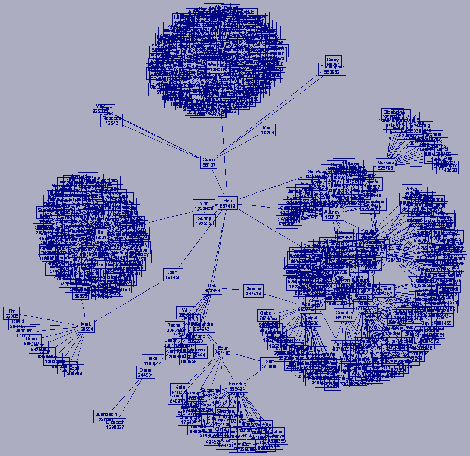
July 27, 2003
Brightly Colored Food, Small Worlds and Social Clouds
Met up with Chad Thornton of brightly colored food yesterday. Chad emailed me a few days back noting that
1 - we went to the same school
2 - he read this site
3 - he once played in a band with a business partner of mine
4 - he knew two of my cousins.
and of course we shared a similar interest in interface design. and I quickly learned he used to be roommates with a good friend of mine.
But some how we'd never met.
These sorts of dense interconnections never seize to fascinate me. At the same time though, I come to expect them, they are so common. You can never predict the specifics, but they occur with regularity no matter where I am. Small world.
Except that its not, we live in a huge world. 6 billion people we are told. And as interesting as the interconnections are, I'm getting more and more interested in the lines of separation.
Things like friendster make it more and more clear that we exist in large scale social networks of hundreds of thousands of people. I call them social clouds at the moment. But beware I use the term cloud, not to represent what these networks resemble, but the emphasize the amorphousness of our knowledge of the dynamics of these networks. If they even exist, their existence is somewhat unproven, the evidence is anecdotal and peripheral at the moment.
Now some of these clouds and clusterings are pretty easy to guess at. Geography and religion are age old forces creating large scale social networks. Organizations like universities and governments generate their own large scale clusters. In the internet age, shared interests is a pretty efficient creator of such groupings as well.
I'd hypothesize that social networks also are divided by more arbitrary and random reasons. An exchange program between two schools creates a social flow. A chance meeting between two consummate networkers leads to a blending of their social clouds. A short love affair between a high school guidance counselor and college admissions officer leads to tight connection between the social networks of the two schools. The same admissions officer however hates the smell of another high school counselor's perfume, and rift grows between the two clouds.
Two people with similar backgrounds and education might live blocks apart, but drift through very different clouds. A meme might percolate through one cloud a year before the other, despite both clouds being in the same target market. Just as we find surprising connections between people I suspect we'll find the disconnects are just as surprising...
July 16, 2003
July 10, 2003
Google Metamorphosis
Ok, so Google isn't turning into an insect, but there is something Kafkaish about the place. Alert readers of the site might have noticed that some Google AdSense powered ads showed up on the site a week or two ago. Don't look, they aren't there now, so let me kick you the story.
I'm an info junkie and an early adaptor. New technology comes around and I'll play with it. Not blindly cause its new, but with a critical eye, I want to know what it does, how it works and if its useful. So of course I signed up for AdSense the moment I heard about it, didn't even cost anything. If fact it could have even made me money.
Sign up was as easy as they come, the Google simplicity was on point. More importantly though Google was serving based on the content of the page so the ads promised to be relevant to reader. I was impressed, they started serving up ads that were genuinely interesting to me, at least from a curiosity standpoint. I've always felt that when advertising is done right its actually a good thing. If the information delivered is useful to you then you're happy to see an ad. People hate ads cause they see to many that aren't interesting to them, and that sucks, especially if they try hard to grab your attention.
But Google was getting close to the advertising wholy grail, ads that people really want to see. And not just because they are funny, because their interests and needs match with an advertiser. Naturally I was interested on what Google served on my site, so I clicked on a few ads. Nothing in the terms of service indicated I shouldn't and Google provided no backdoor into the ads. Was mildly interesting, and I moved on.
Then I decide to place the ads on the subpages of the site. Now that was interesting. Each page now got its own specially tailored set of 4 ads. Most were quite different. Now I was really interested. I clicked on almost all of them. Some were great, sites on globalisation in Africa, philosophy books, and political sites. Others were somewhat relevant, and a few were pretty wrong. A couple right wing organizations would pop-up. The word Iraq seemed to trigger only ads for those Iraq's most wanted trading cards. Felt a bit guilty clicking on all those links, but hey, it was my site, and there didn't seem to be any other way to see what was getting linked. Plus I posted a huge link list of most of sites I visited, figured they deserved some free linkage for advertising on my site.
That sedated most of my curiosity, but I was still wanted to know more. Google never told which links were getting clicked, why a given link would get served, or how much a given link was worth. But they did give frequently updated reports on the total clicks and the total money earned.
My site's pretty low traffic (I was on course to make maybe a $1 a day), so I found I could inter a bit more info by clicking on a few links and then checking the reports. Most of the links were worth about 10¢ a click. Some were closer to a penny it seemed. And one page in particular stuck out. I had used "cash" in a post title. And that seemed to trigger ads for borderline loansharking operations. "Instant Cash". Not exactly my favorite kind of people.
What was interesting was that these links seemed to be worth a lot more then most, close to $1 a click was my guess. The post in question was pretty long and political too. It could have easily triggered a lot of other ads.But the "cash" seemed to win out every time. The loansharks were obviously willing to pay a lot more per click. And this seems to have triggered Google's ad placement algorithm to give them priority. Interesting. Wonder what the tipping point was. Larger archive pages with that post on them weren't getting the loanshark ads. Made a mental note to research more later.
Instead I got a terse letter from Google informing me my account was cancelled. I guess I had clicked on one click to many. I was a bit worried that all my clicking on the "subpage" day would trigger something in their system, it had pushed my click through rate to 40%. But it also resulted in a whole $12 of money, not exactly high impact. Figured a computer might notice it, but then a human would get involved and it would get worked out.
Humans, yeah remember them. Turns out they are in short supply at Google. The first letter was almost certainly computer generated. And the tone was nasty. "Subject: [#2801845] Account Terminated", what a way to start off an email... I was a bit taken aback by the brusk language. I expected at most a warning, which I hoped might actually lead to a dialogue about making more info available to people serving AdSense ads. Instead I got accusations:
"It has come to our attention that fraudulent clicks have been generated on the ads on your site(s). Please understand that we consider deliberate attempts to violate our policies and compromise the integrity of our program a serious matter. Furthermore, your actions have cost Google and our advertisers both time and money. Actions such as this are not tolerated by Google."
Hmmm, guess they are sort of new to customer service. I reviewed the terms of service, I wasn't in violation, although it did say they could cut anyone off. Time to get a human involved. I wrote back asking for a review of the situation and included by phone number. As I sent out the email I noticed the return address. adsense-spam@google.com, hmmm maybe its not going to be as simple as talking to a person.
After a day of no response I decided to call them up. Took some digging on their site but I got the phone number. It lead to a labyrinth. There were a surprising number of dead ends. If you want to talk about "x" hit 1. Hit 1 and you find out that google won't talk about x. Great. As far as I can tell there is no way to get a human on the phone at Google without randomly dialing in extensions. This was beginning to feel a bit like 2001, slowly dealing with a computer out of control.
On Saturday night I got an email back. It seemed to be written by a human, but was signed the "The Google Team". They had no problem addressing me by name though, a nice demeaning touch on their part. Still accusing me of fraud too. No details as to what that fraud was though. Great.
Figured I'd give one more shot, wrote back explaining everything I had done that might have set their computer off, and tossing in some suggestions on how to make it better to boot. Pretty much given up at that point, but it was worth a shot. No love back on their part. Guess the experiment was over.
The worrying thing about it for me is the inhumanness of it all. The money was pocketchange wasn't going to turn it down, but it would have been server costs and small xmas bonus at best. But I enjoyed watching the ads, seeing what got served up, and actually getting paid at least a token amount for writing. And the more I look at Google the more worried I get.
Google of course is still the best search engine around. But there is something brewing there I think that's a touch unsavory. They hold their information really tight to their pockets. They'll gladly lead you to other people's information, but won's share their own. Even their trends pages is hidden and sparse, in pretty dramatic contrast to the Lycos 50 and Yahoo Buzz Index. They've got a treasure trove of data, and it doesn't seem like they plan to share it. Too much potential profit buried there. But that just makes me jealous.
What makes me scared is that they are dangerously close to becoming the only search engine that matters on the web. And that gives them tremendous power. If they use it well then its all good. So far they have done a pretty good job. But they are young, they could change. Going public could change them. Political pressure could change them. Greed could change them. And the fact that they refuse to put out a human face doesn't bode to well. I'll be keeping my eyes open.
July 09, 2003
Connect Selves (and the march towards digital social networks)
connected selves is a new research blog from danah boyd. She's doing some interesting work on social interaction in digital networks, should be an interesting and informative read.
July 08, 2003
Semes
tobias c. van Veen's Hearing Difference: The Seme is now online. Good stuff from the space where culture and sound intertwine.
more too on the "vicious speed of the blogworld".
With the introduction of AOL, I think we're going to see... well: let's think. While maybe this will spurn the same online energy that propelled the "everybody should have a homepage era" (which led to such increased dot-com speculation, for one thing), I also think the speed at which the massive accumulation of blogs will slow down the whole operation will be increased. Thus the entire blog phenomenon will crash & burn much faster than even the dot-bomb. Which is too bad--because for years I've been toiling away on the Net without feeling much response anymore. Netnumbness. Mailing lists are still the best bet, but "online communities" like Rhizome.org have failed to create a cohesive connectability--in part because the digerati have been somewhat resistant to such attempts (perhaps the bitterness over previous online communal failures still rings to close). But blogging is reversing that trend. In only just under two weeks of getting my feet wet in the blogworld, the response has been exponential. I guess the responsibility now lies on me to keep up with the pace.
And yes its true the blogsphere does seem to reward the frequent posters (hence the success of the odious Instapundit). But quality gets rewarded far more. Like in music, "faster!, faster!" can only go so far before some slows it down and concentrates on making it good. One quality post a week should keep any blog alive.
As for AOL introducing blogs. Gets a shrug from me. Don't think it will change a thing. Its another isolated live journal world. Blogs will outlast most failed online communities because they don't try and be communities. All it takes is one person to make a blog. More then that though, blogs allow for a far greater degree of subtly and nuance to develop then say mailing lists or bulletin boards. That's why you don't see the rapid acceleration of disagreements into shouting matches that plagues email lists. Well its part of the reason.
and yeah, reading tobias' site has got me back to listening to electronic music for the first time in months. An old mix of his from 2000 fills my headphones right now, premium techno styles. [warning RealAudio].
Also in rotation, a downtempo mix from by an old friend dijon. The problem with many ambient mixes is they try really hard to sound like they were recorded on a train following the silk road. Dijon's mix actually was done on his laptop as he crossed China, a far better proposition.
Finally to make it three, is quite possibly my favorite mix of all time. I usually not one for smooth, but this one I can taste in my mouth, sublime.
More Suburbanizing of Information
Is the internet a suburban sprawl of information?
Causes for hope seem so few these days, but one might be that these zones of safety will nurture great ideas from the left (and for that matter from every subgroup). But can strong leadership emerge without continuous exchanges and clashes among differing groups? Isolation, which is also expressed in sanitized shopping malls and gated communities, through gay (and liberal) inner-city ghettos, and by newspapers sectioned to serve private interests, is another potential also built into the structure of the internet.
July 01, 2003
Bitpass - micropayments Grow Up
BitPass is live. Back in the dot.com boom days, you'd say they've discovered the holy grail. But things are more sedate and realistic now so lets just say they have a working system of micropayments that will enable a large range of economic possibilities that never existed before. I've been pretty skeptical about micropayments in the past, but I think their time may have arrived. The internet has created a relatively frictionless economic plane, which makes it possible to distribute content that is best priced in the $1 and under range. Bitpass lets you sell things for as little as a penny. And the user interface is quite nice. I've be experimenting as soon as I get the free time. More soon.
June 26, 2003
The Revolution Will Not Be Idealized
Damn, my friend Adam Greenfield is in a dystopian mood today. He writes from Seoul, South Korea:
Show me a case where e-mail or blogs or smart mobs really and unambiguously did bring down a tyrant. Show me a situation in which even one high-school bully was put in their place with the aid of this technology, let alone the pathetic tinhorn strongmen that still ru(i)n so much of this pretty sphere... I mean on the macro scale. Is the planet as a whole detectably better-off in the wake of a decade of decentralized, low-cost-of-entry information availability? Are we better informed, less superstitious, more open-minded, more curious, stronger, less afraid? Do we make better choices?
Christ Adam, take a deep breath. I almost bought the new PDA with the "end tyranny" button, but Howard dean outbid me... Seriously though, this is important; revolutions do not solve problems, they transform problems. The French didn't just wake up one morning in the late 1700's and say "we have no king, life is perfect". Gutenberg didn't print out his first bible and then kick back and watch the world fix itself while making love to Helen of Troy. We live in an imperfect world. Perfectly imperfect some would say.
Life is good, life is bad, times are good, times are bad. You still have the power to set your own pace. And no you aren't going to end poverty by building a website or chatting on IM. But a scream in Calcutta can now be heard in East New York and that means something. Think of baseball, think of averages, improving the world is not about instant ending of tyranny, its about subtly tipping the balance. Its about crafting systems that encourage positive behavior. Its about solving problems slightly faster then you create them. And make no mistake, humans are spectacular at problem solving, but they also are quite skilled at making new messes. That's reality for you.
But if we can solve 2 problems while only creating one, we are improving the world. The results might not be as instant as Viagra, but odds are they will be far more satisfying. One step, deep breath, the world is filled with inexplicable beauty set against the nastiest tragedy and mixed into a poetic swirl. There are moments of perfection and moments of despair. Enjoy them all, its more fun then giving up...
June 24, 2003
Hallucinations & Antics . . ./ New Blog Alert
hot shit from the edges of music, design and culture. I blogged one of tobias' essays in the past and now he's got a weblog, check it. Good shit, and hopefully signs of new breed of blogs, ones tuned into hip hop and techno, electro and punk rock. Ones that look fresh and understand design (ie they aren't a generic template and they don't look at all like anything made by Kotke (sp?)). Fresh styles are emerging, watch out.
June 23, 2003
Flash Based MT Blog
Samuel Wan : News, Information and Resources: Flash-based Blog
Had a thought about making a flash interface for a Moveable Type blog. A quick google surf found Samuel Wan's prototype. Doubt I'll have time to do anything with this for a while, but here it is for archiving and you're pleasure.
Been moving away from Flash for a few years now. The purity of raw html and open standards was refreshing. But now I'm think I may be at a turning point. The need for open standards and compatibility is still there of course, but I think it can be maintained while being integrated into a more lush and developed flash landscape. Something to think about at least...
June 12, 2003
ePatriots
ePatriots is a new grassroots online campaign to raise money for the Democratic party. DailyKos is behind it and I like it so far. But note I'm not a member of the Democratic party, I just hate Bush. And I really like the way the fundraising operation is moving towards aggregating small contributions rather then focusing only on the big money. There is a real opportunity to change a bit of the political balance here, even if we are a long way from any real equality in the system. Check it out, I'll be exploring it more too.
Email and the Friendster Network
Over the last few days I've actually been using Friendster as a replacement for email for some of my friends. And its really nice. No idea if its sustainable, it requires people to check Friendster rather frequently to work. But in our increasingly spam filled world it makes a lot of sense. What better way to filter out spam, but to create a network where only your friends and friends of friends exist? My email filters create some of that functionality, making it easier to sort friend from spam. But I still get the crap. In Friendster I can be reasonably assured that no one is pushing breast implants on me. And if they did I could immediately identify their connection to me and let their friends know about the misbehavior. In other words the system is set up for social self regulation. Now if only that functionality was built into my mail client...
June 10, 2003
June 09, 2003
Friendster Futures
Friendster just keeps on growing. Every day seems to see another social segment jump on board. And its getting a lot closer to being useful to. Not as a dating service mind you (does anyone know of someone who actually got some do to Friendster?), but as a way to connect friends and visualize social networks.
Its the way they've changed the bulletin board that really shows the way to the future. A few weeks back the Friendster bulletin board was filled with often obscene posts from people far off on the fringe of you're extended social network. And it turned people off. But today that problem is gone, and the bulletin board is suddenly an extremely potent tool.
The change? The bulletin board now only shows posts from your first degree friends, the people you have confirmed your linkage too in the system. And with that change the board suddenly has become an excellent way to exchange a level of mundane but useful information with your friends.
Imagine trying to tell your entire social network you plan to hang out at Bar X tonight, or see movie Y at 7:00. Obviously you can call a few friends, old school style, but its not going to cover much of your network. You could send out a mass email as well, but after a couple of those you are going to transform into a spammer. Better save those bulk mailings for the bigger events you want to booster. You could post to a blog too, but how many of your friends really read it daily?
The Friendster bulletin board fills a previously unoccupied space. A way to casually announce mundane events to your entire social network without working too hard, or transforming yourself into a spam farmer. Of course there is plenty of room for improvement, Friendster doesn't account for many of the subtleties of social dynamics that allow society to keep functioning. But its power as a tool seems to grow daily. There is something here and I think its quite potent. More soon.
June 08, 2003
Another Example of Internet Polarization
Don Park continues to see the darker potential of social software and the internet, a side that many seem content to ignore.
What I find interesting here is that two major groups emerged, both highly dependent on the Web and mobile networks for organization and communication. The two groups are not likely to merge at any time and, even if they do, another oppositional group is likely to emerge.
There is plenty of hype and noise about how the internet can bring people closer together, more open, more democratic, etc. But its increasingly apparent that the same tech can amplify differences and drive people apart. My gut is its pretty much a wash, for every marvelous advance, there is an equally troubling development. But with enough care and thought we can tip the balance slightly towards the positive.
June 07, 2003
Firebirds Against Redmond
Mozilla Firebird 0.6 is the latest version of Mozilla/Netscape/Phoenix/Whatever. Its also the first one I'm seriously considering making my default browser. Using it now. It actually starts up in a reasonible time, which is key. Added a couple extensions to emulate the Google toolbar and make tabs work the way I want them too. So far so good. Can I finally kiss Redmond good bye? Well I still use Windows, but otherwise I'm clean. Checked out Joe Kral's 17inch Powerbook today, big but sweet, maybe I'll be back on a Mac come next computer purchase?
June 06, 2003
Yahoo Buzz RSS Feeds
Nice, Nice. Jeremy Zawodny has links to the brand new Yahoo! Buzz RSS Feeds. Nice going to make obsessive tracking of cultural trends even easier. Hope the Lycos 50 can catch up.
May 27, 2003
PageRank Growing Pains
Jeremy Zawodny's declares: PageRank is Dead. Like Zawodny my PageRank has been downgraded to 0. Google doesn't like the style of links coming in, mainly from my State of Emergence mirror blog I think. Think its a bit early to declare it dead but it certainly has growing pains. They are smart people over there in Mountain View, think they will learn that rewarding the communities aware of the power of linkage. Of course they hyperlinkers aren't quite as flush with ad money as some linkage unfriendly corporations, so we'll see how the big G handles this...
May 23, 2003
May 14, 2003
The Dark Side of the Social
Insiteful discussion, on Don Park's Blog, about the potential dark side of social software. Shades of the suburbanization of information?
May 11, 2003
RSS + Blogger
How many users is Blogger losing by not having valid RSS feeds? And how many readers are the users losing? I'm at least 10x more likely to read a blog if it has a working RSS feed...
May 09, 2003
CSS Zen Garden
css Zen Garden: The Beauty in CSS Design
for web design geeks only, but very cool if you happen to be one as I occasionally am.
Beyond Friendster: Openness and the Future of Social Networks
Posted this at marginwalker.org, reprinting it here for your info and my archives.
There has been a lot of talk of Friendster and its kin in the network lately. The sharpest of the observations so far comes from Marginwalker's co-founder Adam Greenfield. As usual Adam's observations are right on the mark. However his conclusion throws me off a bit:
Something tells me these services won't reach their maximum potential until they can incorporate our less salutary feelings about association: the latent but powerful distinctions we make, the dislikes and fears we, however subtly, import into our presentation of self. These are precisely the shadows we may have "gone online" to escape in the first place, but they are a part of what we've always meant by "social," they serve a function evolved over a very long span of time, and I believe we ignore them at some disservice to our ambitions.
Now Adam may very well be right, but I really hope he isn't. We have the ability to use services like Friendster and its descendent's to effect profound changes on the make up of society. Instead of giving into the base discrimination (or "shadows") we incorporate into our daily life I think we should be using technology to eliminate the subtle biases that underlie our culture and selves.
Openness is a potent tool. The public emergence of homosexual culture over the past 35 years provides a telling example. Before Stonewall gays and lesbians stayed hidden from society. And as a result homophobia was able to flourish. You can be certain a lot of homophobic conversations took place in front of closet homosexuals who were too afraid to speak out. Now in 2003 the stigma of homophobia, while still present, is rapidly fading. Major presidential candidates are making gay rights a campaign issue in America, and only the far right gives a damn. Its pretty damn hard to be homophobic when you become aware of the fact that a handful of your friends happen to be gay. And at least in urban America its pretty damn hard not have a handful of gay friends.
The very openness that Adam takes offense too in Friendster, to me is an engine of social change. It forces us to reevaluate some of our hidden prejudices and calls into question some of the forces that segregate society. Now its entirely possible, as Adam seems to imply, that when faces with this sort of info, people will just look upon their friends for the worse. But I personally believe that in the long run the results would be positive. There is a mess of small discriminations that drive many of our social interactions. And when placed into larger contexts they just look silly.
Sousveillance is a term, coined by Steve Mann, which has been gaining some buzz of late. Its roughly the opposite of surveillance. Instead of a power watching over the people, sousveillance is the people watching over a power, and as a corollary watching over themselves. The openness that the architecture of Friendster creates is an integral part of a sousveillance society. And we as a culture are going to have to either learn to embrace the openness or attempt to make it go away.
This is all part of a larger emerging conflict between transparency and privacy, and we are going to dealing with the ramifications for a long time. But for the moment what I'm really interested in is how do we build better social networking technology? Adam is probably right that Friendster, LinkedIn and company are just the beginning and I agree that the ideal solution is an open source one. An open social networking standard which permits people to choose and build their own interfaces. I think some standard will inevitably be emerging in the next few years, and hopefully its not a proprietary one.
The question I have is what do we want this network to do? Is it there to cement our social networks and further our interactions within them, or is the goal to open up our social boundaries and push us towards new cultural understandings? These are delicate lines to walk. And if we build the right structures I think there is a tremendous opportunity to change society for the better. But there is a constant threat of building the opposite, tools which reinforce existing inequalities. How do we ensure we do the right thing?
May 07, 2003
Flight Risk: the Blog as Future Fiction
Intriguing. Visited a few times, never been able to dig deep enough into it. I like what I see though. May be real. Probably not.
I'm all for blogs a medium (or part of a medium!) for fiction. Wrote about it a bunch in an altsense thread a while back. Good discussion. My comments are under the name abe1x or a variant thereof.
Salam Pax Returns
Only read a bit so far, loads of stuff written from Baghdad during and after the war. Extremely interesting so far. You just can't get this stuff anywhere else.
May 02, 2003
Sidebar Links Mirror
I've mirrored my sidebar links here. I only really did to make it easier for me to surf on my Treo, but maybe someone else will find it useful. But yeah you can still get all the links off my sidebar. And if you're wondering how I get the most recent posts to show up, I'm using the MT-RSS Feed plug-in to do it.
April 25, 2003
Emperor, New Clothes
The current buzz around social software reminds me of the excitement around web services last year... The new monikers allow people to talk about old concepts as if they were new...
April 22, 2003
Farewell to Back to Iraq (for now)
Christopher Allbritton has a great post on leaving Iraq, A Farewell to Arms. His experiment with user supported blog driven journalism has been a great success. His reports were great and the concept is fully proofed. He's dedicated to developing the form and I wish and all other indy journalists the best of luck. He's got some reflections on the experience and should be returning to Iraq soon to go deeper into the fractured rebuilding on the country (countries?). Can't wait to read more.
April 14, 2003
Will T-Mobile ever get it?
T minus 1 year and counting. Been over a year now that Starbucks has been offering 3rd party wireless internet. Forgot the initial company name, but the service is run by T-Mobile now. And its a case study on how not to attract customers.
Would you rather rip off one customer or have 10 happy customers? T-Mobile apparently wants the former. From the get go the Starbucks wireless service had 2 pay options. Pay by the minute at super sized prices or unlimited access provided you commit to a year contract. What's missing is a middle ground, the space where all most all their target market lies. People's need for wireless internet comes in bursts, on random trips where they don't have access in an office or hotel. And when they have need for access they want it to be unlimited. If T-Mobile offered day passes for $10, weeks for $20 and months for $30 they'd be racking up customers. Instead they rack up animosity. I've paid them at times, but each time I do I hate them more. And I sure don't recommend them to people.
Writing this up now because for a second I thought T-Mobile had learned. They finally offered a month to month option for a sort of reasonable $40 I only need a week but I almost paid up, it make this week a bit smoother. Until I saw the $25 cancellation fee. WTF? What is the point of a monthly option if you get penalized for only taking a monthly. Could have easily bought 3 or 4 months scattered through this year at $40 a pop. Instead I'll be taking my business else where, thank you.
And just for google let me add that T-Mobile sucks.
April 09, 2003
Social Excess (Software)
The excesses of "Social Software" rings really true with me. Choice quote:
But there's something about the abandonment of concepts of 'online community' and the complete rejection of familiar terms and paradigms like the message board that worries me. There seems to be a bizarre lack of history to the whole enterprise - a desire to claim a territory as unexplored when it's patently not. And more importantly a remarkable lack of implementation and experiment around the place.
Agree completely, there is a feeling as if the theorists and idle chatters are running in one direction and the coders in another. Lots of talk, and a bunch of experiments from the coders, but not that much useful stuff yet. There is definitely a regression of sorts, the current blog driven communities are actually less cohesive then the old school message board ones.
What I think is happening at the moment is a case of taking a step or two backward in order to progress forward. Blogs have some serious advantages over boards, they promote high quality writing, archive better, and are far more standards compliant. But they also are significantly more ego driven then boards, and the conversations that arise are scattershot and often hard to follow. And as a result I think there are few conversations per community member, a fact that has been offset by the continued growth of the community.
I think we'll be seeing a resurgence of the bulletin board soon in the blogsphere. Already sites like Daily Kos and the Agonist are switching over to bulletin board systems for their comments. And I have a feeling a good way to integrate blogs, RSS, and bulletin boards is going to emerge soon. Or at least I hope it will.
April 06, 2003
April 03, 2003
Moblog: On
The First International Moblogging Conference has a date. July 5 in Tokyo. Props to Adam for putting it together. Now if I can just figure out a way to get there...
Googlewashing Democracy?
The Register has an interesting article on the "Googlewashing" of the 2nd Superpower. Describes how quickly the phrase the 2nd Superpower went from being used to describe the protesting masses and switched to the blogging masses. Definitely shows how blogs can get overweighted in Google current Page Rank algorithm. But its also way premature in its critique. For one Google constantly tweaks its algorithm and more importantly a quick Google bleep is not a signal of a permanent trend. If the author's preferred use of the term has real roots its going to continue spreading, online and off. And over time Google should reflect this. $20 that Google's results balance out in a month or two. Or perhaps ironically this article will come up first...
April 02, 2003
March 22, 2003
More Google Visualization
TouchGraph is another data visualization tool using the Google API, interesting, similar to Kartoo in a way. Got to say I like the Flash styles at Kartoo more then the Java of TouchGraph. Wonder how Flash is stacking up to Java in programming power nowadays?
[via Joi Ito's Web]
March 18, 2003
The First International Mob
The First International Moblogging Conference moves closer to reality. Should be a great time, best of luck to Adam in putting it together. Hoping circumstances line up and allow me to make the trip to Tokyo.
The Blogger as Independent War Reporter?
War looks more and more inevitable now. The last one in Iraq was a disaster in terms of independent journalism, although the Bush administration probably seems it the opposite. Arguably the fact that the Pentagon had almost perfect control over the presses access to info in the Gulf War 1 was a major factor in the fact that it was so easy for Bush and Co to manufacture the Gulf War 2. How different is this one going to be?
There are few online attempts to provide an alternative information source for the Gulf War 2. Hope they do a better job then the mainstream press did a decade ago.
http://www.back-to-iraq.com/ is a pretty much unknown journalist, Christopher Allbritton, going at it alone. This is a real attempt to be an independent journalist using an online blog as the outlet.
http://www.kevinsites.net/ is the blog of CNN reporter Kevin Sites. Given that he gets paid by a big cable network his ability to speak his mind is a bit more truncated. Still this blog appears like he might have a "what I do on my own time is my own business' attitude. Hope that its true and he can provide a really candid view of the war.
http://dear_raed.blogspot.com/ is the blog of Salam Pax an Iraqi living in Bagdad. No pretenses of being journalism here, but its never the less far more informative about what's actually happening in Iraq then anything I've ever read in the papers. Good stuff, hope it can stay up and Salam can get through this evermore inevitable seeming nightmare untouched.
March 16, 2003
Flashing the Map
Kartoo is a great flash driven tool that creates visual representations of search quires. Interesting stuff and maybe even really usefully.
Lynching Information
Saw Clifford Lynch speak over at UC Berkeley on Friday, courtesy of Ethan Eismann. Recently reformed OG blogger Peter Merholz also showed up.
Lynch took way to long to get to the interesting bit of his talk, research into collaborative filtering and personalization. Talked ended just as he started getting to the juicy issues. Did get a chance to talk to him about the issues of information segregation though.
The issue was one he new about from discussions of online newspapers, but still remains unanswered. He did note that when people configure online news sources they general will select very focused interests and then balance that out with some sort of filtered general list like the top Reuters feeds. So at least part of the answer lies in picking good filters that know how the mix up the info flow the way a good newspaper does.
Another interesting (but discouraging) part of the talk was his reference to problems in getting access to large enough groups of people to test out collaborative filtering ideas. More anecdotal evidence of the inverse Metcalfe's Law?
March 11, 2003
A Brand New Dance We Call the Google
The Google Dance. Be warned it contains more information then you probably ever want to know about Google's servers. Do not expect humor from this link. Thank You.
March 10, 2003
Flow My Information the Blogger Said
Information Flow is Ethan Eismann's new blog (finally). Time to update those blogrolls y'all. PC users get a special, limited edition, ultra elegant, minimalist version.
The Inverse Network Effect
The always insightful Clay Shirky has just released Social Software and the Politics of Groups. The underlying core: we have no antecedents for how nonlocal groups, and the technology that supports them should function. In other words there is almost no precedent for the way a group of people across the world can interact in a mailing list or chat room. And its equally difficult to design software for those interactions, as there is no precedent for thinking about the problems.
What sprang to mind immediately was Metcalfe's Law which basically states that the usefulness of a network increase exponentially with the number of users. Perhaps there is a reverse law as well. That the larger the network the difficulty in designing new software increase exponentially. How do you test software designed to let 1000 people communicate at once? Its hard enough deal with the tech issues, working with the interface and social use models is a whole other story.
The classic example being that 1 person with a telephone is useless as they have no one to call. 2 people with telephones is useful assuming they want to talk to each other. The more people
March 07, 2003
Properly Domained
Abstract Dynamics now has a proper domain name! If you go to the old url you should be automatically redirected to this one: abstractdynamics.org .
World of Ends
World of Ends is something of the Cluetrain Manifesto part II. Same tone, and same mixture of insite, naivety and marketing speak. In other words worth reading, there are diamonds in the bullshit...
March 04, 2003
Moblogging Mo Hype?
Adam Greenfield proposes aMoblog Conference for Tokyo summertime. Well Tokyo sounds damn enticing, has been for quite some time. Moblogging on the other hand just doesn't sit right with me yet. A handful of smart people (Greenfield, Rhiengold, Ito, Eismann) are really excited about the idea, but I just can't catch their enthusiasm.
What really sets me off is that I seem to be closer to really moblogging then most of the boosters. I've been a nomad for 2 years now, I was one of the few Ricochet customers, I've uploaded files next to drug dealers at 1 am in Washington Square Park, I've had top of the line pda/cell phones for the past few years, I've used them to connect to the web a ton. I've actually posted blog entries from my Treo.
Its not that exciting.
So why are smart people getting so into the idea? A dream I think, its a step towards the mythical ubiquitous computing Xanadu. A hope for more dotcom style euphoria. And maybe I'm wrong, but I don't think taking pictures from a cell phone really is going to get you there. Its not that different then taking a digital picture and uploading later in the day. All it really means is there is less friction in the system. Info gets digital quicker, circulates a bit faster. Done. No revolutions, no ecstasy, just a slow excelleration of the velocity of information.
February 26, 2003
Burst a word
I may feel that bloggers have a big time overexaggerated vision of their worth as a media, but the rapid development of blog based datamining tools is pretty impressive. Daypop Top Word Bursts is a pretty cool social indicator. And it also shows just how marginal blogs are at the moment. These are words that a very small subset of the population is talking about, not what people are thinking about in general. Still its a great resource for info junkies like me. Should be interesting to compare to the Lycos 50, Yahoo Buzz Index and random Google droppings.
February 18, 2003
One Google to Rule Them All
Everybody loves Google, yes? It makes the internet work, answers our questions, plus its friendly and pop-up free. Brand Channel just named it the brand of the year, number one the world over. Apple built Google right into the interface to its new browser. Google is rapidly becoming essential, perhaps even omnipotent. And that is the problem. Google is rapidly become the biggest threat to the free internet around.
Saw Howard Reingold speak the other night, at KQED's Media Salon. Towards the end of the discussion, the moderator (whose name escapes me, sorry) posed a very interesting question. He mention that despite being in the television business, he often wishes that TV was never invented. The negative impact it has on culture far out weighs its benefits, at least in his opinion. The question he asked was:
"What can we do now in order to prevent us from looking back in 10 years and wishing the internet never existed?"
My head rolled around that a bit, as the conversation continued. All the usual fears of media monopolies, baby bells, and governments big brothering the internet to further their powers. All legitimate outside threats, but I wasn't getting too worried. The architecture of the internet still encourages free expression, and I've yet to see a model by which any of these forces could really seize control. Not that its impossible, but I'm not losing any sleep, yet.
My mind kept racing. Where was there a legitimate threat of the internet being controlled? It hit me. Google. The most powerful address online, the most powerful organization online. And we happily give it this power. For good reason too, its the best search engine around. But as its powers increase so do the threats it presents.
We rely upon Google to return legitimate answers to our search queries. And its won our trust by returning good results. So far its all good. But Google has the power to alter it search results. It can subtly send people to websites in favor of one political viewpoint. If Google blocks a website, how easily could we find it? Its easy to put something up online, but its worthless if no one can find it.
Search engines are highly centralized. There are only a handful of companies offering the service. As the volume of information grows it is likely that it will cost even more to start up a new search engine. The result? An industry that is relatively easy to control. Control Google and you've got the internet in a choke hold. Control both Google and the few companies competing with it and you've got the internet on lockdown.
Google has already shown a few warning signs. They've caved into pressure from the Scientologists and China and restricted search results. They leave all moral decisions to one of their founders. So far he seems to be doing a decent job, but how long can that last? What happens when it becomes a publicly traded corporation? And its profits start declining? What happens if the FBI knocks on its door and asks it to restrict access to "subversive" websites.
The more we love Google the more power we give it to. Its a classic catch-22, use Google and it gains the power to use us. And more importantly it increases the ability of other powers to use Google to use us. And as the internet becomes increasingly corporate and governments see it more and more of a threat, the risks increase. Less then a century ago, radio and tv were both seen as liberating, democratic technologies. And when used right they can be. But they are rarely used right nowadays. Lets make sure the internet doesn't fall into the same trap.
What can we do? Strengthening Google's competitors might help a bit, except it means living with inferior search results. But if one wants to hotbot will allow you to search using 4 different engines, one is Google, but Inktomi, FAST and Teoma are also available.
One idea for the lazyweb is a decentralized distributed computing search engine. The processing and storing of search results can be done on millions of computers on their downtime ala SETI@home. (On a side note, its pretty pitiful that the most popular distributed computing project around is devoted to something as impractical and absurd as the search for extraterrestrial life). The mechanics of such a system are beyond me, so I can only hope it's a possibility.
Until then all we really have is faith that Google and company will return reliable results. "Information wants to be free", yeah I hope so. Its pretty obvious that a lot of people want to control information. And if we want it to be free then we need to keep building the tools that will keep it that way.
February 14, 2003
Blogs Over Baghdad
Where is Raed ? is a blog from Baghdad. Good stuff. Bush and co want us to forget that Iraq is filled with people just like us. This is an excellent remedy. Spread the word.
February 01, 2003
The Rocks/Sucks Google Machine
Jeff Jarvis pushes some good insite into using Google to investigate brands. Search for band and "sucks" and see what comes up. The nastier the results the worse the brand.
Already works ok, could work a lot better with some concious effort. Have an awful experience with Charmin? Whip up a quick "Charmin Sucks" web page or blog post. Get an XML RFC geek to make it all machine readable for extra credit. And let Mr. Google do the hard work.
And since we like to say nice things too, don't forget those "Charmin Rocks" pages, for the days when it saves your ass. Or maybe "Charmin is the bomb", or "Charmin is the shit" but maybe that's going to far. No, the key is that every one uses the same words or else it falls apart. "Rocks" and "sucks" are the popular choice, live with it, embrace them and use them in war on bad brands.
For those who want to go the extra mile, a few ideas. A rocks/sucks index page, where you can see the pros and cons of the brand lined right up against each other. Or a handy rocks/sucks page generator app. If it was really slick it'd two way link all the relevent "sucks" pages. That's like giving google a blowjob you'd go straight to the top of the list...
And there you have it, the Rocks/Sucks Machine. Make it, use it and spread the meme.
Linkage
newsQuakes is an interesting little app, with some potent potential. Very little documentation on it, but it filters news articles and maps them to of all things a map. It gives an instant geographic representation of what region of the world is in the news. Needs development though, it seems to only react to country names, and is presently mapping all US news to Los Angeles on the map for some reason. [via Jon's Radio]
The Guardian has an excellent article on the future of blogging, including the rumor that AOL is about to introduce a blogging feature...
Same paper also has an excellent round up of the NY music scene. As much as I love NY I don't buy the argument that this is the future of music. More like an exhibition game before some real innovators step up and twist heads into new sonics.
January 28, 2003
Open Futures
Open Content Network is a new infrastructure for delivering public domain and creative commons content. No idea if its hype or really useful, maybe someone could tell me? Worth checking out none the less.
January 27, 2003
Window Shopping: Reflections on New Web Browsers
Posting this from Apple's new Safari web browser, on my dad's G3. Quite a nice program, but still short of perfect. It is indeed fast and I love the stripped down interface, which removes major junk but includes a google search imput. The loading status indicator inside the url field seems great to me, although it seems to annoy some people.
The back button doesn't quite work as I hoped. I had been told it contained a universal history, allowing you to go back pages before the one you actually launched the window with. Only browser that I've ever seen do this is iCab, and its great. Launch a page in a new window and you can still go back a few pages to an early site. Makes no sense to me why a new window shouldn't be able to go back to the page that launched it.
The lack of tabbed browsing doesn't bother me mainly because I haven't spent enough time with a browser that supports them. And in the times I have I could never get them to do what I wanted. Namely open each and every single link as a new tab, while retaining focus on the current page. Would be perfect for what I assume is my unconventional browsing technique, where I open a dozen or two windows and then close the pages as I finish them.
My dad has a different problem with Safari, he's grown attached to IE on OSX's "page holder" feature. And for good reason. It splits the browser into two window panes. On the left goes the page holder web page. Clicking links on this page opens them up in the right pane. Amazing for pages with a lot of links. I want this feature on my PC laptop, but it seems to be a Mac IE only thing. Given that its one of the best interface improvements to the browser yet, I really hope its soon universal...
note: after first publishing this, I noticed that Safari is screwing up some of the type formatting CSS on my site. Isn't this supposed to be Apple's strength?
note 2: and then I noticed IE messes the same formatting up, guess its time to make a Gif...
The Ruralization of the Internet
Adam at V-2 points out several graphics that amply illustrate the socio-geographic divide that underpins the internet. The first is an excellent interactive graphic showing the distribution of blogs around the world. The result is remarkably predictable. The usual suspect of Europe, America and whiter of the English Commonwealth countries lead the pack, with Japan also showing up respectably. Mainland Asia and the Southern Hemisphere? Barely there. The second graphic, a map of all the wi-fi spots in Manhattan shows the same digital divide reoccurring fractal like on a smaller scale. Harlem and points north are poorly represented, while the far wealthier areas of the southern half of the island are virtually blanketed with points. The very scary exception is the chunk of downtown comprised almost entirely of government buildings, which appears to be wi-fi free...

Now the digital divide is a well known phenomena, all be it one that still hasn't been solved. I'm more interested in the distribution of people and information on the internet itself. And what's worries me about those distributions is that they have very strong magnifying potential. That on the internet itself we will find a distribution of power, where certain social groups will find themselves in privileged places that allow for a consolidation of power.
I only have anecdotal evidence of the stratification of the internet, but its enough to be worrying. There are only a few strong social structures on the web: mailing lists, bulletin boards and their cousin the usenet, chat rooms, and linkrings are the ones I can think of offhand.
These communities often start out completely open, anyone can post or join in, provided of course they can find the place. But as these communities grow in prominence they begin to attract unruly members. Spammers and trolls are the most notorious problems. At the same time the shear effects of growth often hurt the community. Signal to noise ratios worsen, or the volume of the noise just gets loud enough to be annoying. The shear number of posts can discourage participation, and the new members often repeat old conversations at the annoyance of the old guard. The result is a need to regulate the community.
There are a handful of techniques of regulation. Slashdot and Kuro5hin style user moderation are among the most democratic. Often only a few individuals are allowed to moderate. But moderation is an intensive job, often its easier to just close the gates. Some sites like the late Dreamless hide their entrance so only those in the know can get access. Others like the Pho list require members to apply for entry. The most exclusive like John Brockman's Edge list are invitation only, a secret society for the information age. Linkrings like those found in the blogger community, are an organic form of invitation only. Bloggers tend to post links to other bloggers they like. Follow these links and you'll quickly wind up back at your starting point. These links tend to reinforce each other, strengthening the positions of the most prominent bloggers, while pushing others to the sidelines.
None of this is a huge surprise. It mirrors the processes found in governments, religions, secret societies and businesses. Like minded people tend to seek each others company and find that keeping others out increases the level of conversation. And often increases their power as well. The internet just makes this process fast and global. If news aggregators and the like represent a suburbanization of the internet, then this is a far older process, a tribalization, or ruralization of the internet.
Each social group is a remarkably isolated information bubble. It might have some established trading routes with other groups with similar interests, but thats about it. The nettime list for instance is limited to discussions of the social implications of technology with a dose of politics and art. Posts from the rhizome net art list, or the futurefeedforward scifi satire list are sometimes brought into the mix by certain trader individuals. But the subjects are well defined, and as insular as an isolated agricultural village. And since these groups often serve as news sources for members, they restrict the diversity of information even more then news aggregators can.
When power is thrown into the mix the result is stratification. A closed group with many powerful members serves to consolidate power. They have an excellent means of communication and sharing information. A group with a few powerful members and other less powerful ones can work as a funnel, bringing members into more prominent positions. And groups without much power? They just get locked out.
Combine this effect with the already existing digital divide and the result is amplification. For all the talk of internet revolution and how it evens the playing field its just not true. Sure there are opportunities for new groups to seize power, new ways for oppositions to organize. But like all revolutions the promises of power for everyone rapidly seem to be shifting towards power to a new group of people. The more things change...
January 22, 2003
One For the Dreamless Massive
Checked my server logs this morning and found I was getting requests from the legendary and long dead dreamless.org via the Wayback Machine. Guess nothing ever dies on the internet, although the archive is far from complete. Interestingly enough the front door for wayback dreamless is still locked the way it once was. Only those who know the backdoor can get in. Artifacts of the legendary designer's TAZ remain hard to find...
January 21, 2003
Kabloging on the Run
Sending this from my Treo 300, using a program called Kablog. Pretty cool if it works. Damn hard to put urls in though. Will change the structure of blogging if it takes off...
just added the hyperlink from my computer. Realized while outside that most posts I'll want to make from my Treo probably won't have any uses for links anyway. Who gives an F about hyperlinks when away from a computer screen? Perhaps the future is nature blogging?